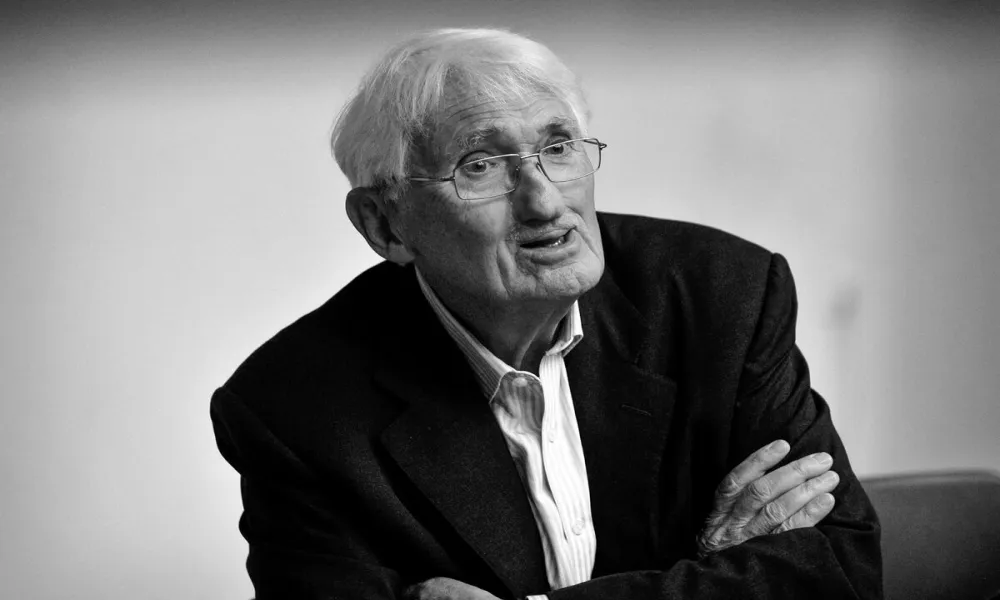
Last Saturday, one of the greatest thinkers of our time passed away. The eminent German philosopher Jürgen Habermas defended reason through his work and theories. He remained faithful to the central project of the Enlightenment: the emancipation of the individual. The Enlightenment was a philosophical movement of the 17th and 18th centuries in Europe, with profound political and material consequences. It was the age of reason and, as another major philosopher, Immanuel Kant argued, Enlightenment was humanity’s emergence from intellectual immaturity and ignorance.
The emancipation of individuals through reason, away from superstition and traditional power structures, led to major social transformations and political revolutions, shaping the era of modernity. Technological progress, the establishment of democracy and the rule of law, popular struggles for better working conditions, and the improvement of human welfare all emerged as outcomes of reason and the new values introduced by the Enlightenment.
For the first time, universal and fundamental principles were articulated concerning human dignity, freedom, equality and solidarity. All schools of thought born out of the Enlightenment ultimately aimed at human self-realisation. Liberals and Marxists put forward different visions of human progress, the former emphasising freedom and the latter equality. Yet both shared a commitment to the advancement of humanity in the face of reactionary and conservative forces that sought to preserve old privileges and traditional values.
Obscurantism began to recede as Enlightenment ideas spread across the Western world, and some of Europe’s medieval kingdoms collapsed. The advance of reason and universal values also provoked a reaction, giving rise to the philosophical movement of Romanticism, which placed emphasis on emotion, subjectivity, history and popular traditions. In this context, new “demons” emerged, such as nationalism, and societies once again became trapped in irrational ideas, lacking scientific grounding but sustained over time by human attachment to them.
As a result, a world full of contradictions took shape, where barbarism accompanied progress and people came to believe in new secular “religions”. The nation, race and other ideas associated with Romanticism contributed to the rise of fascism and Nazism. The First and Second World Wars exposed the limits of reason. Intellectuals such as Habermas sought to understand the causes of this bloodshed and argued that the Enlightenment did not fail, but remained incomplete. Indeed, the moral optimism of Enlightenment philosophers was the driving force behind all major transformations.
Today, how much moral optimism remains when international law and institutions such as the United Nations are increasingly discredited? When the White House, under the leadership of Donald Trump, produces and publishes video games about the war with Iran, aimed at dehumanising the enemy so that victims on the other side appear as objects, in order to legitimise war crimes in the eyes of the international community. Which universal principles of the Enlightenment are being upheld by the political parties of the Republic of Cyprus, when most conduct election campaigns without a single reference to fundamental values?
The Enlightenment may indeed remain unfinished. But who will confront these irrational “demons” and bring humanity back to the forefront?