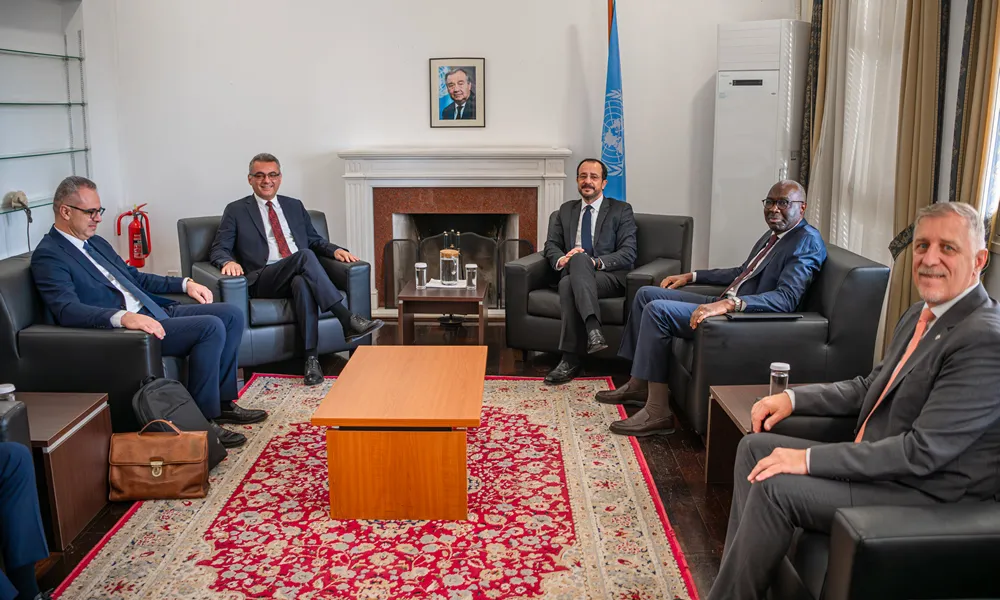

It is clear that, at the personal level, there was a good climate between Christodoulides and Erhürman during their first meeting last Thursday at the UN offices at the old Nicosia airport, though certain remarks by Mr Christodoulides last Friday about Turkish guarantees, and Mr Erhürman’s subsequent comments, demonstrate how fragile the relationship remains, still filled with mistrust.
Nevertheless, the warm embrace between the two leaders and their decision to avoid statements before and after the meeting that could fuel tensions certainly sent positive signals, dispelling the toxic climate that Ersin Tatar’s public remarks regularly created after such encounters. Of course, there are also the four conditions put forward by Mr Erhürman, which will determine whether substantive negotiations will begin.
For now, some observers, not unjustifiably, note that the improved climate will be helpful once the discussions touch on issues of substance. The statements of the two leaders, they argue, could be read as indications, perhaps even proof, that something has shifted in the Cyprus problem compared with the past five unproductive years:
- For the first time, the negotiators of the two sides will resume regular meetings within a structured dialogue, something explicitly recorded in the UN announcement.
- Nikos Christodoulides, in Friday’s meeting, reiterated the Greek Cypriot side’s readiness to resume negotiations from where they left off in Crans-Montana in 2017, referring also to the six points of the Guterres Framework.
- Tufan Erhürman did not refer to ‘sovereign equality’ or a two-state solution, positions put forward by the Turkish side in recent years. On the contrary, he called for recognition of the convergences already achieved (within the framework of a federal solution), stressing that these must not be reopened.
- A joint meeting between the two leaders and the UN Secretary-General’s Personal Envoy to Cyprus, María Ángela Holguín, was agreed, something Tatar refused to accept. She will be on the island on 5 December and will meet Christodoulides on 6 December. Erhürman stated that a joint meeting with Ms Holguín will then take place.
- A meeting between Erhürman and the European Commission’s Special Envoy Johannes Hahn now appears almost certain, despite the fact that neither Ankara nor Ersin Tatar had previously agreed to meet him.
The two leaders
Both leaders of the two communities in Cyprus belong to a different generation from the older figures who traditionally negotiated the Cyprus issue. Tufan Erhürman was born in Nicosia on 11 September 1970. Nikos Christodoulides was born in Paphos on 6 December 1973. Neither has living memory of the intercommunal violence of 1964, nor firsthand experience of the tragic events of 1974. Could their distance from the events that scarred modern Cypriot history and Cypriots themselves prove productive in solving the Cyprus problem, or not?
One could argue that distance from the lived trauma of Cyprus’ modern history could, in theory, serve as an advantage in handling the Cyprus issue. The absence of personal memories of violence and fear softens reflexes of suspicion and allows the two leaders to approach the political process more rationally and less emotionally. They belong to a generation shaped by post-war Cyprus, within conditions of Europeanisation, institutional development and international connectivity – factors that can underpin a more modern, pragmatic negotiating approach.
However, distance from the past does not automatically imply deeper understanding of it. The societies they represent still carry the burden of historical memory; family narratives remain alive, and political structures continue to function with the logic of earlier decades. The leaders’ lack of firsthand experience may ease dialogue but does not erase the fears, sensitivities and red lines of their respective communities. Thus, temporal distance is an opportunity, but not a guarantee. It may contribute to a more productive climate – provided the two leaders can fully grasp the emotional and historical weight that still shapes perceptions on both sides, so long as that weight does not overwhelm them.
The four preconditions
Tufan Erhürman seeks to place four preconditions on the table for the start of substantive talks, insisting that the Turkish Cypriot side will not enter substantive negotiation unless they are met. Let us examine them more closely.
1. Recognition of the political equality of Turkish Cypriots, that is, their participation as an equal co-founding component of the solution, not as a minority. The Greek Cypriot side argues that this issue is already resolved on the basis of the Anastasiades–Eroğlu agreement of 2014, which states that “the united Cyprus, as a member of the United Nations and of the European Union, shall have a single international legal personality and a single sovereignty, which is defined as the sovereignty enjoyed by all member States of the United Nations under the UN Charter and which emanates equally from Greek Cypriots and Turkish Cypriots.” It is also clear that “neither side may claim authority or jurisdiction over the other.”
This skilfully crafted, constructively ambiguous formulation both addressed and defused debates over “transformation versus virgin birth” and certainly nullified two-state-solution narratives. Anything beyond this leads back to the rhetoric of “sovereign equality” introduced by Ersin Tatar in 2021.
2. The existence of a timetable for negotiations. Talks must not be endless but should be bounded by a realistic timeframe, likely shaped by the following parameters:
a) Conclusion of Turkey’s discussions with the EU and US regarding SAFE, resolution of the Palestinian issue and handling of the Syrian issue. It is clear that Turkey is trying to make the Cyprus solution part of a broader package;
b) the Greek Cypriot parliamentary elections in May 2026;
c) Cyprus’ EU Council Presidency ending in June 2026;
d) the end of António Guterres’ term at the end of 2026.
Based on the above, an eight-month timeframe could prove realistic if proper preparatory work is done by all sides in the coming months. An intensive final round of negotiations could take place in mid-summer (July–August) and conclude in early autumn.
3. A fast-track process aimed at results, with no reopening of issues previously agreed. This means recognition of all convergences achieved to date, including the map submitted in Geneva in 2017, the property arrangements, and quotas for naturalisations of Greek and Turkish nationals in Cyprus, among others.
4. The fourth precondition, considered the most difficult, stipulates there should be no return to the current status quo if the negotiations fail, especially if the Greek Cypriot side delays or obstructs a solution, as it did in 2004. In other words, in the event of a new failure, Turkish Cypriots do not wish to return to the pseudostate status, while Greek Cypriots continue to enjoy international recognition. What they essentially demand is a provision, guaranteed by the UN and the EU, that a new discussion will begin on the future of Turkish Cypriots. The Greek Cypriot side considers Erhürman’s insistence on changing the status quo for Turkish Cypriots in the event of failure attributable to the Greek Cypriot side as an approach that “serves the logic of two separate states”. On the other hand, the international community appears closer to the Turkish Cypriot position, as it believes the Greek Cypriot side did not display a constructive stance in 2004 under Tassos Papadopoulos, nor in 2017 under Nicos Anastasiades.
The CBMs (Confidence-Building Measures)
As part of implementing Confidence-Building Measures, Mr Erhürman submitted ten proposals/requests from the Turkish Cypriot side which he believes could improve the climate between the two sides. In reality, they were proposals aimed at improving the daily life of Turkish Cypriots and many settlers and their children living in Cyprus, which is why some Turkish Cypriot newspapers criticised them for mainly serving the Turkish Cypriot community.
Such CBMs could certainly improve the atmosphere in the event a new round of talks begins, but they are not sufficient on their own to launch substantive discussion.
The difficulty the two leaders face in communicating – and, more importantly, in overcoming the lack of trust between the Greek Cypriot and Turkish Cypriot leaderships – is evident from Tufan Erhürman’s statements 24 hours after his meeting with Nikos Christodoulides.
Mr Erhürman reacted to remarks by Mr Christodoulides during the medal-award ceremony for the Hellenic Force in Cyprus in Malounda, in the presence of the President of the Hellenic Republic, Konstantinos Tasoulas. More specifically, the President stated, among other things: “For us, a solution to the Cyprus problem without the withdrawal of Turkish occupation troops cannot be accepted.”
Mr Erhürman, in a social media post, argued that during their meeting the two sides had agreed to avoid public statements through the media, with the aim of creating a more constructive atmosphere for the resumption of negotiations. However, he said this agreement was violated when Mr Christodoulides’ statement was published that “a solution is only possible with the abolition of guarantees and the withdrawal of the Turkish army.”
If such an agreement did exist, this statement should indeed have been avoided by President Christodoulides. On the other hand, it also shows how sensitive Mr Erhürman is when the discussion turns to Turkey.