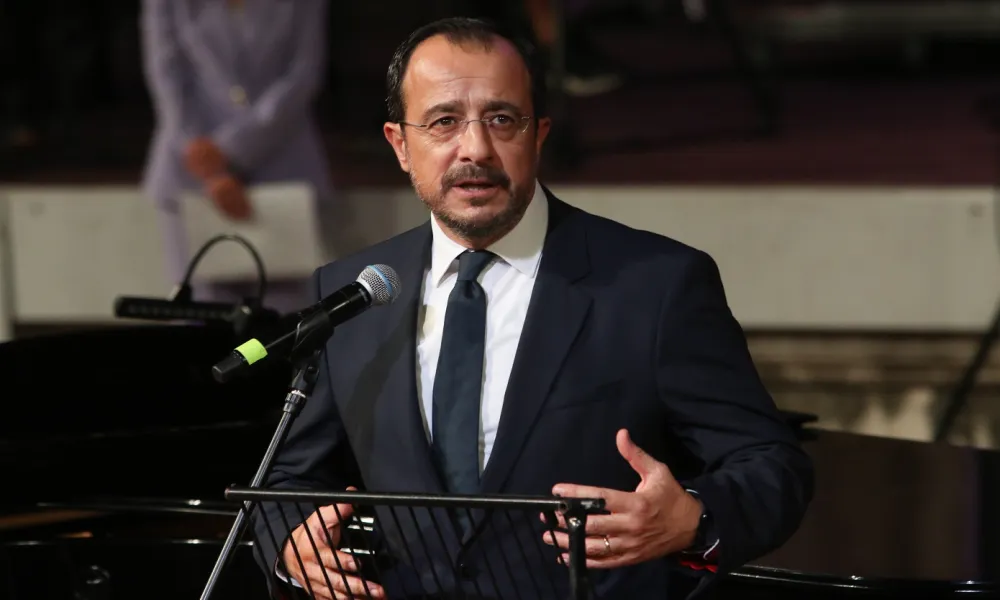
How ready is President Christodoulides to resolve the Cyprus problem? While his statements suggest a willingness to engage in talks, he does not yet appear ready to sit down at the negotiating table and discuss the final outstanding details. The same applies to Tufan Erhürman, who recently visited Ankara and at least managed to leave without fully aligning his words with Erdoğan. The new Turkish Cypriot leader has maintained his pre-election promise to resume negotiations - ostensibly for a federal solution, though he did not explicitly name it - while knowing that no Turkish Cypriot leadership can negotiate seriously without Turkey’s political backing. This remains the main obstacle to resolving the Cyprus problem.
All sides accept that Turkey naturally has interests in Cyprus and the Eastern Mediterranean. Yet, no one - not even Turkish Cypriots - is willing to let those interests turn a post-solution Republic of Cyprus into a subordinate state. The immediate goal is for both communities to deepen ties with the EU, not to fall under the control of a country that is, realistically, bordering on being a developing nation.
Turkey
At this moment, Turkey does not appear to fully grasp the implications of the current geopolitical landscape for the Cyprus problem. Nor does today’s political climate place Cyprus anywhere near the top of Ankara’s priorities. To be fair, Cyprus is no longer viewed, as it was in 2015–17, as an urgent, standalone issue. It has become one component of a far broader strategic puzzle, a bargaining chip in the high-stakes geopolitical poker unfolding across the region.
Turkey’s immediate priorities lie elsewhere: Gaza, Syria, Ukraine, its evolving political and economic relationship with the European Union, the future of Iran, the Kurdish question, its participation in Europe’s new defence doctrine (SAFE), and, not least, the recalibration of its relationship with Donald Trump’s interventionist US foreign policy. Ankara seeks a guarantor role in Ukraine and Palestine, presents itself as a stabilising force in Syria and northern Iraq, expands its influence in the Gulf through Qatar, and enjoys notable diplomatic penetration in Africa.
It's regional policy also contains clear weaknesses, particularly regarding its unpredictable posture towards the West. This unpredictability continues to hamper deeper integration into European political and economic structures. Domestically, the democratic deficit is stark: nearly all major political opponents of President Erdoğan are imprisoned, and opposition media operate under constant pressure. While the economy shows a respectable growth rate of around 3.5%, inflation remains extremely high - estimated at 34.9% for 2025 - while macroeconomic imbalances persist: a weakened lira, high interest rates and widening current-account deficits.
In short, Turkey remains a powerful regional actor - arguably the most powerful when viewed comparatively - yet its vulnerabilities are real and place limits on its ambitions. In the Middle East, it faces geopolitical counterweights such as Israel, Egypt and Saudi Arabia. To the West, it must contend with the Cyprus problem, Greek–Turkish tensions, deep scepticism among many EU states regarding its support for Russia, and Washington’s anger over Turkey’s role in channelling Russian natural gas to the West in violation of sanctions.
Christodoulides
Nikos Christodoulides has understood the international context relatively well. With Cyprus preparing to assume the EU presidency, he hopes to engineer conditions that may shift certain balances in Cyprus’s favour.
Under his leadership and with Russia isolated internationally, Cyprus has fully embraced Glafcos Clerides’ doctrine that “we belong to the West”. The Republic is now a reliable EU partner and a predictable US ally. Christodoulides has gone further by seeking Cyprus’ accession to NATO - an initiative directly affecting the Cyprus problem because it would remove Turkish Guarantees from the equation.
During his recent meeting with German Chancellor Merz, Christodoulides made symbolic overtures toward Turkey, announcing that he would invite Erdoğan to attend the European Council meeting to be held in Cyprus, while outlining certain conditions for deepening Ankara’s cooperation with the EU.
Yet none of this is enough. Cyprus lacks both the size and geopolitical leverage to initiate major regional shifts without bigger actors. More critically, Christodoulides has not convinced the public that he is ready for a final phase of negotiations. He has never clarified what he means when he insists that talks must resume “from where we left off” at Crans-Montana.
For credibility, two things are essential:
1. He must define where, exactly, we left off.
If he accepts the Guterres Framework and the surrounding convergences, this has concrete implications: rotating presidency; political equality; and effective Turkish-Cypriot participation in governance - meaning at least one T/C minister’s effective vote on matters of fundamental importance to the Turkish-Cypriot community.
At Crans-Montana, what remained unresolved was the list of issues on which this effective vote would apply. That list - prepared by negotiators Mavroyiannis and Nami - was verbally endorsed in 2019 in the presence of António Guterres at the Anastasiades–Akinci meeting in Berlin. Also pending was the mechanism for resolving disagreements between President and Vice-President. And crucially, the timeline for terminating Guarantees whether via a sunset clause or a review mechanism remained open.
Is the Greek-Cypriot leadership ready to accept these elements? Or does “starting where we left off” refer only to procedure?
2. He must abandon the unrealistic strategy of ‘isolating’ Turkey.
Attempts to encircle Turkey via gas pipelines, electrical cables, trilaterals or 3+1 meetings are, frankly, politically naïve. Far more credible would be the creation of a technical energy committee including Turkish Cypriots, covering the entire Cypriot EEZ - north and south. This would strengthen Cyprus’ international credibility and could even pave the way for Turkish companies to conduct drilling operations within the Cypriot EEZ.
Likewise, the debate over the GSI electricity cable would be far more realistic if Turkish Cypriots - potential energy consumers - were part of the equation. A technical committee on water could also be established, as water scarcity is a severe problem on both sides.
Erhürman
Parallel gestures could also come from the Turkish-Cypriot side, if Turkey consented. One can imagine, for instance, a Turkish company drilling within the Republic of Cyprus’ EEZ while Varosha opens for Greek Cypriots under UN administration. Or the international recognition of operations at Ercan airport accompanied by territorial returns to Greek-Cypriot refugees, based on the Geneva map, particularly areas south of the old Nicosia–Famagusta road.
We already possess an almost complete picture of a final settlement. What is missing are innovative, confidence-building moves implemented gradually over a period of around three years, that could shift the dynamics and eventually lead to a referendum where both communities vote Yes.
However, in the absence of any realistic prospect for renewed negotiations, which does not currently exist, Erhürman appears satisfied with minor confidence-building measures, mainly the opening of additional crossing points. Under present circumstances, this may indeed be the only available option.
Nowhere Near Enough
Confidence-building measures may be useful, but they are not enough to change the course of events. They cannot overturn the unacceptable status quo. They cannot reunite Cyprus. Real change requires hard work and leaders with genuine political will - leaders capable of generating disruptive, imaginative ideas.
The turbulence created by the two ongoing wars in the region shows that we face enormous risks. What Cyprus needs, above all, are leaders who will stop losing themselves in the small picture. So far, such leadership is lacking. So much so that - judging by a recent question posed on the Politis website - more than a few now believe that only Donald Trump could find the solutions.