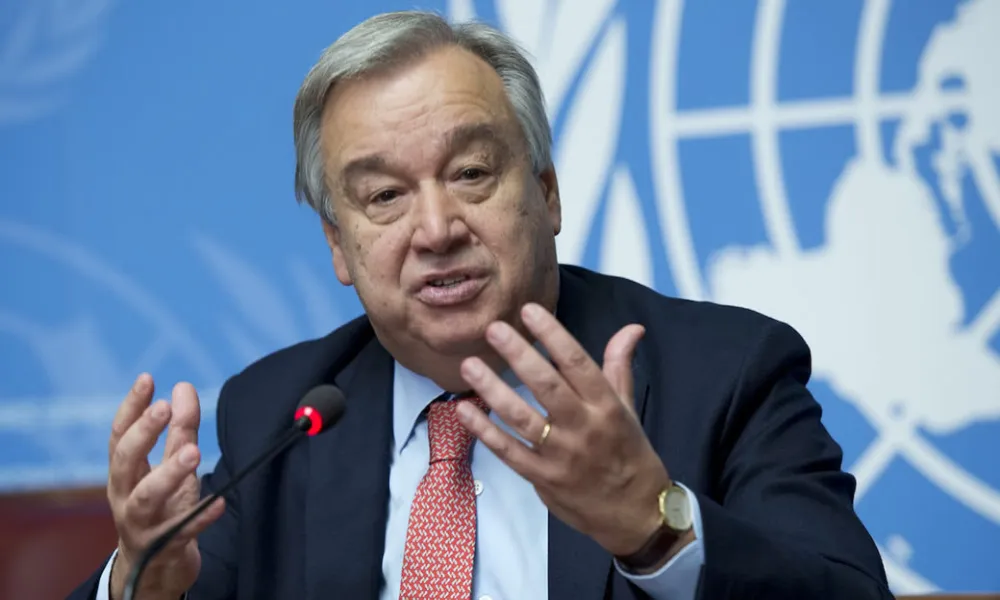

In warm but measured words, UN Secretary-General António Guterres extended his congratulations to Tufan Erhürman on his election as leader of the Turkish Cypriot community. A new dynamic appears to be emerging in the long-stalled Cyprus issue. The crucial question now is whether this moment can be seized, or if it will once again fade, as so many opportunities have in the past.
Based on the existing, complex conditions, even after Erhürman’s election, rapid developments should not be expected. However, it is crucial to see whether the UN can outline a roadmap to reverse the division on the island. This seems very difficult. The Cypriot leaders are judged not by what they declare, but by what they do: how they prepare the ground, what initiatives they take, what atmosphere they create between them, and how they handle their exhausted public opinion.
Signs
For years, the signs have not been good. Some people feel no urgency, even though 50 years have passed. President Christodoulides phoned Erhürman, but the latter delayed returning the call, which initially went unanswered. After ten days, they managed to speak and agreed to meet as soon as possible.
The Cyprus problem remains a frozen conflict. Internationally, there is no one eager or intending to present proposals, let alone impose a solution plan, despite what is often written in local media. What is now absolutely necessary is that the Cypriots themselves first demonstrate through actions that they want and mean a solution. Time is not on their side, and global uncertainty does not favor postponing the issue into an undefined future “for better days,” as several Greek Cypriot politicians claim.
The Five-Party Meeting
The UN Secretary-General’s personal envoy, María Ángela Holguín, will visit the island in the coming days to prepare another informal meeting on Cyprus in an expanded format, the so-called Five-Party Conference. Two such meetings were already held, in March and July, but were practically fruitless. Still, for the UN, they helped to bring back some movement to a process that had been dormant for eight years, keeping the parties engaged around the table.
Guterres urges Erhürman to work with Holguín “to possibly chart a mutually acceptable way forward for the Cyprus issue.” This message, of course, also concerns his counterpart, President Nikos Christodoulides. But what kind of way forward?
Outcome
The Secretary-General knows very well what has happened over the years. The gap has widened, and it will take great effort and commitment from both sides to recover lost ground. A reasonable approach would be to reaffirm already agreed documents and convergences. This would mean an end to the endless cycle of repetitive discussions that resurface every decade.
The UN considers such repetition entirely undesirable. However, this issue remains unresolved. Holguín’s behind-the-scenes discussions, mainly with Turkish Foreign Minister Hakan Fidan, focused on a framework document based on the previous work done. It concerns a conclusive negotiation, an updated Guterres Framework of six key points presented in Crans-Montana, and not a return to old documents or reopening of settled issues.
These consultations did not progress because, despite Ersin Tatar’s known negative stance, Holguín found no productive engagement from Christodoulides either. In contrast, she observed a positive attitude from Greece and Turkey. Following that failure, since October 2024, the UN has focused on discussing confidence-building measures (CBMs) with the Cypriot leaders to at least maintain momentum.
Updated Framework
Exploring a revised “Guterres Framework” may now resume, with Erhürman at the table. What is essentially being tested is Christodoulides’ readiness to reveal his position on political equality, provided his interlocutor no longer demands “two states,” as Tatar did, and that Hakan Fidan again leaves room for a federal settlement. This could happen, but Turkey insists on hearing first about political equality before addressing other package issues, most sensitive for the Greek Cypriots being security and guarantees.
This scenario seems the least desirable for Christodoulides. He wants the talks to resume but not as a conclusive negotiation. The talks are “Cypriot-owned,” and he has often shown discomfort with an environment that could surprise or pressure him into immediate political decisions. He and his close associates have made serious misjudgments in such contexts before. That is why the Presidential Palace is preemptively creating a narrative against “fast-track processes” or “tight deadlines.”
Useful Time
Based on past experience, the UN neither wants nor is in a position to impose developments. Instead, it aims to use the window of opportunity and the useful time available. Thus, ahead of the new Five-Party meeting, regarding the substance of the Cyprus issue, Holguín will focus on meeting the new Turkish Cypriot leader, probing his views, and then visiting Ankara. Meanwhile, Erhürman will start forming his negotiating positions after his initial contacts with Turkish President Recep Tayyip Erdoğan and Foreign Minister Hakan Fidan. Valuable will also be his meeting in Athens with Greek Foreign Minister Giorgos Gerapetritis on Greek-Turkish relations and in Brussels, where the agenda on EU-Turkey relations and European security architecture with NATO states has expanded. The key question for Athens and Nicosia is whether they will truly leverage the European context to make strategic connections or merely to block Turkey from gaining benefits.
Confidence-Building Measures (CBMs)
The “roadmap” for Cyprus also includes CBMs that can be implemented to have a real impact on the societies and people divided by the Green Line. Erhürman seeks ways to advance their implementation through bicommunal meetings held in Cyprus, not only when the Secretary-General convenes a Five-Party conference.
The experience from the Christodoulides–Tatar co-leadership period is not encouraging. It would be deeply disappointing if nothing progresses. On CBMs, Christodoulides will have to provide far more convincing answers than the often puzzling actions he has taken for years, regarding new crossing points and Green Line trade.
The most serious immediate consequence of potential failure on CBMs would be a surge in mistrust and a weakening of momentum toward substantive negotiations on the core of the Cyprus issue. If this ultimately leads to another total collapse, like in Crans-Montana, then the status quo in Cyprus will become entirely unmanageable.