Pakistan described its clashes with Taliban forces along the Afghan border as an “open war.” Israel, in coordination with the United States, struck Iranian nuclear facilities in what it termed a preventive operation. Iran retaliated with missile attacks targeting Israeli territory and U.S. assets across the Gulf. At the same time, the Russia–Ukraine war grinds on in Europe.
To read these developments as isolated events would be a mistake. What we are witnessing is the simultaneous release of accumulated geopolitical tension. And the consequences extend beyond the military domain. Energy security, trade corridors, financial stability and regional power balances are all in play.
South Asia: From border tension to “open war”
Islamabad’s language is no longer ambiguous. Pakistani authorities have described the situation along the Afghan border as “open war.” Pakistan announced air strikes against Taliban targets near Kabul and Kandahar, accusing the Afghan Taliban of tolerating or enabling Tehrik-i-Taliban Pakistan militants. The Taliban denied the claims and said they had responded along the border.
This confrontation is not rooted in sectarian divides. It centers on sovereignty, cross-border militant movement and territorial control. Yet perception matters. When a nuclear-armed state declares open war on its western frontier, the consequences extend beyond bilateral tensions.
South Asia’s risk premium rises. Investor confidence weakens. Credit costs increase. Regional fragility deepens. This may not be the first shockwave to hit global markets, but it adds to an environment already strained by uncertainty.
Iran front: From shadow war to open engagement
The systemic shock, however, is centered in Iran. In the early hours of February 28, Israel launched strikes on Iranian nuclear facilities, describing the move as a preemptive action. U.S. coordination was openly acknowledged. Explosions were reported in Tehran, Isfahan and other strategic locations. Israel closed its airspace.
Washington went further than previous crises. The operation was described as “major combat engagement,” and U.S. President Donald Trump publicly called on the Iranian people to pursue political change.
The language signaled that the file had moved beyond nuclear deterrence. Years of cyber operations, sabotage, assassinations and proxy confrontations have now transitioned into overt military engagement. That marks a strategic threshold.
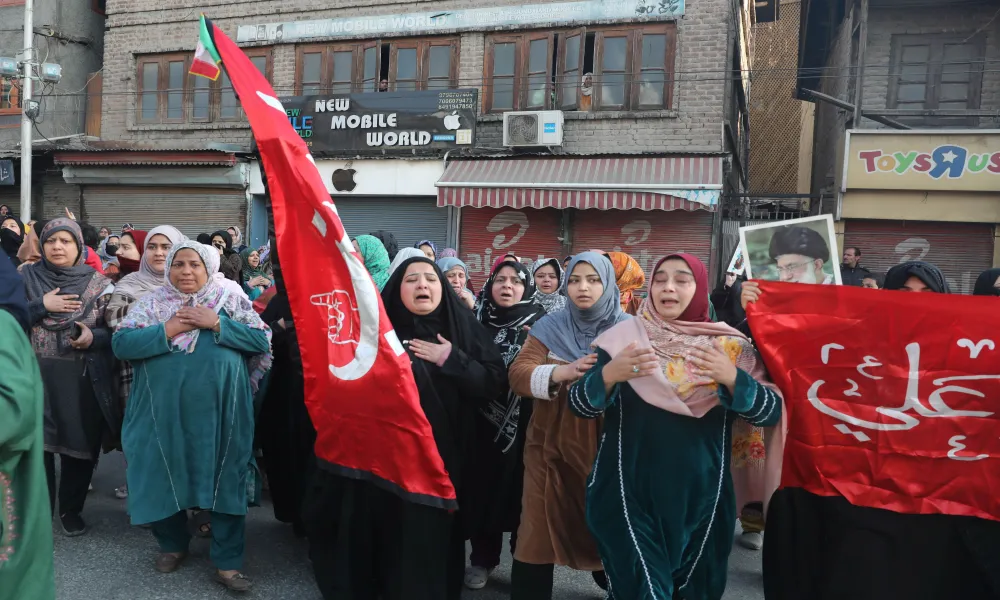
Reports indicate that Iran’s Supreme Leader Ayatollah Ali Khamenei was killed during the initial wave of strikes, along with key regime figures. If confirmed, this would represent not only a military escalation but a direct assault on regime continuity.
Iran responded quickly. Missile launches targeted Israeli cities and U.S.-linked facilities across the Gulf. Bahrain reported threats near installations associated with the U.S. Fifth Fleet. Qatar activated air defense systems. Explosions were heard in the United Arab Emirates. Airspace restrictions followed.
Gulf: Energy geopolitics under stress
Financial markets are watching one point above all others. Will the Strait of Hormuz remain secure?
Approximately one fifth of global oil flows through Hormuz. A significant portion of global LNG shipments originate from the Gulf. Markets do not simply ask whether oil exists. They ask whether oil can move safely.
If Hormuz becomes unstable, energy risk premiums will rise sharply. Even discussions within OPEC+ about increasing production cannot offset transit insecurity. Prices are shaped not only by supply but by safe delivery.
Compounding the concern, reports from Yemen suggest that Houthi forces may resume operations along the Red Sea corridor. If both Hormuz and Bab el-Mandeb face simultaneous disruption, the Asia–Europe trade axis would be squeezed at two strategic chokepoints.
Shipping costs would increase. Insurance premiums would spike. Delivery times would lengthen. The result would be renewed inflationary pressure globally.
Market reactions follow a familiar pattern in moments of geopolitical shock.
Equity markets retreat. Gold rises. The U.S. dollar strengthens. Emerging market currencies come under pressure.
This reflex reflects uncertainty rather than certainty. The first 48 hours will be decisive. Will Hormuz remain open? Will U.S. ground engagement follow? Will Iranian proxies activate additional fronts? Where will oil prices stabilize?
The regional picture: Fragmented alliances and strategic drift
The regional reaction has been divided. Gulf states, including Saudi Arabia, Qatar and the United Arab Emirates, condemned Iranian missile strikes on their territories while emphasizing their right to self-defense. Yet many of these same governments had previously sought to avoid overt alignment.
European leaders urged maximum restraint. European Commission President Ursula von der Leyen called for de-escalation and respect for international law. UN Secretary-General António Guterres warned that the use of force threatens global peace.
Russia labeled the strikes a dangerous adventure that risks destabilization. China called for sovereignty to be respected and dialogue to resume. Yet neither Moscow nor Beijing has taken decisive steps beyond diplomatic statements.
The absence of credible deterrence becomes apparent. In a functioning balance of power, major actors act as brakes on escalation. When that balance weakens, unilateral action becomes easier.
Earlier this year, Washington carried out a large-scale operation in Venezuela that resulted in the capture and removal of President Nicolás Maduro without United Nations authorization. Many legal experts described the move as a violation of sovereignty. Despite rhetorical objections from parts of the Global South, there was no decisive counterweight from major powers that often speak of multipolar order.
The pattern reflects a broader shift toward power politics. When force becomes the primary instrument of policy, international law becomes selectively applied.
Regime change and structural risk
Officially, Washington and Tel Aviv maintain that their objective is preventing Iran from acquiring nuclear weapons. However, several elements complicate that claim.
The strikes occurred despite announcements that U.S.–Iran negotiations were scheduled to continue in Vienna. Both President Trump and Prime Minister Benjamin Netanyahu publicly called on the Iranian people to consider political change. Early attack waves reportedly targeted regime centers in major cities.
The question arises whether nuclear nonproliferation is the stated objective while regime transformation is the underlying aim.
If regime change occurs through decapitation or elite fragmentation, regional political balances will shift radically. Yet the most significant strategic risk may not be regime collapse itself, but fragmentation.
Iran is a civilizational state with complex internal ethnic and regional dynamics. Instability in Azerbaijan regions, Kurdistan or Baluchistan could trigger border shifts and systemic chaos. A fragmented Iran would not produce stability. It could generate a geopolitical black hole.
Neither Israel nor the United States, nor regional Arab monarchies, would easily manage the consequences of such fragmentation.
Türkiye: Between two active belts of conflict
Geographically, Türkiye sits between two active conflict zones. To the north lies the Russia–Ukraine war. To the east and southeast, the Iran-centered escalation unfolds. To the south, South Asia faces renewed instability.
For Ankara, this is not simply a diplomatic puzzle. Energy supply security, financial stability, border management and migration flows all intersect.
President Recep Tayyip Erdoğan condemned both the U.S.–Israeli strikes on Iran and Iran’s retaliatory attacks on Gulf states as unacceptable. He warned that unless restraint prevails, the region could become a ring of fire.
Türkiye denied providing airspace or operational support for the strikes, emphasizing that NATO obligations were limited to defensive measures. Ankara has engaged in active diplomatic outreach, with Foreign Minister Hakan Fidan holding contacts with Iran, Gulf states and European counterparts to prevent escalation.
Historically, Türkiye and Iran have shared one of the world’s oldest stable land borders since the 1639 Treaty of Kasr-ı Shirin. Ankara does not seek war with Tehran, nor instability within Iran. Trade routes, energy flows and broader regional connectivity are deeply intertwined.
At the same time, Türkiye has been attempting to ease tensions in South Asia, intervening diplomatically in Pakistan–Afghanistan developments.
Controlled escalation or chain reaction?
February 28, 2026 may be remembered not merely as the day strikes hit Iran, but as the morning multi-front escalation began.
The coming hours will determine whether this is a controlled escalation or the start of chain reaction spread.
Will Hormuz remain open? Will U.S. involvement expand beyond air operations? Will Iranian proxy networks activate new theaters? Will oil stabilize or surge?
Geopolitics makes ignition easy. Containment requires strategy and restraint.
Today the world stands at a systemic threshold. The issue is no longer who is right. The issue is who will act wisely enough to prevent cascading instability.
The fire has been lit. Whether it spreads depends on the decisions made now.