
By Professor Andreas G. Orphanides, Ph.D., D.H.C
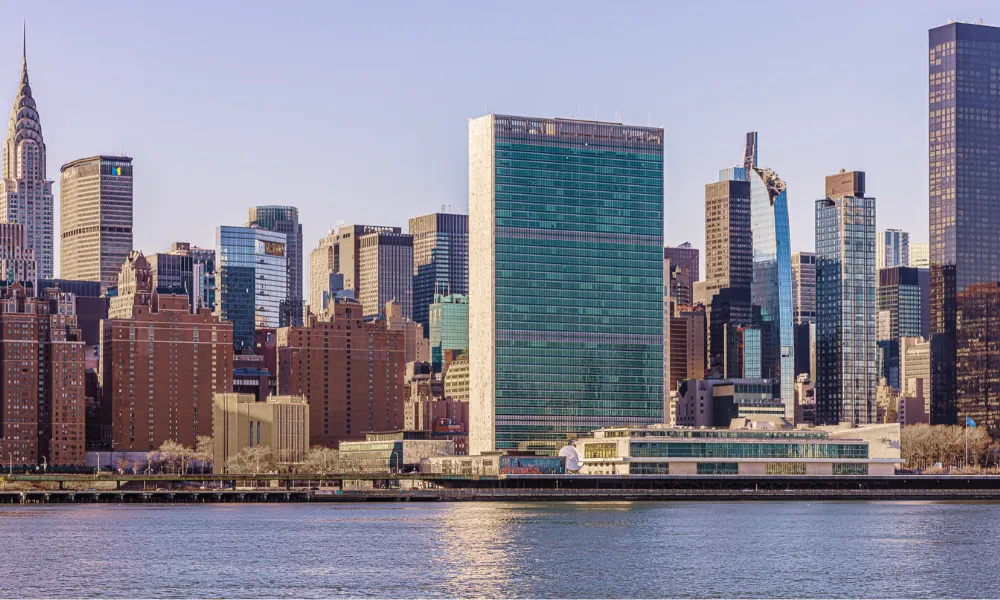
The recent warning letter from UN Secretary-General António Guterres about a “visible risk of financial collapse” facing the Organization is not merely another bureaucratic alarm bell. It is a dramatic political admission of disintegration, striking at the very core of the international order as it was constructed after the Second World War. Anyone unwilling to grasp the gravity of the moment is choosing willful blindness. And the historical irony is merciless. This, in essence, is how it all began for the League of Nations, when Benito Mussolini derisively remarked that it was “very good when sparrows are chirping, but useless when eagles are fighting.”
The United Nations’ financial crisis did not come out of the blue. It is the accumulated result of chronic structural pathologies, intensifying geopolitical rivalries, and a growing reluctance among powerful states to fund an organization they themselves systematically undermine politically. Delays and cuts in assessed contribution, particularly by major donors, have led to acute cash-flow shortages, affecting core functions such as peacekeeping operations, humanitarian programs, and even the basic administrative capacity of the Secretariat.
Guterres’s warning carries particular weight because it is not merely about balance sheets. It concerns the UN’s ability to function as even a minimal mechanism of international stability at a time of overlapping crises, such as high-intensity wars, climate breakdown, migration pressures, food insecurity, and technological risks. The Organization’s financial exhaustion comes precisely at a moment when global demand for UN action is greater than ever.
The problem, however, runs deeper than a lack of money. It is political and institutional. The UN is funded by states that often treat it as an instrument rather than a collective good. When its decisions do not serve their interests, they paralyze it. When they seek legitimacy, they invoke it. This instrumental relationship erodes the willingness to provide consistent funding and reinforces the perception that the UN is useful only selectively.
The comparison with the League of Nations is not merely rhetorical. Then, as now, the great powers were unwilling to commit meaningfully to a system of collective security that constrained their freedom of action. Financial weakening preceded political collapse. When the “eagles” eventually clashed, the institution lacked both the means and the political legitimacy to intervene.
Today, the UN risks being reduced to a low-intensity crisis-management body, incapable of influencing the strategic decisions of major powers. The financial crisis merely accelerates this slide. Program cuts, shrinking missions, and administrative uncertainty undermine morale and functionality within an organization already strained by internal contradictions.
The challenges are manifold. First, the UN’s funding model is outdated. It relies on state contributions that are often hostage to domestic political disputes within member states. Second, the unequal distribution of power in the Security Council generates a persistent legitimacy deficit, especially in the Global South, making consensus on strengthening the Organization increasingly difficult. Third, lack of transparency and bureaucratic rigidity fuel criticism of inefficiency.
Yet collapse is not inevitable. Realistic solutions exist, provided there is political will. The first concerns diversification of funding sources. The UN cannot remain exclusively dependent on state contributions. Innovative financing instruments, such as global levies on specific cross-border activities or mandatory contributions from international financial institutions, could enhance the Organization’s sustainability without undermining its public character.
Second, institutional reform is required to restore a measure of credibility. Greater transparency in resource management and a clearer linkage between funding and results could address legitimate concerns among member states. Effectiveness is not merely a technical issue; it is a prerequisite for political support.
Third, the UN must redefine its role in a multipolar world. It can no longer operate on the logic of the postwar era, when the hegemony of the victors provided a relative framework of stability. Greater integration of regional organizations and the meaningful participation of emerging powers in decision-making are essential, so that funding is accompanied by a sense of ownership.
Guterres’s warning is, in essence, a last appeal, not only for money, but for political seriousness. The collapse of the UN would not simply mark the end of an organization. It would signal the failure of the international community to preserve even a minimal rules-based framework in a world sliding toward raw power competition.
In conclusion, if the international community chooses to ignore the message, history is unlikely to be forgiving. As with the League of Nations, the fault will not lie with the organization itself, but with those who allowed it to be hollowed out of resources, authority, and meaning. Moreover, when the “eagles” clash once again, there will not even be a table left for dialogue to save appearances.