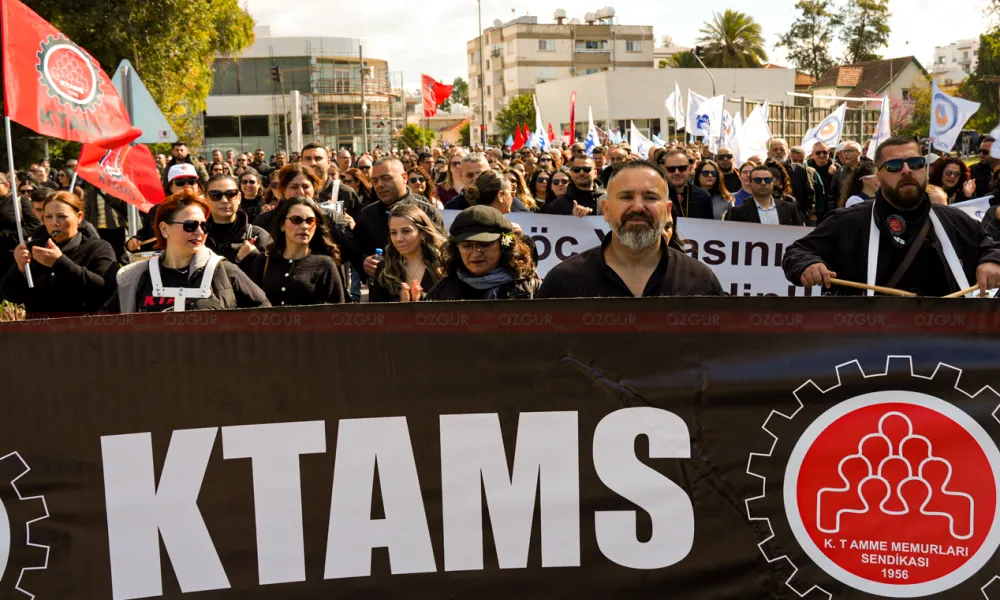
The "government"’s willingness to adopt, albeit belatedly, a formula originally proposed by trade unions might have been expected to ease tensions. Instead, it has reinforced a deeper problem: a collapse of trust between the "state" and organized labor.
The latest proposal, which foresees paying 50 percent of the inflation adjustment in July and deferring the remaining half to January 2027, is not controversial in substance. It is controversial in origin and timing. The same formula was rejected when unions tabled it. Its reappearance as a government proposal has therefore been interpreted less as compromise and more as reluctant capitulation under pressure. This perception matters because it shifts the dispute from a technical negotiation over wages to a political judgment about credibility.
The unions’ insistence that the arrangement be secured at committee level rather than left to the plenary is a direct reflection of that mistrust. In ordinary circumstances, the distinction might seem procedural. In the current climate, it is existential. Union leaders fear that a deal passed directly to the general assembly could be altered at the last moment, diluted or reinterpreted. Without procedural guarantees, they argue, there can be no meaningful agreement. This position explains why the general strike has continued despite the withdrawal of the decree that triggered the crisis. The issue is no longer what the government offers, but whether it can be believed.
Ankara lifeline or fiscal illusion
Behind the political confrontation lies a hard fiscal reality. The government’s push to modify the cost-of-living mechanism was not simply ideological. It was driven by liquidity concerns. The administration fears that without some form of adjustment, borrowing capacity will narrow and even the ability to meet end-of-month salary obligations could come under strain. This concern has pushed the ruling coalition toward Ankara in search of additional financial support. Ahead of the visit, Prime Minister Ünal Üstel emphasized that the new economic cooperation package with Türkiye would reach roughly 24 to 25 billion Turkish lira and focus on infrastructure, economic resilience and energy.
Yet the structure of that support raises difficult questions. Much of the funding is earmarked for investment and sectoral programs rather than direct salary payments. This means that even if the agreement is signed and funds are released, the immediate wage crisis may remain unresolved. The government’s apparent strategy is to use partial deferral of the allowance to create fiscal space, then rely on borrowing to cover ongoing expenditures. This is a familiar cycle. Borrow, pay salaries, accumulate interest, return to the same problem. Critics argue that this approach effectively mortgages the future to manage the present.
The deeper issue is structural. Northern Cyprus operates within a constrained economic framework shaped by political isolation, currency dependence and limited fiscal autonomy. In such an environment, external support can stabilize but rarely transform. Ankara can provide liquidity, but it cannot substitute for internal discipline, institutional reform and sustainable budgeting. The current crisis exposes the limits of a model in which public finances rely simultaneously on external transfers and domestic borrowing.
Will Monday bring compromise or push the crisis to the ballot box?
The early Thursday morning decision to suspend parliamentary proceedings until Monday, officially attributed to exhaustion and rising tensions, has effectively created a narrow window for de-escalation. Whether that window is used productively remains uncertain. The pause reflects not only physical fatigue but institutional paralysis. The legislature did not manage to move the issue into a stable procedural framework before adjourning. As a result, the crisis continues outside formal channels, in the streets and through union mobilization.
At the same time, political dynamics are shifting. Opposition voices are increasingly framing the situation as one that can no longer be resolved within the current parliamentary arithmetic. Early elections are being presented as the only legitimate exit. The ruling coalition, for its part, appears reluctant to take that step, aware of the political risks of going to the polls amid economic strain and public discontent. This creates a familiar but unstable equilibrium: a government that cannot easily govern, and an opposition that cannot yet force change without escalation.
The coming days will therefore be decisive. A negotiated compromise remains possible. If the government formally adopts the union proposal, secures it through a trusted legislative process and gains at least limited financial reassurance from Ankara, tensions could ease. Public services could resume, and the coalition might buy itself time. But such an outcome would be, at best, a temporary stabilization. It would not restore confidence or resolve the structural weaknesses exposed by the crisis.
The alternative path leads toward early elections. That option carries its own uncertainties. Elections do not eliminate fiscal constraints, nor do they guarantee more coherent governance. But they can reset legitimacy. In a context where trust has eroded so deeply, that reset may become unavoidable.
For now, northern Cyprus stands at a crossroads. The crisis has already moved beyond the realm of wage policy. It has become a test of whether political leadership can rebuild trust under pressure, whether institutions can function under strain and whether a fragile economic model can sustain itself without deeper reform. The answer will not be determined solely by numbers in a budget or percentages in a wage adjustment. It will be determined by whether the system can convince its own citizens that it still works.