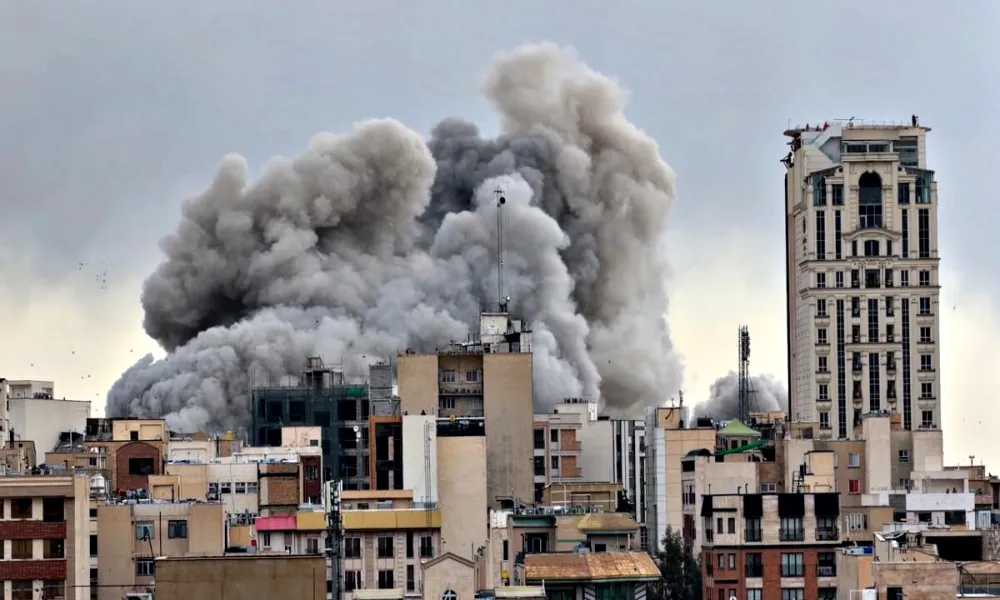


Every war leaves visible devastation, measured in lives lost and cities destroyed. Yet conflicts also produce less visible consequences. Fires at oil facilities, missile explosions and the thick clouds of smoke seen across the Middle East have once again raised concerns about the environmental impact of warfare.
Smoke, chemical pollutants, heavy metals and toxic particles can travel long distances under certain conditions. The question now being asked is whether Cyprus could be affected by the ongoing hostilities in the region, and if so, how.
Experts speaking to Politis explain that while the risk appears limited, authorities are closely monitoring atmospheric conditions, air quality levels and the movement of dust and air masses that could potentially carry pollutants toward the island.
How pollutants could reach Cyprus
Environmental engineer Dr Michalis Loizides says the geographical distance between Cyprus and Tehran, as well as the main theatres of conflict, is significant.
“The distance is roughly 1,500 kilometres. That alone acts as a major limiting factor,” he said.
According to Loizides, substances released from explosions or fires at oil or chemical facilities are unlikely to travel directly to Cyprus on their own. If pollutants were to reach the island, the most probable pathway would be through dust particles.
“Any potential problem would most likely arrive in particulate form, through dust on which pollutants have settled,” he explained.
For that reason, authorities closely monitor wind direction and the movement of air masses. Cyprus and European monitoring networks track the origin of dust reaching the island and can determine whether it originates from regions such as the Sahara, Syria or the wider Middle East.
If pollutants were carried with the dust, the range of possible substances could include benzene, toluene, dioxins, polycyclic aromatic hydrocarbons, chlorinated compounds, ammonia and heavy metals. These substances can be released when oil installations are hit and incomplete combustion occurs.
However, Loizides stresses that the key factor is the concentration of any pollutants that might reach Cyprus.
“Even if traces arrive, that does not necessarily mean they will affect public health,” he said.
He also noted that dust poses a greater concern than rainfall in this context. Rain tends to deposit particles onto the ground, while dust can keep them airborne and therefore potentially inhalable.
Monitoring the composition of dust
According to Dr Chrysanthos Savvides, head of the air quality unit at the Department of Labour Inspection, monitoring stations have not recorded elevated dust concentrations at ground level in recent days, despite warnings from the Meteorological Service about a dust episode.
Savvides said authorities can determine the origin of incoming air masses and identify where dust events originate.
The difficulty arises when trying to determine what the dust actually contains.
“There is a way to identify its composition, but we cannot know it in real time,” he explained. Chemical analysis is required and the process can take around one month.
The delay creates a potential gap in understanding what people may have been exposed to, although Savvides noted that this limitation is not unique to Cyprus but exists internationally.
Lessons from previous conflicts
Savvides also sought to ease concerns by pointing to findings from previous conflicts. Chemical analyses conducted during earlier regional wars did not detect dangerous concentrations of hazardous substances linked to chemical or other weapons above detection limits.
“Of course there is no absolute zero in chemistry or science,” he said, explaining that measurements were simply below the instruments’ detection threshold.
Scientific data also suggests that many of the 40 to 50 chemical substances monitored by the air quality unit have short lifespans in the atmosphere. The long distance they would need to travel makes their presence in measurable concentrations in Cyprus unlikely.
“Scientifically, it is very difficult to observe such elevated concentrations,” Savvides added. He said distances of between 20 and 50 kilometres from a source would normally be the range where concerns could arise.
Radiation monitoring and preparedness
Another scenario that raises concern is the possibility of radioactive contamination.
In recent years Cyprus has strengthened its radiation monitoring system, largely due to the construction of the Akkuyu nuclear power plant in Turkey. The island now operates a network of monitoring stations that measure gamma radiation in the atmosphere in real time, allowing authorities to detect sudden changes quickly.
Specialised measurements can also detect radioactive iodine and caesium, two isotopes considered particularly dangerous in the event of a nuclear or radiological incident. According to officials, monitoring is continuous and provides real time information on radiation levels. However, the challenge is not only detecting a problem but also responding effectively if one occurs.
Cyprus maintains reserves of iodine tablets used to protect the thyroid from absorbing radioactive iodine. Yet it remains unclear how these would be distributed to the public in an emergency. Distribution is expected to take place under the national nuclear and radiological emergency plan known as Electra. However, the mechanism has not been publicly presented and parts of the plan remain confidential.
This leaves a gap in public information, as citizens do not yet know where or how they would obtain the tablets in a crisis.
Shelters offer limited protection
Experts also highlight practical weaknesses in the island’s protection infrastructure. Civil defence shelters in Cyprus are designed primarily to protect against conventional military attacks and are not airtight. As a result, they cannot fully prevent the entry of radioactive particles in the event of radiological contamination.
In such a scenario, the main recommendation to the public would likely be temporary shelter indoors and avoiding exposure to the atmosphere until the situation is assessed.