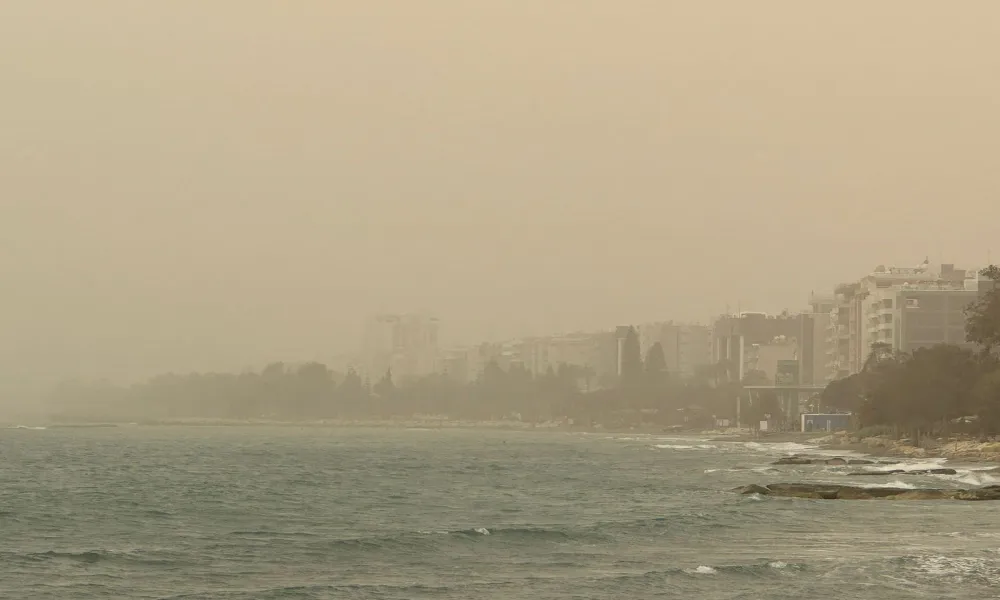

Cyprus remains engulfed in dense African dust, with authorities warning that levels will stay extremely high today, continuing to affect daily life and strain public systems. The Meteorological Service says the situation is not only persisting but worsening, as airborne particle concentrations rise well beyond acceptable thresholds. Officials describe one of the most severe dust episodes of recent years and urge the public to limit movement and take strict protective measures.
The Ministry of Health has issued clear guidance, advising people to avoid unnecessary travel, minimise outdoor exposure and use high‑efficiency protective masks. Particular emphasis is placed on vulnerable groups – people with respiratory or cardiac conditions, children and the elderly – who are urged to remain indoors and contact their doctor immediately if they develop symptoms. The ministry also advises people to avoid outdoor exercise, stay in air‑conditioned and well‑ventilated spaces and use protective equipment where necessary.
The Ministry of Labour has issued similar instructions, reminding employers of their duty to protect workers, especially those outdoors, by providing suitable masks and reducing exposure wherever possible.
Workers remain outside without protection
Despite the clear instructions, scenes on the streets painted a different picture. Social media videos showed outdoor workers such as delivery riders and construction labourers continuing their duties, often without the required protective gear. The images highlight once again the gap between official recommendations and real conditions on the ground, raising concerns about whether employers and the state are doing enough to safeguard workers in such hazardous episodes.
Classrooms with shut windows
Schools also operated under unprecedented conditions. Pupils remained indoors with windows shut and no possibility of ventilation, while playgrounds and outdoor areas were essentially out of use. Scheduled excursions, sports events and other activities were cancelled due to the dangers of outdoor exposure. Parents and educators strongly criticised the situation, arguing that schools should have remained closed. Keeping children in sealed classrooms with inadequate ventilation, they said, is not a viable solution when dust levels are so high.
A rare and severe episode
Meteorologist Panayiotis Georgiou told Politis that the dust originated from atmospheric disturbances over Libya, where low‑pressure conditions lifted large amounts of desert dust into the air before winds carried it across the Eastern Mediterranean to Cyprus. He said concentrations peak today and conditions should gradually improve from tonight. Dust levels are expected to drop from level 4 today to levels 2-3 tomorrow, with further improvement from Saturday night into Sunday, when the skies should clear.
The dust is affecting almost the entire population and is noticeable across all regions, with the most severe impact on vulnerable groups such as those with respiratory illnesses. Scientists describe the episode as unusually intense and uncommon in frequency, with air‑quality monitors showing significant exceedances of permitted limits.
Health risks and dangers
African dust is more than an inconvenience – it is a serious public health concern. Its fine particles penetrate deep into the respiratory system. Personal doctor Dr Maria Apostolidou explained that inhaling these particles can trigger immediate symptoms such as coughing, shortness of breath, and irritation of the eyes and nose, while also worsening existing conditions. “Patients with asthma, Chronic Obstructive Pulmonary Disease and heart problems are particularly vulnerable, as exposure can worsen their condition or even lead to hospitalisation,” she said.
The impact is not limited to the respiratory system. “The particles are so small that the body cannot easily filter them, allowing them to remain in the lungs and cause inflammation,” Dr Apostolidou noted. The dust may also carry toxic substances, bacteria and fungi, further burdening health. International studies, she added, show increased mortality during high‑dust periods, mainly due to cardiovascular and respiratory causes, especially when exposure is prolonged.
“In periods of elevated dust concentrations, we see more cases of chronic‑disease destabilisation and an increase in Emergency Department visits,” she said, adding that even healthy individuals may experience symptoms after sustained exposure.
As for protective measures, Dr Apostolidou stressed that “the most important step is limiting exposure. People should avoid going out, use high‑protection masks when necessary and stay in air‑conditioned environments.” She urged special caution for children and the elderly and emphasised that “any symptom should prompt immediate medical consultation.”