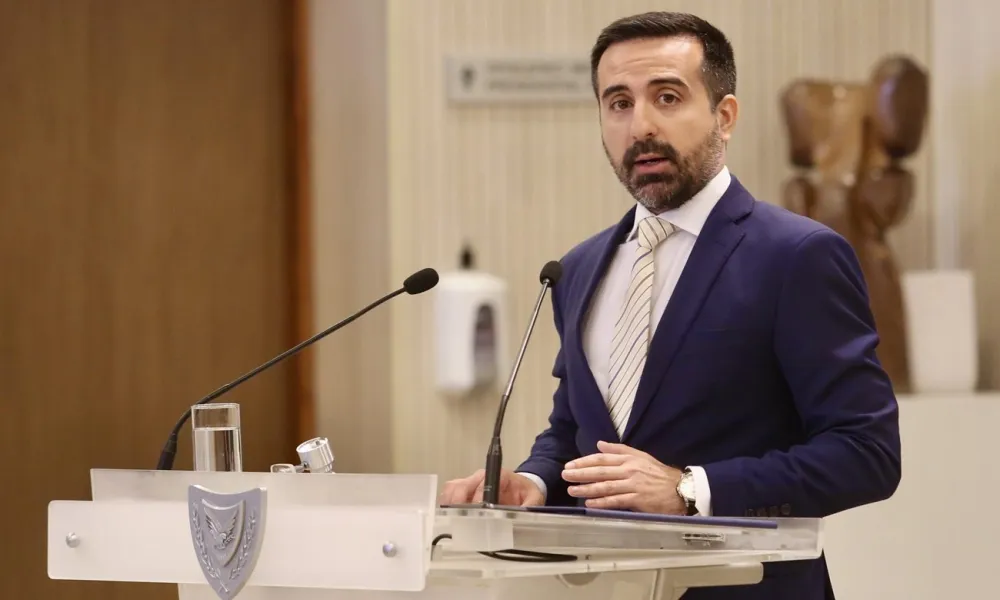
The government’s goal is to transform migration from a problem into a solution, in a way that contributes to strengthening the economy and safeguarding social cohesion, as well as public order and security, said Deputy Minister of Migration and International Protection Nicholas Ioannides on Monday during a press conference where he presented the Deputy Ministry’s report on its work for the year 2025.
He also noted that compared to 2022, irregular arrivals in 2025 decreased by 86% and new asylum applications fell by 87%, while a significant decrease was also observed in pending asylum cases, which, compared to 2024, decreased by 34%.
He also highlighted the fact that Cyprus ranks among the top EU member states in terms of the number of returns of third-country nationals, as in 2025, the total number of departures reached 12,029, the highest ever recorded, while from the start of the administration through February 28, 2026, a total of 31,312 third-country nationals have departed from the Republic of Cyprus.
Improved accomodation
The Deputy Minister noted that in 2025, particular emphasis was placed on infrastructure upgrades, such as the renovation of the Pournara facility, which was funded by the European Commission and is now in its final stages, while construction of the Reception Center in Limnes, with a capacity of 1,000 people, is proceeding with EU funding.
This Center, as noted, will substantially enhance the capacity to provide decent accommodation for asylum seekers and will help relieve congestion in urban areas, while at the same time, the Pre-Departure Center, with a capacity of 800 people, is expected to improve the pace and efficiency of returns, with its first zone already operational.
As the Deputy Minister emphasized, the Government’s policies are yielding results, and this is reflected in the numbers.
Cyprus had most return decisions
At the same time, the Deputy Minister noted that 70% of the repatriations in 2025 involved individuals who took advantage of assisted voluntary return programs, which are 90% co-funded by European funds. He added that this trend continued into the first months of 2026, as 1,341 departures were recorded between January 1 and February 28, 2026 alone.
The Deputy Minister also emphasized the shift in the ratio of arrivals to departures, noting that, in 2025, five times as many people are leaving as are arriving, while he also highlighted the fact that the European Commission noted in its first annual report on Asylum and Migration that between July 2024 and June 2025, Cyprus issued the most return decisions in Europe, relative to population and GDP.
In a specific reference to Syrian nationals, the Deputy Minister noted that they constitute the largest demographic group of applicants for international protection. As he noted, in 2025 a significant number of pending applications were withdrawn and status revocations were recorded, while 4,081 Syrian nationals returned to their homeland by the end of the year.
Comprehensive strategy
Ioannides also said that as of the end of 2025, there were 184,745 valid immigration permits, with the largest category being domestic employment, followed by other significant categories linked to labour market needs. He also noted that the category of international protection accounts for the smallest number of immigration permits and is the only one showing a downward trend compared to the previous year.
The Deputy Minister also emphasized the importance of drafting the first comprehensive National Strategy for the Integration of Legally Residing Migrants, for the implementation of which, as he said, funding has been secured from Switzerland, while additional funding from European funds is also expected.
“The government’s goal is to transform migration from a problem into a solution, in a way that contributes to strengthening the economy and safeguarding social cohesion, as well as public order and security,” he concluded.
Costs
Asked about the cost of processing asylum applications and returns, and whether part of it is covered by co-funding from the European Union, Ioannides first clarified that statistically, most foreigners in Cyprus hold valid permits, either as workers, students, or family members of Cypriots and Europeans.
He added that asylum seekers and beneficiaries of protection constitute a much smaller demographic group, and that with the reduction in inflows and the increase in returns, this number is steadily decreasing.
“I can tell you about the costs that over the past three years, the amount of material reception conditions—as the allowances are called—which are received only by those who submit an asylum application, has been cut in half, it has decreased by 50% precisely because of this reduction. Also, it should be noted that not all asylum seekers are entitled to benefits; there is also the option to work after nine months, and soon this option will be available after six months. Therefore, our effort is to continuously reduce costs, while the majority of the programs we implement are co-funded by the European Union and other agencies,” he explained.
“I would say that, overall, more than 60% of the costs associated with migration are covered either through European co-funding or in cooperation with other countries, such as Switzerland, and our goal is to continuously reduce this amount so as not to burden the state budget,” he added.
No impact from regional war yet
Asked whether the Deputy Ministry is concerned about developments in the region and whether there is an assessment of the risk of new migrant flows, the Deputy Minister said that so far no flows have been observed from the region.
“Of course, we remain vigilant; all of Europe is. We were also in Brussels with our colleagues recently. We are in communication with the European Commission and the other member states and procedures are now being introduced under the New Pact on Migration and Asylum, but more broadly, the attitude and approach of the European Union and its member states toward migration have changed,” he added.
“Everyone understands that a new refugee crisis like the one we had in 2015 must not be allowed to happen. Legislation has improved, infrastructure has improved, and attitudes have changed, so we are prepared to handle any potential new waves of migration. But I am telling you, at this moment there is no indication of this, nor have people arrived in Cyprus due to the crisis,” he noted in this regard.
Syrian nationals
Asked about Syrians who have integrated into Cypriot society and whether there is a possibility that they themselves might want to leave Cyprus after so many years, Ioannides said that beyond voluntary departures, we have now entered another phase with the rejection of many asylum applications from Syrian nationals, as the criteria set by international and European law are no longer met.
“Many applications are now excessive, people are clearly coming here for work without facing any danger, and we are rejecting them. Some of these have already been upheld by the Court, which means that the Asylum Service of our Deputy Ministry is doing its job correctly,” he added.
“We will continue at this pace because we want the asylum system to be sustainable, so that we can provide protection to those who are entitled to it. When people arrive and over 80% of the applications are abusive, you realize that the system is being disproportionately burdened and we cannot help those who deserve it. “We will continue with the intensive review of asylum applications and rejections where the law allows,” he added on the matter.
He also highlighted a new measure regarding the revocation of protection status from individuals who are no longer eligible for international protection because conditions in their countries of origin have changed.
“This does not apply only to Syrians, it applies to other nationalities as well. There are two subcategories: those who commit criminal offenses—which is the tool we now have under the new legislation when they are deemed a threat to public order and security— and the rest, who may not be considered a threat to public order and security but do not meet the legal requirements for asylum,” he further explained.
Asked whether there is coordination with the authorities in Syria and whether there are plans to reopen the embassy in the country, which could potentially facilitate the efforts of the Republic of Cyprus, Ioannides said that in recent years the Cypriot embassy has reopened, but with a chargé d’affaires, not an ambassador, adding that the Republic of Cyprus has a presence in Syria and there is indeed contact with the Syrian government, while recalling that the Minister of Foreign Affairs had visited the country.
Unaccompanied minors
Commenting on the unaccompanied minors currently being hosted in the country, the Deputy Minister, after initially noting that as of January 1, 2026, responsibility for housing unaccompanied minors in centres and facilities has been transferred from the Deputy Ministry of Social Welfare to the Deputy Ministry of Migration, stated that their numbers have decreased significantly as a result of the overall decline in migration flows.
“There are no more than approximately 150 unaccompanied minors in our reception centres, so the numbers remain low. The Asylum Service has taken charge of management and has drawn up a very comprehensive plan so that we can manage these children in a holistic manner; because it is not just about housing, it is also about the overall approach, their education, psychological support, and locating families if they exist, whether in Cyprus or in their home country, should they ever wish to return. Therefore, we are working very seriously on the issue of unaccompanied minors,” he added.
Asked whether the Deputy Ministry’s initiatives on legal migration meet employers’ demands for labour, Ioannides said there has been a significant increase in permits in recent years, which, as he noted, is partly due to government policies having reduced unemployment among Cypriots to below 5%, meaning there are conditions of full employment for Cypriots, so the vacancies must be filled by foreign nationals.
Roma community
Finally, asked about the Deputy Ministry’s actions regarding the increase in Roma migration observed in recent years in the Republic of Cyprus, as well as the high rates of criminal activity and complaints from citizens recorded by the police, Ioannides said that the number of Roma has indeed increased and that this is something the Deputy Ministry has also observed.
“But here we must take a very important factor into account: these people are European citizens. We have citizens of the Hellenic Republic and other Balkan states, so European citizens are treated differently from third-country nationals, the conditions for them to leave Cyprus are stricter, they cannot be placed on a list of prohibited persons, as we do with third-country nationals, we simply restrict their movement,” he explained further.
“However, these people are subject to the same laws and obligations as all citizens. We are working with the police to combat crime committed by foreigners, and our efforts to address crime committed by these individuals fall within this framework. I simply wanted to note that the difference lies in their status as European citizens, which requires a different approach,” he concluded.
CNA