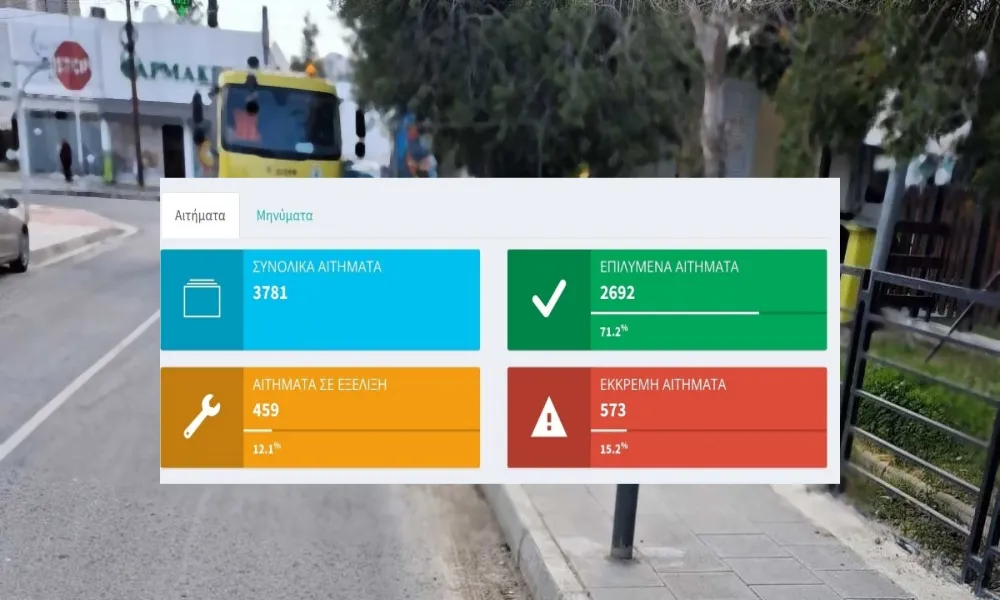

From 1 December 2025 to 23 March 2026, a total of 3,781 citizen requests were recorded through the Novoville application in the Municipality of Strovolos, clearly reflecting both the volume of everyday issues and the shift of residents towards more direct ways of communicating with municipal services.
According to official data obtained by “Politis”, 2,692 of these requests have already been resolved, representing 71.2% of the total. At the same time, in addition to the application, the Municipality of Strovolos has reactivated its social media pages, while mobile messaging has also been introduced. Through these tools, the Municipal Council aims to strengthen online communication alongside physical presence, as it is considered more immediate and allows real-time interaction using the tools available to the municipality.
The picture of the first months
During the first three months of the platform’s operation, 2,817 requests were submitted. Of these, 1,975 were resolved, 372 are currently in progress and 426 remain pending. The resolution rate stands at 70.1%, while the average processing time is recorded at four days and seven minutes. These figures highlight both the ability of municipal services to respond quickly to a significant volume of requests and the steady flow of new issues that continue to be reported.
Residents became more active
The widespread use of the application shows that there was a strong need among residents for a more immediate and functional channel of communication with the municipality. The ability to submit requests in real time appears to have mobilised citizens, who use the platform for issues affecting their daily lives. Through the application, residents can also submit suggestions in addition to complaints. Requests relate, among other things, to cleanliness and waste management, green spaces, abandoned vehicles and other interventions in neighbourhoods across the municipality. At the same time, the ability to track the progress of each request strengthens the sense of responsiveness, as citizens are informed at every stage until the process is completed.
How it works
Requests can be submitted free of charge through the Novoville mobile application or via the municipality’s online platform. The user selects the location, records the category of the problem, adds a photograph and submits the request, which is immediately forwarded to the competent service. Municipal services therefore obtain a more immediate overview of the issues arising in the area, allowing for better planning and more targeted interventions. At the same time, the application also functions as an information and communication tool, offering the possibility to send announcements, access useful information and enable citizens to participate in short consultations. Data from the first three months show that residents responded quickly to the new opportunity provided to them, using the application as a main communication channel with the municipality.
Necessary for everyone
“The response of residents to the new application confirms something that, as a municipality, we already knew – that there was a real need for an immediate, simple and transparent way of communication,” said the Mayor of Strovolos, Stavros Stavrinidis, speaking to “P”. As he noted, “within a few months thousands of requests were recorded, which demonstrates that citizens want to participate actively and have a voice in the daily life of their city.”
Mr Stavrinidis stressed that the application is not simply a tool for recording complaints, but “a modern request management system that allows us to see problems in real time, prioritise them and intervene more effectively.”
He also underlined that the resolution rates and response time show that “the municipality can meet the demands, but that there is also room for improvement, which we are already working to address.”
“Our goal is a municipality that is more immediate, more functional and closer to the citizen. Technology gives us the tools, but the key is to use them properly, with consistency and transparency,” he concluded.