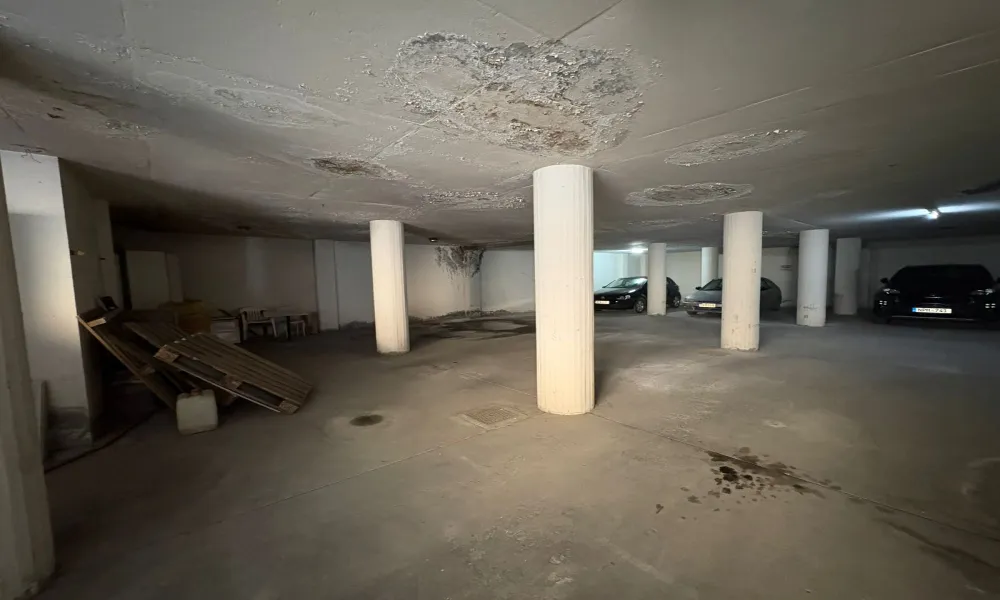
Around 200 civil defence shelters in very poor condition will be removed from the official list, Interior Minister Constantinos Ioannou said on Monday, after inspections of nearly all registered facilities across Cyprus.
Speaking to Politis Radio 107.6 & 97.6, Ioannou said authorities had inspected approximately 99 percent of the island’s 2,480 registered shelters. Of those, around 200 were deemed unsuitable and will be removed, while about 230 are currently not accessible to the public.
Shelter system dates back to 1999
During the programme Proini Epitheorisi, the minister explained that the shelter system was first established in 1999 and relied largely on private underground spaces voluntarily declared by owners.
In recent years, authorities have attempted to increase coverage by identifying additional underground spaces used by the public, including parking facilities and other underground infrastructure.
According to Ioannou, the current system provides coverage for around 40–45 percent of the population.
He added that an extensive inspection campaign had been carried out in recent days to assess the condition and availability of the registered shelters.
Civil defence reorganisation planned
The minister also acknowledged the need to strengthen Cyprus’s Civil Defence service, noting that it remains understaffed.
At present, the service operates with around 30 to 35 officials, despite having 42 approved positions.
Ioannou said the government is preparing legislation aimed at upgrading civil protection structures and creating the position of a national coordinator.
Until the legislation is approved by parliament, a temporary coordinator will be appointed to oversee the system.
SMS alerts temporary until 112 system launches
Addressing the use of SMS alerts for emergency warnings, Ioannou said the system currently being tested serves as an additional tool for informing citizens during emergencies, operating alongside the existing siren system.
However, he noted that full and immediate public warning capabilities will only be achieved once the 112 emergency alert system becomes operational.
The minister said the system was originally tendered in 2022, but the procedure was later judged flawed and cancelled in 2024, requiring a new tender process.
The government now expects 112 to become operational in June.
Until then, the SMS system will function on a temporary basis and has limitations because it relies on the user’s registered location with their telecommunications provider.
As a result, citizens who live in one district but work or travel in another may not receive emergency alert messages.
Limited warning window in case of threats
Referring to potential incidents involving missiles or drones, Ioannou said that once a threat is detected by radar systems there is usually only a short window of a few minutes before a possible impact.
In such cases, Civil Defence is immediately informed and activates the available warning mechanisms to alert the public.