*by George Koumoullis
The survey conducted by Omega TV on 24 April should be considered extremely worrying. It revealed that among young voters aged 18 to 34, ELAM is by far the most popular party. Specifically, in this age group, 21 percent said they would vote for ELAM, while only 13 percent and 12 percent would vote for Democratic Rally (DISY) and AKEL respectively.
Admittedly, the attraction of young people to far-right or fascist parties is not exclusively a Cypriot problem. Increasing support from younger voters for such parties can also be observed in some other countries. However, the situation is not as discouraging as it appears in Cyprus. Notably, in the most recent elections in the United States and the United Kingdom, young voters appeared more progressive, turning out in larger numbers than older voters to support liberal and progressive parties.
On the other hand, studies have shown that young voters in the European Union are more likely to feel politically disillusioned, less attached to mainstream parties and less committed to liberal democracy. There is therefore conflicting evidence regarding the extent to which younger generations are less supportive of liberal democracy and more likely to back parties that challenge democratic principles compared with older voters.
In Cyprus, however, the picture appears very clear. In the parliamentary elections of 2016, ELAM received only 1.1 percent of the vote. In 2021, it rose to 6.8 percent. In 2026, projections suggest that it could reach around 16 percent. If this trend continues, ELAM could become the largest party in the elections of 2036. The risks, not only for democracy but also for the survival of the Republic of Cyprus, are becoming visible, although that is not the focus here.
The main reason behind the party’s rapid growth is the embrace of its ideology by younger voters. Even if some of these young supporters abandon such views as they grow older, the overall number of voters backing the far-right party will continue to increase.
Many observers will point to nationalist education as a cause. However, education in Cyprus has historically been nationalist. In the 1940s, several students of the Pancyprian Gymnasium were expelled because their parents were communists. In the 1950s, education became even more nationalist.
Others argue that ELAM portrays every foreign presence as a threat through strong anti-immigration rhetoric. This certainly resonates not only with parts of the youth who worry about demographic and social change but with the party’s broader electorate as well. Therefore, it does not explain the difference in ELAM’s popularity between age groups.
The same applies to the party’s position on the Cyprus problem, where it adopts a hard line, rejecting the solution of a bizonal bicommunal federation and promoting the idea of a “unitary state”. These factors help explain the rise of ELAM but not the particularly strong support it receives from younger voters.
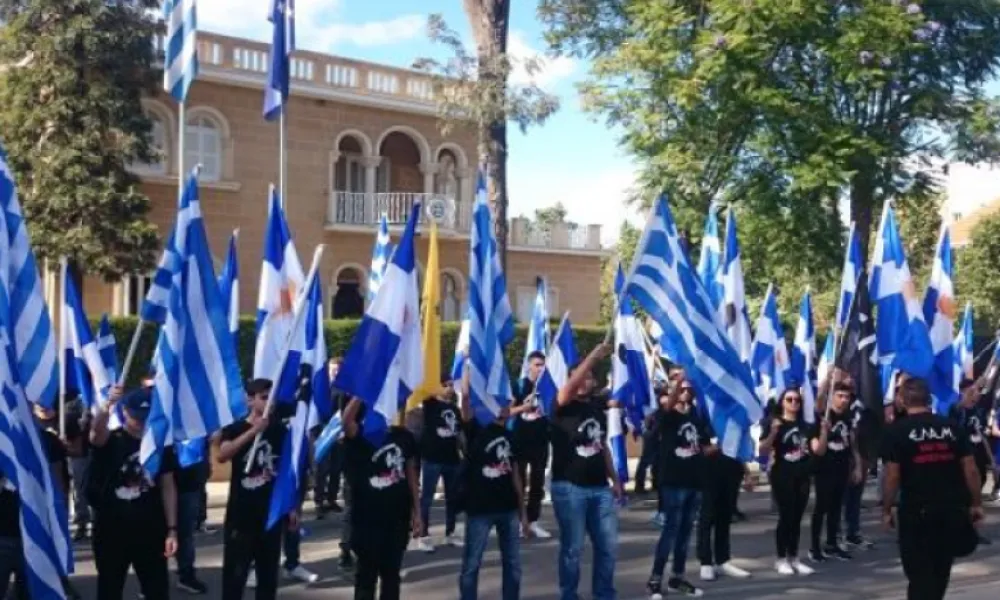
So why is ELAM the most popular party among young people in Cyprus? The answer lies in the fact that the party has managed to gain influence over the leadership of the so-called nationalist football clubs, which constitute the overwhelming majority, and to implant its ideology among teenagers.
A striking example of this influence was the photograph of a supporter of a nationalist club in Nicosia who was seen giving a Nazi salute in the stands last week as his team entered the stadium. The image quickly went viral on social media and was also published by Politis. The club’s leadership, which is reportedly influenced by ELAM, remained silent. An independent and democratic leadership would have strongly condemned such an act. The Nazi salute is widely interpreted as an expression of hate, directly associated with Nazi ideology that promotes racism, xenophobia and violence.
In essence, given that football is an extremely popular sport in Cyprus, that the overwhelming majority of football clubs identify as nationalist, and that most teenagers identify with a team and its symbols and ideology, the risk of fascistisation within Cypriot society becomes evident.
A teenager in the stands is surrounded by ELAM symbols, including Greek Cypriot flags, banners of Georgios Grivas and even references to the SS. These symbols become associated in the teenager’s mind with his club. How can that teenager later vote for a different party?
In no other country in the world do sports clubs appropriate national symbols designed to unite society rather than divide it. These symbols represent shared values, history and aspirations.
The conclusion that can be drawn is that at least 75 percent of young people aged 15 to 18 admire the ideology associated with ELAM, Grivas and even Adolf Hitler. This helps explain the steady rise of the far right already under way.
If steps are not taken to separate sport from politics, the far right will inevitably grow to a point where it becomes a serious threat to democracy. The ideological heirs of Grivas could eventually rise to power through elections.
The sad conclusion is that few people have recognised the connection between football clubs and the rise of fascism. Even fewer address the issue publicly. Very few are willing to devote serious thought to dismantling this phenomenon.
Economist, social scientist