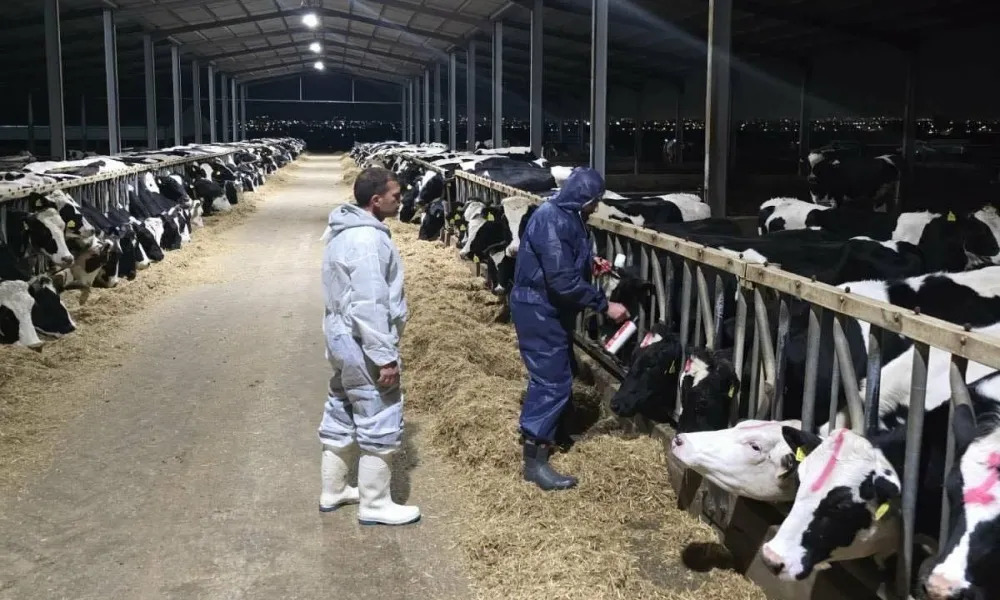
A large-scale vaccination campaign against Foot and Mouth Disease has begun on cattle farms in Aradippou and within a three‑kilometre radius inside the surveillance zone of the infected triangle Oroklini–Livadia–Aradippou. Private veterinarians have been called in to assist after guidance from foreign specialists, and the campaign will gradually expand to other districts.
According to the Ministry of Agriculture, the vaccination plan was activated on Wednesday with the help of private veterinarians who already work with farms in the affected area. The aim is to prevent the spread of the virus to the rest of Cyprus, alongside the culling of approximately 13,000 to 14,000 animals. Two factors made it possible to begin immediately: the arrival of European Commission experts on Tuesday night and the delivery of 10,000 EU‑supplied vaccines from the north the following day.
During a lengthy briefing, foreign experts provided detailed instructions to the veterinarians and presented the vaccination plan for the coming days. The plan will be adjusted as new information emerges. Farmers in Aradippou were informed in advance about the procedures. A ministry source clarified that vaccinated animals will not be culled, stating that “only those already identified and declared positive in the infected area” will be put down. It was also explained that meat consumption will continue after vaccination.
Expansion to other districts
The mobilisation of private veterinarians will continue for an extended period because the vaccination effort will eventually cover all districts. Senior veterinary officer Sotiria Georgiadou said that once vaccinations in the infected area are completed and two to three weeks have passed, the programme will move to other regions. The timeline and allocation of veterinarians are being discussed with the foreign experts. She noted that animals typically develop antibodies within about two weeks.
How the decision was taken
A representative of the Veterinary Association explained that the European Union recommends the immediate culling of herds showing clinical symptoms but allows member states to vaccinate animals within a designated zone to limit the spread of the disease. The decision to begin vaccinating susceptible animals, particularly sheep, goats and cattle, within the three‑kilometre radius was taken late on Tuesday night after the experts arrived and were briefed on the epidemiological situation.
Additional vaccine supplies
Within the week, Cyprus expects the remaining 529,000 vaccine doses ordered by the European Commission. Loading of the vaccines began yesterday, according to a photograph shared by the Ministry of Agriculture. A further 10,000 doses are still pending from the north, out of the 20,000 requested through the bicommunal Health Committee. The virus serotype, Sat‑1, is the same as the one detected in the north, meaning the vaccines provided by the Turkish Cypriot side are suitable.
Culling and disinfection procedures
Georgiadou said that “the positive thing is that we do not yet have new cases from the samples being examined”. So far, 11 livestock units in eastern Larnaca have been affected, with around 14,000 animals to be culled. The culling of cattle has already been completed, totalling 263 animals. Disinfection of the units will follow, along with the destruction of feed and hay. Sheep and goats are next in line. “We are already in Oroklini today. Records and valuations of animals, feed and other products to be destroyed will be carried out and then culling will begin. Burial sites have already been opened,” she said.
When farms can reopen
Regarding whether affected farms must remain closed for a period, Georgiadou said that disinfection and repeated inspections will take place for at least one to two months. Only after further inspections will authorities decide whether owners may reintroduce animals. She added that contamination depends on factors such as humidity levels and pH. Sampling and laboratory testing in the infected area continue daily, and she expressed hope that no new positive results will appear in the next update.