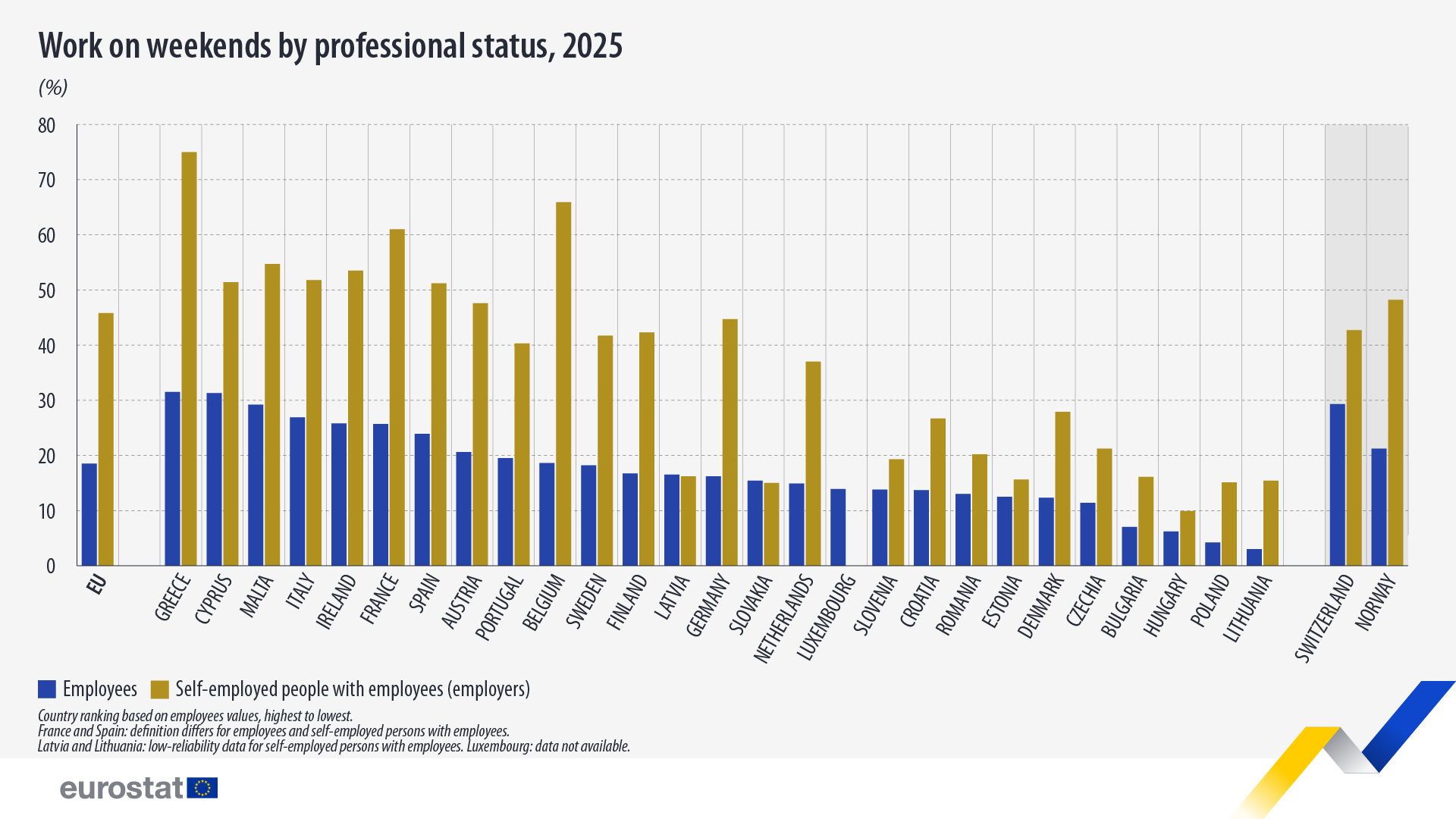
Three in ten Cypriots work during weekends, with the country recording the second‑highest rate in the European Union.
According to data published by Eurostat on 1 May, in 2025, 21.3 per cent of employed people in the EU aged 15 to 64 usually worked on weekends.
Weekend work was most common among employees in services and sales (47.6 per cent), skilled workers in agriculture, forestry and fishing (47.2 per cent), and those in elementary occupations (25.7 per cent).
Only 18.5 per cent of employees usually worked on weekends. By contrast, the rate was significantly higher among the self‑employed, reaching 45.8 per cent for employers, 35.9 per cent for own‑account workers, as well as 45.1 per cent among contributing family workers.
Greece Leads
Among EU countries, Greece recorded the highest share of workers employed on weekends at 31.5 per cent, followed by Cyprus at 31.3 per cent and Malta at 29.2 per cent.
At the other end of the scale, the lowest proportions were recorded in Lithuania (3.0 per cent), Poland (4.2 per cent) and Hungary (6.2 per cent).
For self‑employed workers with employees who work on weekends, Greece again topped the list with 75.0 per cent, followed by Belgium (65.9 per cent) and France (61.0 per cent), while Hungary (9.9 per cent), Slovakia (15.0 per cent) and Poland (15.1 per cent) recorded the lowest shares.