
Three months before the parliamentary elections in May, Cyprus’ political landscape resembles shifting sand rather than stable ground. The first of four polls conducted by Noverna Analytics on behalf of Politis does more than record party balances. It captures a society that is fatigued, sceptical and divided. Voters appear to be seeking change, yet remain unconvinced that existing parties and their leadership can deliver it.
At the centre of the pre-election debate is no longer the Cyprus problem, as historically was the case, but corruption, the economy, transparency and the effective functioning of Parliament. On all these issues, citizens express pronounced distrust.
One in four remains undecided
One of the clearest messages from the survey is uncertainty. In theory, 71% of respondents say they will “definitely” vote. The remaining 29% are hesitant or wavering.
In voting intention, 21.1% state “I will not vote/Undecided”, while an additional 2.9% declined to answer. In simple terms, nearly one in four citizens has yet to make a party choice.
DISY and AKEL
In raw voting intention, DISY leads with 17.5%, followed closely by AKEL at 16.1%. The gap is narrow enough for the contest for first place to remain within the margin of statistical error, and therefore open.
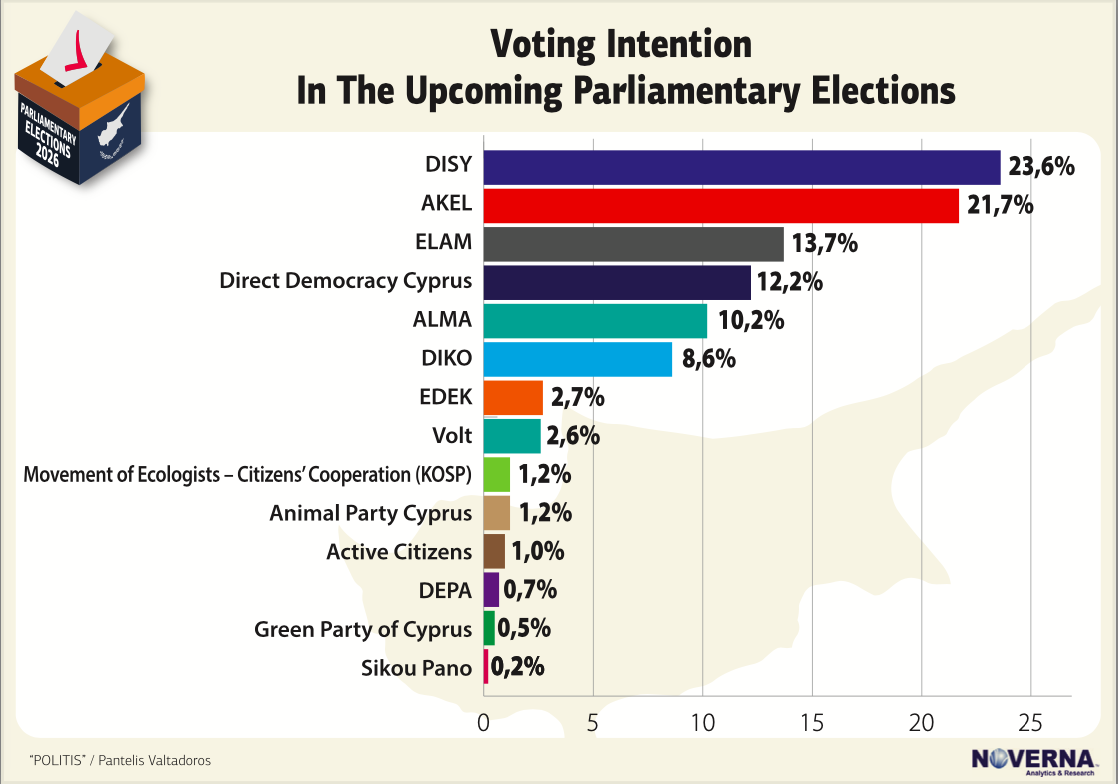
With proportional allocation of undecided voters, a method that is indicative and not predictive, DISY rises to 23.6% and AKEL to 21.7%.
This picture suggests three conclusions:
- First, the two major parties are likely to secure percentages above 20% if these figures hold.
- Second, with such levels, neither party holds a dominant position, whether to shape the election of the Speaker of the House or, more significantly, to lead a presidential candidate into the second round of the 2028 presidential election.
- Third, both record erosion compared to previous electoral cycles. Neither DISY nor AKEL appears close to its 2021 parliamentary performance.
For DISY, the decline reflects the typical wear of a former governing party during a period marked by economic pressures and scandals. For AKEL, the challenge is different. Despite being in opposition, it has not managed to capitalise fully on dissatisfaction with the government.
Both parties also face a broader trend: widespread distrust towards traditional political formations, a phenomenon not confined to Cyprus but visible across Europe.
ELAM as a third pole
ELAM records 10.2% in raw voting intention, rising to 13.7% with proportional allocation. It is no longer a marginal force and appears to be consolidating as the third party. However, it does not display the momentum indicated by some previous polls, as it seems to be losing ground to two new parties, Direct Democracy and Alma.
Its base remains largely centred on the migration issue. Seventy per cent of its voters cite migration as their primary criterion, despite the fact that migrant flows have declined significantly over the past two years.
As long as a segment of citizens, even if inaccurately, perceives migration as the country’s most pressing issue, ELAM is likely to retain notable support. Its rise does not necessarily reflect endorsement of a broader economic or social vision, but rather anxiety around security, identity and social cohesion.
A fragmented centre
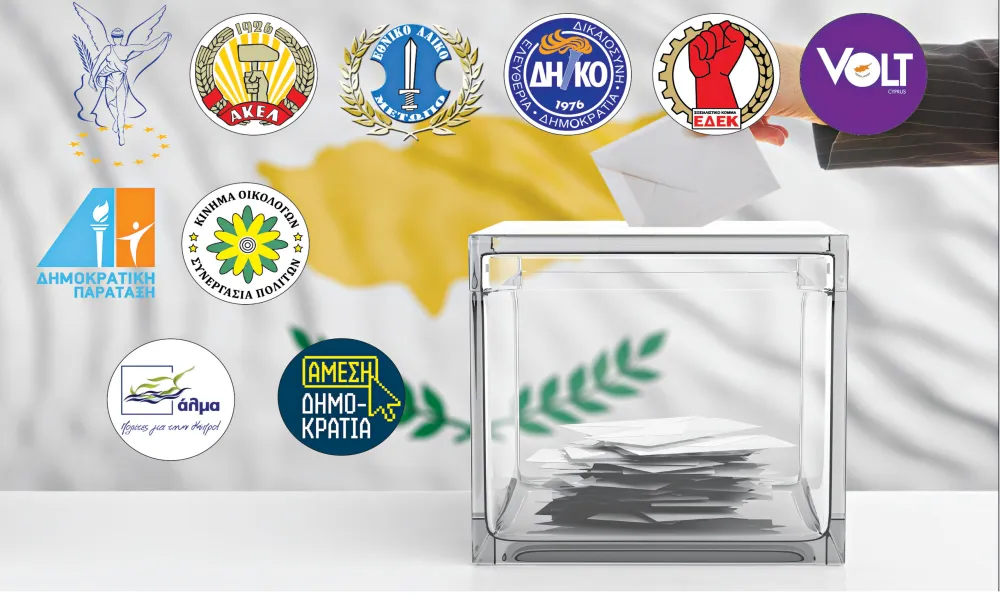
The intermediate political space appears heavily fragmented, particularly with the emergence of Alma and Direct Democracy. DIKO shows reduced percentages, while EDEK, the Greens and DIPA record dramatic declines, with the latter three at serious risk of failing to enter Parliament.
Current polling figures show:
- Direct Democracy: 9.1%
- Alma: 7.6%
- DIKO: 6.4%
- VOLT: 1.9%
- EDEK: 2%
- Greens: 0.9%
- DIPA: 0.5%
In the 2021 parliamentary elections, DIKO, EDEK, the Greens and DIPA together secured 28.5% and 20 of the 56 seats in the House. Today, based on this measurement, they do not appear to exceed 10%.
If Alma, Direct Democracy and VOLT, also considered centrist formations, are included, the broader centrist space remains close to 29%. The difference lies in its lack of cohesion.
A mosaic of parties, combined with the weakening of the two largest forces, makes a Parliament without clear majorities highly probable, where alliances would be necessary and potentially fragile.
Who can deliver change?
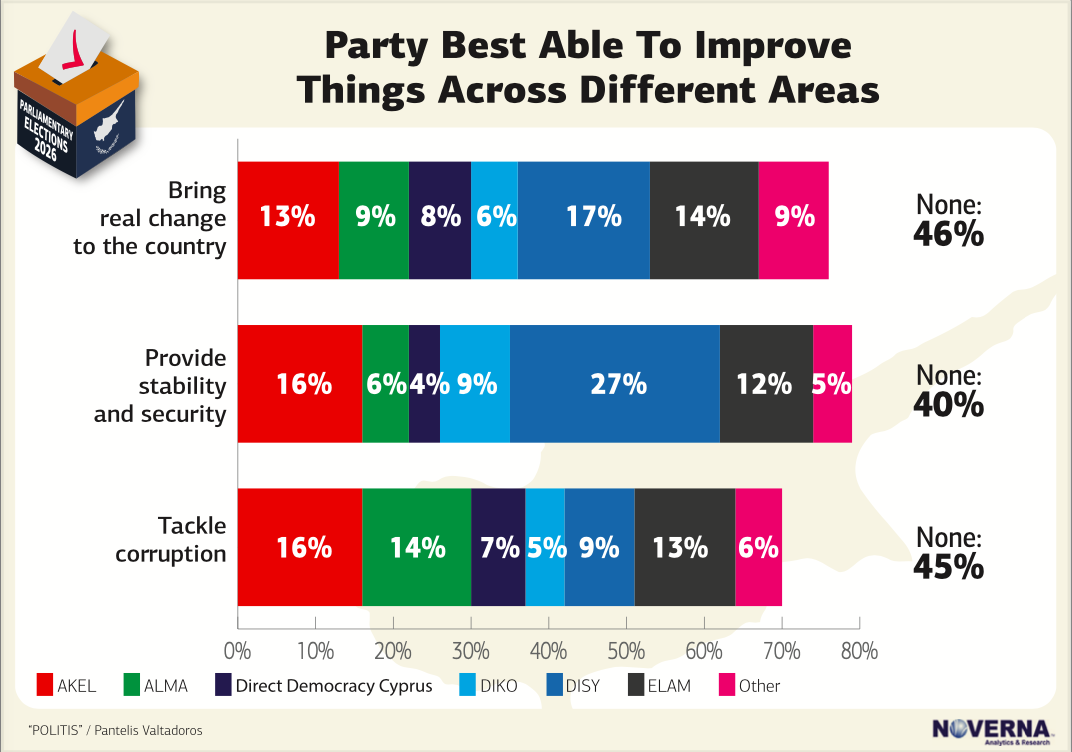
On the question of which party can bring meaningful change, 46% respond “none”. Among those who select a party, levels of trust remain modest:
- DISY: 17%
- ELAM: 14%
- AKEL: 13%
- Alma: 9%
- Direct Democracy: 8%
- DIKO: 6%
Nearly half of citizens believe the party system lacks either the will or the capacity to transform the country.
Stability and security
On stability and security, DISY leads with 27%, followed by AKEL at 16% and ELAM at 12%. Yet 40% respond “none”, indicating that even in an area traditionally associated with the centre-right, confidence remains limited.
Addressing corruption
The most striking finding may concern corruption. Forty-five per cent of respondents state that “no party can address corruption”, including parties that place anti-corruption at the centre of their narrative.
Among those selecting a party, AKEL leads with 16%, followed by Alma at 14%, ELAM at 13% and DISY at 9%.
What kind of Parliament do citizens want?
On the composition of Parliament:
- 49% prefer a House with many parties and fewer MPs each, offering more alternatives. This preference is stronger among younger generations.
- 46% favour a clear majority of fewer parties for easier law-making, a scenario preferred by older voters.
- 5% are indifferent.
Society appears divided between pluralism and governability. Younger voters aged 18 to 34 lean towards pluralism, while those over 65 favour clearer majorities.
What will ultimately decide the elections?
The data suggest that May’s ballot will not be shaped primarily by traditional ideological divides but by three key areas:
- Corruption: 84% say it plays a major role in determining their vote.
- Economy: 82% consider it decisive for their standard of living.
- Social policy and migration: 70% regard them as highly significant for daily life.
The Cyprus problem remains important, particularly for AKEL and DISY voters, but it does not dominate the broader agenda.
The political wager of May
The poll indicates that the upcoming elections will not simply be a contest between parties but a test of trust and persuasion. Society is clearly asking for:
- Clear policies
- Credible economic solutions
- Fewer scandals
- Greater accountability
At present, voters have not determined which parties can meet these demands. The two major parties retain the largest shares despite losses, yet without their former dominance. Traditional centrist parties, with the partial exception of DIKO, appear to be contracting sharply.
Attention now turns to the trajectory of Direct Democracy and Alma. Should they convince voters of their capacity to respond to public expectations, their support may increase further in the coming months.
If May resembles a political referendum, the core question may not be who wins the election, but whether the political system itself can regain public trust.
Survey identity
Conducted by: Noverna Analytics & Research, member of SEDEAK and ESOMAR, on behalf of the newspaper Politis
Sample and methodology: 1,051 interviews with a representative sample of the voting population in the government-controlled areas eligible to vote in the upcoming parliamentary elections, using random sampling
Interview method: Structured questionnaire with telephone interviews via CATI (Computer Assisted Telephone Interviewing)
Polling dates: 25 January – 9 February
Weighting: The sample was weighted according to the demographic profile of the electorate
Maximum margin of statistical error: ±2.7% at a 95% confidence level