Another difficult year is expected in the energy “Middle Ages” that Cyprus continues to experience. While the maximum electricity demand curves show increases again this year – reaching 1,450 MW under extreme summer weather conditions according to long-term projections by the Transmission System Operator – the energy sector remains stagnant, as generation capacity has neither increased compared with last year nor is it expected to increase in the coming years, unless the private diesel‑powered plant at Vasilikos comes into operation.
A serious failure in the conventional generation units is very likely to lead to a widespread blackout, meaning inconvenience for households and damage to businesses. The outlook is equally unfavourable for the coming years up to 2030, as demand continues to rise, with projections reaching 1,600 MW under extreme summer conditions – far from unrealistic for Cyprus, which lies in a climate change “hot spot.”
The detailed reasons behind this pessimistic scenario are as follows:
1. The natural gas infrastructure remains stuck due to the collapsed contract and the Technip expert studies, which are still being evaluated by ETYFA (Natural Gas Infrastructure Company) in hopes of finding a way for the project to continue. The earliest possible date for the LNG terminal to operate – considering the bidding process and all required procedures – is 2030.
2. The June deadline (also stipulated in the Cyprus Energy Regulatory Authority, CERA’s licence) for completing the central energy storage project under the TSO will be missed, with the most optimistic scenario pushing completion to the end of 2026. This estimate does not include any potential appeal before the Tenders Review Authority. According to Politis sources, bids from four companies are still being evaluated, while the TSO’s 2026 budget has not yet been approved by Parliament – preventing the release of €41 million needed for the project. Meanwhile, this amount is insufficient compared with three of the four bids received.
The bids themselves show extreme discrepancies: one bid for all three storage units to be installed at EAC (electricity authority) substations comes to just €1.7 million, while the other three – one from telecoms company CyTA, one from a Cyprus company of Chinese interests, and one from a Chinese consortium – range from €48.5 million to €52.5 million. The TSO still hopes the project can be ready by July.
It should be recalled that the state chose not to open the central storage system to tenders, even though the private sector might have proceeded much earlier – an assumption now confirmed. The government secured a derogation from the EU to allow state‑owned storage, as energy storage is considered a competitive activity in Europe and EU directives explicitly prohibit TSOs from owning, developing, managing or operating storage facilities.
The restriction aims to prevent market distortion, safeguard fair access and ensure proper separation between regulation and business operations. A derogation may only be granted if the country follows an open, transparent and non‑discriminatory tendering process and only if no interest is shown in providing reliable central storage services at a reasonable cost and in time. This was not the case in Cyprus.
In addition, the operational framework for the central storage units – where private Renewable Energy Sources (RES) producers would store surplus energy instead of discarding it – has yet to be finalised.
3. Even the most advanced private energy‑storage projects are awaiting final terms from the TSO. Companies speak of “unbelievable bureaucracy” leading them to conclude that the delays are merely excuses and that, in reality, what is being attempted is protectionism of the EAC, which also secured storage licences. By the end of 2025, preliminary connection terms had been issued for 231 MW and 570 MWh of storage (eight applicants), while the TSO was drafting preliminary terms for an additional 456 MW and 1,655 MWh (21 applicants).
4. Nothing has changed in electricity generation that would increase supply. EAC’s 6th unit at Vasilikos remains offline because it can operate only on natural gas. The same applies to Cyfield’s unit, which also remains inactive.
5. Electricity prices remain high, and participants in the competitive market – launched five months ago – fear that consumers are unlikely to see reductions, and increases may be ahead.
6. The new EAC units at the Dhekelia power station, which were supposed to operate by mid‑2028 (given that the ageing and polluting units must shut by 2029), will not operate before 2030. As the EAC chairman told Parliament’s Finance Committee last week, Siemens – the contractor – recently informed the organisation that delivery will be delayed by a further 18 months.
7. As for the GSI electricity interconnector – which would absorb excess RES production and resolve energy security problems due to Cyprus’ isolated grid – it has been “frozen” despite public statements to the contrary, and no one knows where the project currently stands.
A thorn‑filled path to decarbonisation
The year 2025 was a landmark year for electricity generation from RES in Cyprus. The country recorded a new high in solar‑energy penetration, ranking second in the EU.
RES penetration in the electricity mix is estimated to have reached 25–26% (official 2025 data from the TSO are not yet available), with solar energy accounting for 24.6% of total generation. Meanwhile, gross final energy consumption from RES rose to around 21–22%.
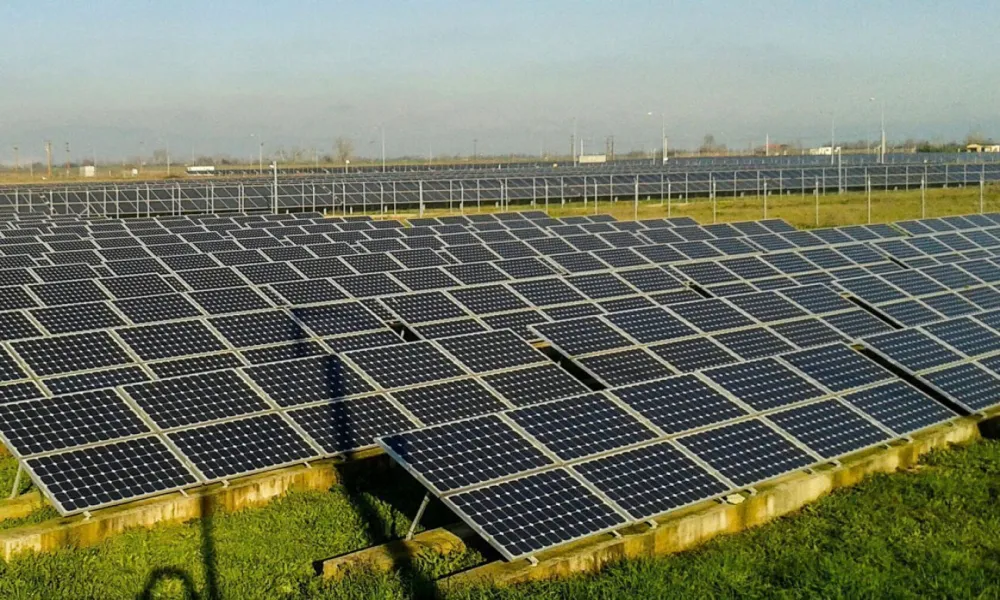
In 2025, approximately 122 MW of new solar capacity was added, bringing total installed photovoltaic capacity to 957 MW, including large parks and household systems. To illustrate the scale of investment interest, the Environment Department is currently examining applications for photovoltaic parks exceeding 450 MW.
Curtailments above 50%
Because the network is unable to absorb all production – and combined with the absence of storage – 2025 recorded a negative all‑time record for curtailments. Approximately 47–48% of green energy – equivalent to 306 GWh, enough to power 50,000 households – was lost for system‑stability reasons. For 2026, excess RES electricity is expected to rise further, surpassing 50%.
Under the revised National Energy and Climate Plan (NECP) 2021–2030, the national target for RES share in gross final energy consumption has increased to 32%, with similar levels expected for RES penetration in electricity generation.
Given current RES levels and high investment interest in new photovoltaic projects, Cyprus could meet its European targets – but only under certain conditions, and with environmental trade‑offs, as the countryside is increasingly covered by solar parks.
Storage and grid
However, two major problems persist:
• storage projects – both public and private – are not moving forward, as previously described, and
• difficulties in connecting new RES parks to the grid continue, because there is either no available capacity or insufficient infrastructure at nearby substations and transmission lines.
According to the EAC, there are completed photovoltaic parks that cannot be connected – mainly in rural areas of Nicosia and Larnaca districts, but also in parts of Famagusta and Limassol – where the distribution network has reached its technical limits.
Grid infrastructure projects
The EAC says that among the infrastructure projects currently being promoted, those relating to strengthening and upgrading the transmission network are of particular importance. Their aim is to enable the grid to absorb larger quantities of RES energy while improving system stability and reliability. The projects include upgrades of existing transmission lines, construction of new substations, and creation of new connections between critical points of the system – either through underground cables or overhead lines.
A major issue for electricity supply in Nicosia district will also be resolved by the new Transmission Substation to be installed at the Vasilikos Power Station site, west of the existing “Central Vasilikos” substation. All necessary permits have been secured and the tender for building construction has been awarded. The project is expected to be completed and operational in early 2027, according to the EAC. Given that the Dhekelia station will not be modernised with new units before 2030, the construction of this project will provide alternative solutions in the event of a failure at Dhekelia – a common occurrence, especially in summer.
Cyfield on diesel
Another significant project that will provide some relief before 2030 is the modification of the private Cyfield power station to run on diesel. The proposal submitted by Cyfield together with Energean to bring Israeli natural gas to Cyprus via pipeline was rejected by the government, as suggested by statements made by the Energy Minister in Parliament. According to our information, the conversion is progressing, and the 260 MW plant could possibly come into operation this summer.