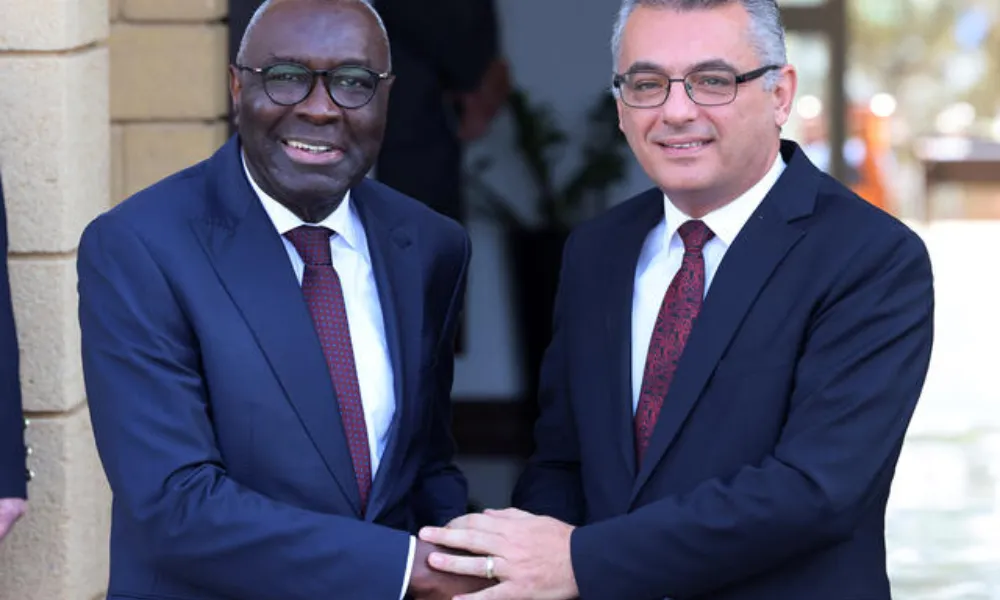
There is no consensus on a settlement model for the Cyprus problem, and media interpretations on both sides regarding UN Security Council resolutions are misleading, Turkish Cypriot leader Tufan Erhürman said on Friday. He stressed, however, that both before and after the elections, in Ankara and during his contacts in Cyprus, he has consistently focused on political equality, which he described as the first pillar of his proposed negotiation methodology, linking it directly to the issue of a rotating presidency.
Speaking after the second meeting of the so-called “political council” in the north, which lasted around two hours, Erhürman said discussions covered a range of issues in four stages: the substance of a settlement, confidence-building measures, a ten-point package he has presented, and a fourth package of proposals tabled by President Nikos Christodoulides during the trilateral meeting.
He said he has not yet responded to President Christodoulides’ proposals, which were discussed during the meeting attended by the leaders of the CTP, RCTP, DP and KP parties, as well as the YKP and TDP, which are not represented in the parliament.
Political equality as the starting point
On the first issue, Erhürman referred to the four-point methodology he said he has been advocating for the past three years.
“When our people gave me a mandate, they did so knowing that I would go to the table with these four points,” he said. “They knew that the first of these is political equality. Since taking office, both during my visits to Turkey and after returning here, I have consistently underlined these four points.”
He noted that the concept of political equality was once again included in the joint statement issued after the trilateral meeting, but cautioned against misinterpretation.
“I want to state clearly once again that political equality, as mentioned in the joint statement, does not mean that the first point has been completed,” he said. “For the first point to be completed, the rotating presidency must also be accepted.”
According to Erhürman, the process is currently only halfway through the first pillar of the four-point methodology. “We are still at the stage of political equality,” he said, adding that no discussion or conclusion has been reached on the settlement model.
“Our position is clear,” he said. “What is referred to as the settlement model is the substance of the issue. We have repeatedly stated throughout this process that we will not discuss anything related to substance until the methodology is completed.”
No agreement on the model of solution
As a result, Erhürman said, there is no agreement between the sides on the model of a solution. He criticised what he described as selective references to UN Security Council resolutions in both Greek Cypriot and Turkish Cypriot media, which are often interpreted as confirmation of a federal solution.
“This is not correct,” he said. “If one reads the relevant passages carefully, it becomes clear that the Security Council resolutions refer only to political equality. Political equality is already the number one element of our methodology and is known to everyone. It is not something new.”
He added that there would be no move to the second stage of the methodology until the remaining part of the first stage, including the rotating presidency, is addressed.
Prospects for a new informal 5+1 meeting
Asked about a possible new informal 5+1 meeting, Erhürman said it would not serve either side’s interests to hold such a high-level meeting without tangible results, even on relatively simple issues.
“If there is to be a third informal 5+1 meeting, I believe it should take place only after certain agreements have been reached in Nicosia,” he said.
He added that expectations now centre on the return of the UN Secretary-General’s Personal Envoy, María Ángela Holguín, to the island in late January, at which point progress made up to that stage would be assessed.
“If some matters can be finalised during these meetings, then of course we can move towards a 5+1 format to announce certain outcomes,” he said, stressing that he is not opposed to such a meeting, but believes it must be results-oriented.
No external pressure, Erhürman says
Asked whether pressure could come from Israel, Erhürman said he could not speak on behalf of other parties but insisted that no form of pressure could be exerted on his side.
“I know that my people are calm,” he said. “What I said before the elections, I will do after the elections. There is talk about Israel and the United States, but I have no information on this.”
He also referred to reports about a potential Cyprus–Israel–Greece rapid reaction force in the eastern Mediterranean, saying he was closely monitoring developments. He pointed to statements by Defence Minister Vasilis Palmas indicating that such reports do not reflect reality.
“We are following these developments very closely,” Erhürman said.
Source: CNA