By Rafaella Spanou
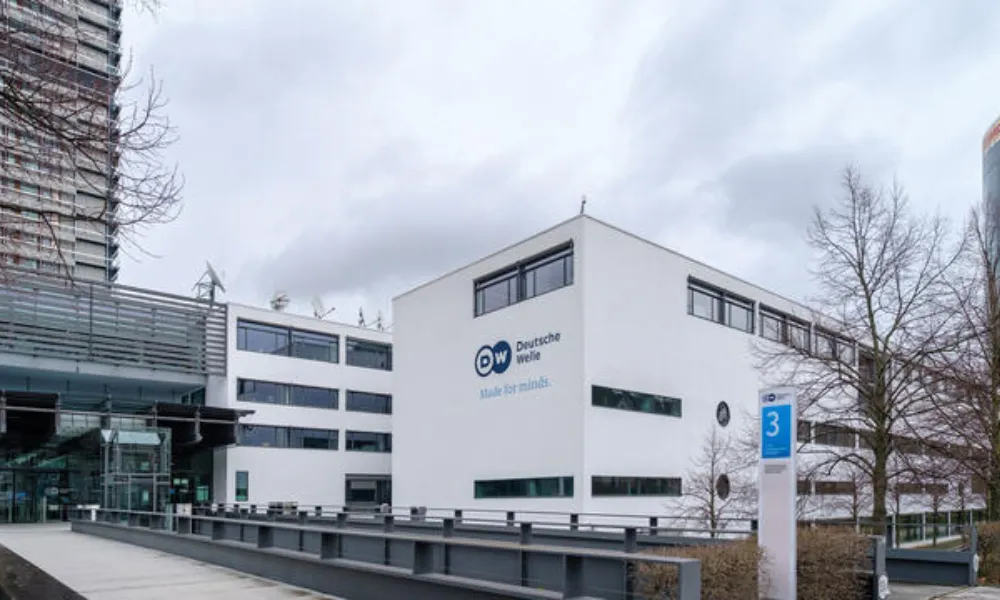
After 62 years of contribution to impartial reporting, the Greek service of the German international broadcaster Deutsche Welle is set to close following a decision by the organisation. The move has drawn criticism, particularly because of the service’s growing presence and relevance in Cyprus at a critical time for the region.
Reactions have followed the decision by Deutsche Welle to shut down its Greek department after 62 consecutive years of continuous reporting. The decision was announced in February, with the broadcaster planning to discontinue the Greek-language service on 1 January 2027 for “financial reasons”, following a reduction in federal funding for 2026.
The required savings of €21 million have led to mergers between departments and the elimination of positions expected to affect around 160 people, although the service has stated that “there will be no layoffs”. Specifically, the German government decided to reduce the subsidy to the public broadcaster by €10 million, bringing the total budget down to €415 million.
With this development, the Greek service is not the only one affected, but it is the only department scheduled to close entirely. Deutsche Welle currently offers its services in 32 languages.
Not a unanimous decision
Sources told Politis that the decision to reduce the overall budget was supported by the governing Christian Democratic party in parliament. However, the decisive step regarding the Greek-language programme was taken by the Broadcasting Council and the group’s administrative board.
According to the same sources, the decision was not unanimous.
The Greek-language service is considered one of the most successful in Europe, particularly in its digital transition, reaching between four and six million users each month. Its activity also extends beyond its own platform, as a network of contributors and correspondents provides coverage of European and German news in Greek, while also reporting on developments in Greece and Cyprus in English and German.
No evaluation conducted
The impact in Cyprus appears to be deeper than in Greece, as the service’s closure means the loss of a news source in what sources described as “a very critical region for Europe”, at a time of significant geopolitical developments and domestic political activity.
What is particularly notable, according to the same sources, is that no substantial internal evaluation was carried out by Deutsche Welle before the decision was taken. The organisation reportedly was not even aware that the programme was broadcasting in Cyprus.
This is reflected in the explanatory note issued by the broadcaster regarding the closure of the service, in which Cyprus is not mentioned at all. This omission is striking given that the Greek programme of Deutsche Welle maintains important collaborations with several local media outlets, including Politis.
The expansion to the Cypriot audience had been a deliberate strategy of the programme and a long-standing objective that was achieved only recently and continues to develop through new partnerships.
The decision was described as “sudden” and is expected to affect around 200 people in practice. The assurances that no layoffs will occur may not fully apply, since the Greek-language programme relies heavily on external collaborators and staff employed on fixed-term contracts that are periodically renewed and will not continue.
Efforts to reverse the decision
The situation may still change, as the federal budget will not be finalised until December 2026, while the broader outlook is expected to become clearer by the summer.
The decision has triggered strong reactions at both political and social levels. Several Greek-German organisations and official bodies in Germany, Greece and Cyprus have expressed dissatisfaction and solidarity.
Journalistic organisations such as the Athens Journalists’ Union (ESIEA), the Cyprus Union of Journalists (ESK), as well as other Greek and German media outlets, have voiced concern about the potential impact on public information.
At the same time, the President of the House of Representatives, Annita Demetriou, issued a statement expressing concern and calling for the decision to be reconsidered. Such a choice, she said, “constitutes a downgrading of the official language of two Member States of the European Union, undermining the linguistic and cultural diversity of the European project”.
These concerns are placing pressure on both the government and the broadcaster in the hope that the discussion will reopen, either at parliamentary level through a revision of the funding reduction, or internally through a different allocation of resources. According to the sources cited by Politis, the total budget of the Greek-language programme accounts for just 0.2% of the broadcaster’s overall budget.
According to Deutsche Welle’s official statement, the reasoning behind the decision is that Greece has been a member of the European Union for many years and is considered “a stable democracy with a pluralistic media landscape”, meaning the need for the service is viewed as secondary.
By contrast, the broadcaster said countries such as Russia and Iran currently have a greater need for independent reporting, and the organisation intends to focus its resources there.
A long history during difficult periods
The Greek-language service of Deutsche Welle has a long and significant history in independent reporting. During the military dictatorship in Greece between 1967 and 1974, it was one of the few radio stations broadcasting objective news, helping to break through the censorship of the period.
What is certain is that the decision has generated reactions on many levels, with organisations warning that it may harm journalism in the region and potentially affect Greek-German relations, as well as the lives of hundreds of journalists associated with the programme.
“As long as there are reactions, there is hope,” sources told Politis.