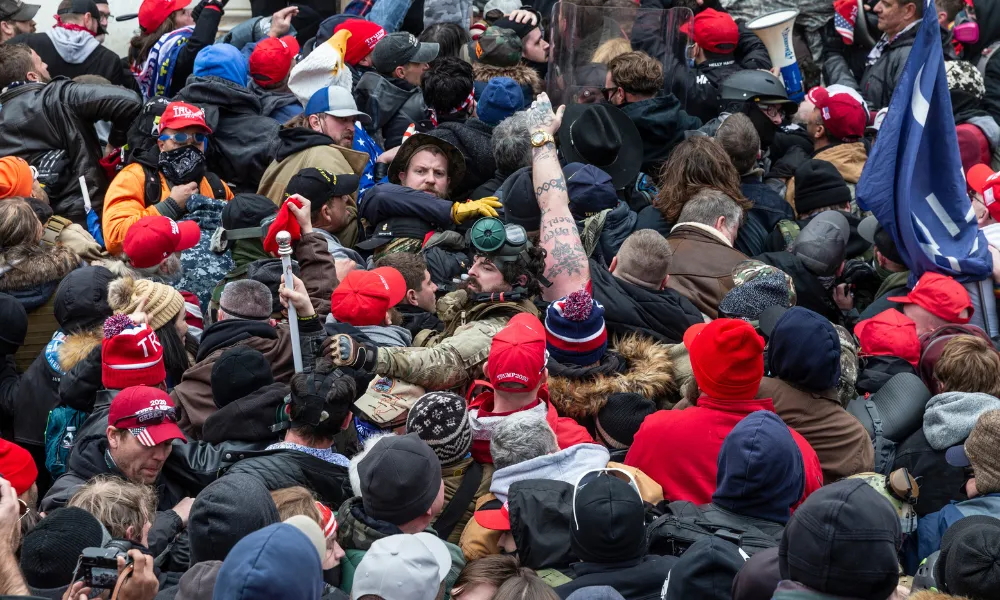
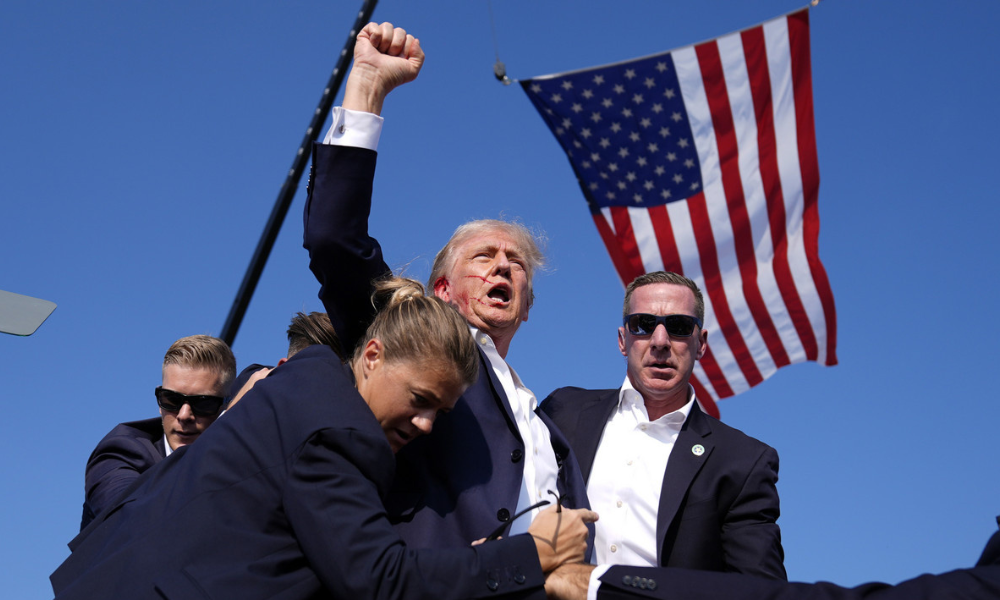
On the 13th of July 2024, a gunman opened fire at a campaign rally in Butler, Pennsylvania, grazing Donald Trump's ear and killing one bystander, Corey Comperatore. Less than two months later, on 15 September 2024, Ryan Wesley Routh hid in shrubbery outside Trump's West Palm Beach golf course armed with a rifle, waiting for the then-candidate to reach the sixth hole. A Secret Service agent spotted him first, fired several rounds, and Routh fled before getting off a shot. He was convicted and sentenced to life in prison in February 2026. Then, on the evening of 25 April 2026, a 31-year-old man from California named Cole Tomas Allen opened fire near a Secret Service checkpoint at the Washington Hilton, where Trump, Melania Trump, Vice President JD Vance, and members of the Cabinet were attending the White House Correspondents' Dinner. Allen, who had been staying at the hotel and described himself in writings as the "Friendly Federal Assassin," charged the security screening area armed with multiple weapons before being subdued and arrested. One Secret Service officer was struck but saved by a bullet-resistant vest. It was the third time in less than two years that an armed individual had attempted to kill a sitting or former American president, and it happened at the same hotel where John Hinckley Jr. shot Ronald Reagan in 1981.
A minority pathology
Political violence in Western democracies has never followed a single pattern, but it has followed a direction. In the 1960s and 1970s, it was overwhelmingly the work of disciplined, ideologically rigid organisations: the Weather Underground in the United States, the Red Brigades in Italy, Baader-Meinhof in West Germany. These groups recruited members away from mainstream life, deepened ideological immersion, and struck at symbols of state power. Violence was a minority pathology, and the late 1970s data reflects this: only 6% of Americans said they could justify violence for political goals, according to Carnegie Endowment research.
By the 1980s and through to the 2010s, the ideological centre of gravity shifted rightward. Far-right militia groups, white supremacist organisations, and anti-abortion extremists became the dominant source of political violence in the United States. But the fringe remained fringe: committed, isolated, and socially stigmatised. Then something shifted again. Carnegie Senior Fellow Rachel Kleinfeld, writing in the Journal of Democracy, identified a structural break beginning around 2016. Perpetrators were no longer the radicalised loner, they were middle-aged, employed, married, with children.
Today, most political violence in the United States is committed by people who belong to no formal organisation, according to the Global Terrorism Database maintained by START at the University of Maryland. The Journal of Peace Research describes this as the defining challenge of the current moment where violence has "ungrouped". It no longer requires infrastructure but only a grievance, a screen, and a community of tacit endorsement.
A security threat
The most consistent finding in recent academic literature is the relationship between affective political polarisation and political violence. Affective polarisation, the intensity of hostility toward the opposing political camp, distinct from disagreement on policy, has been shown to be among the strongest predictors of willingness to endorse or commit violence. Penn State political scientist James Piazza, in a 2023 study published in Security Studies, surveyed nearly 1,900 Americans and analysed data from 83 democracies. According to his findings, Republicans who expressed strong aversion toward Democrats were 18% more likely to support political violence. Democrats with equivalent aversion toward Republicans were 8% more likely. Across all 83 democracies, high affective polarisation made a country 34% more likely to experience frequent political violence.
The mechanism works through dehumanisation, moral zero-sum framing, and group mobilisation. A 2025 special issue of the Journal of Peace Research on political violence in democracies reinforces this idea, showing that public disapproval of violence collapses when the perpetrator belongs to the observer's own political tribe.
Alarming Numbers
Longitudinal survey data from the University of California Davis, spanning 2022 to 2024 and published in Injury Epidemiology, provides the sharpest picture of where public attitudes actually stand. In 2022, 32.8% of a nationally representative American sample said violence was usually or always justified to advance at least one of 17 specified political objectives. That figure fell to 25.3% in 2023, a non-election year, but by 2024 it had not declined further, sitting at 26.2%. The researchers had expected an election-year spike. Instead, they found entrenchment. Threats against members of Congress reached 9,474 in 2024, a tenfold increase over nine years. The FBI recorded a 357% rise in domestic terrorism cases between 2013 and 2021.
Princeton University's Bridging Divides Initiative, tracking threats against local officials, recorded more than 600 incidents in 2024 alone, a 10% increase from 2023, with women and minority officials disproportionately targeted. Their 2025 report identifies a growing share of vigilante violence: extrajudicial acts by unaffiliated individuals, requiring no organisational structure, primarily targeting Black, Jewish, Arab, Muslim, and LGBTQ+ communities.
De-escalated political violence
Across five decades, a handful of interventions have shown consistent results. Elite norm enforcement is the most powerful, when prominent political figures across party lines explicitly and repeatedly delegitimise violence, it declines. When they equivocate, it spreads. Kleinfeld's 2024 Journal of Democracy analysis of countries that have de-escalated political violence, including Colombia, South Africa, and Northern Ireland, identifies elite norm reinforcement as the single most consistent factor. Rhetoric is not peripheral to the problem. It is central to it.
Princeton's BDI found that anti-LGBTQ+ groups who caused widespread confrontation at Pride events in 2023 had their impact substantially blunted in 2024 through advance scenario planning and information-sharing between organisers, businesses, and local authorities. Early warning infrastructure was the differentiating factor. Research from The Hague Institute for Global Justice further distinguishes between access to education, which does not on its own reduce radicalisation risk, and quality of education that builds critical thinking and civic engagement from a young age.
Finally, accountability functions as a deterrent only when applied consistently. Carnegie Endowment research on civic space documents that impunity is among the most reliable predictors of escalation. Where perpetrators face no consequences, violence normalises. Where legal accountability is selective or politicised, it loses deterrent force entirely.
Polarisation
Five decades of evidence converge on a set of uncomfortable conclusions. Political violence requires weak norms to flourish. The profile of those willing to use or endorse it has expanded well beyond any fringe. Its ungrouping renders traditional counter-terrorism tools increasingly insufficient. And polarisation is a measurable security threat, with a direct, documented relationship to the frequency and severity of violence in democracies. The lesson history offers is not reassuring: every era that treated political violence as a marginal or manageable problem paid a price when it proved to be neither.
Sources: