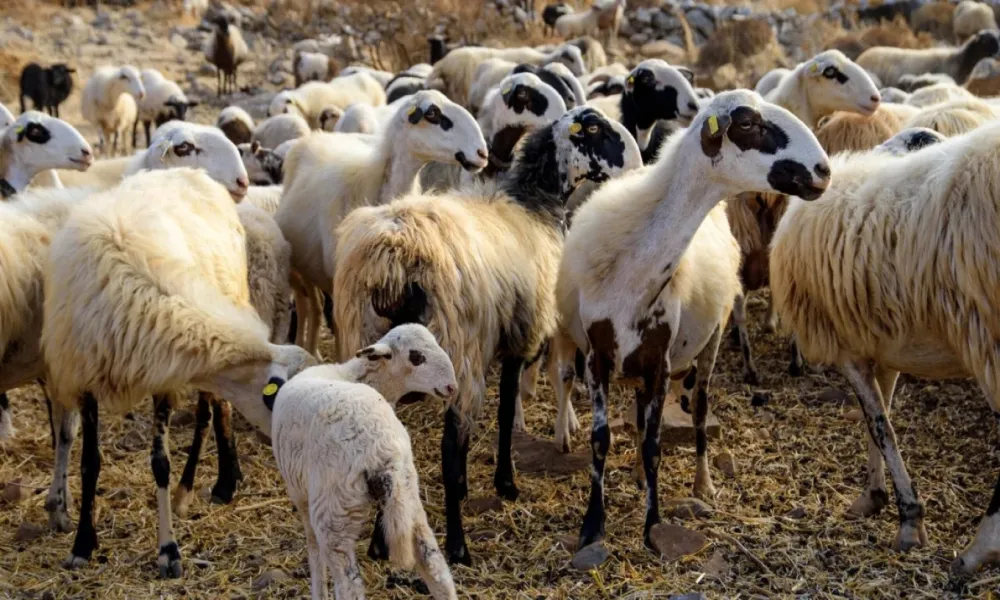
Efforts to contain Foot-and-mouth disease across Cyprus are increasingly exposing the core divisions of the Cyprus problem, as talks between Greek Cypriot and Turkish Cypriot veterinarians progress slowly while the virus spreads rapidly through livestock units in the south of the island.
Cases have now been recorded in pig farms, while culling in areas under the control of the Republic of Cyprus has exceeded 9% of the animal population. The risk of gradual infection across the entire island is now considered real.
The long-standing inability of Greek Cypriot and Turkish Cypriot leaderships to reach a political settlement has left Cyprus effectively divided - with the internationally recognised Republic of Cyprus in the south and a breakaway administration in the north backed by Turkey. As a result, different laws and measures are applied within a single geographic space.
However, issues such as foot-and-mouth disease cannot be resolved through unilateral action. Even if the virus is contained in the south, there is a strong likelihood it could re-emerge due to its presence in the north - and vice versa. The division of the island offers no real protection for its livestock.
European protocol
Cyprus joined the European Union on 1 May 2004, and the entire island is considered EU territory. However, under Protocol No. 10 of the 2003 Accession Treaty, EU law is suspended in areas not under the effective control of the Republic of Cyprus.
This creates a structural gap - the Republic is obliged to implement EU protocols for tackling foot-and-mouth disease but cannot ensure similar measures are applied in the north.
The issue has been discussed within the bicommunal Technical Committee on Health, which has met at least four times since the first case was detected in the north last December. While veterinarians from both sides exchange information and data, they ultimately operate within separate frameworks shaped by the island’s political division.
Culling dispute
Following the outbreak in the north, the Turkish Cypriot side received vaccines from the EU and proceeded with inoculations. However, it has refused to implement the EU protocol requiring culling in infected units.
Talks are ongoing within a veterinary subcommittee under the Technical Committee on Health, where a unified policy was first formally raised on 17 March. The Turkish Cypriot side initially rejected the proposal but later signalled it would respond after internal consultations.
Delays prompted Greek Cypriot co-chair Leonidas Phylaktou to request a new meeting date, which has now been set for 30 April. It remains unclear whether agreement on culling will be reached.
Diverging positions
The Greek Cypriot side insists that a unified response based on EU protocols is the most effective approach, noting that this is standard practice in developed countries.
The Turkish Cypriot side, however, maintains that the outbreak has not spread beyond its initial location in the Famagusta district village of Lapathos and argues that vaccination has successfully contained the virus. It also points to similar approaches used in parts of Latin America and the Middle East.
Crucially, it stresses that it is not bound by EU law and highlights the economic implications of stricter measures. Turkish Cypriot farmers export meat to Turkey and some Arab countries, and any disruption could have significant financial consequences.
Isolation remains a key concern. The north is recognised only by Turkey, with ports and airports closed to international traffic, limiting trade routes. This creates practical obstacles to culling, as replacing livestock or importing meat to cover shortages is difficult.
Commission stance
According to sources, the European Commission is prepared to support the Turkish Cypriot community if it adopts the EU protocol, including compensation for affected farmers.
Brussels views the EU framework as the only viable solution and believes time is working against Cyprus, with the outbreak worsening. Any delay in decision-making risks escalating the crisis.
No clear solution
However, there is still no clear plan for how the Turkish Cypriot side would replenish livestock or cover meat shortages. Reliance on imports from Turkey - where foot-and-mouth disease is also present - raises concerns about reintroducing the virus.
By contrast, the Republic of Cyprus has access to international markets, allowing it to import livestock and meat, stabilise supply and maintain prices while implementing EU measures.
For a unified approach to work, similar provisions would need to be found for the Turkish Cypriot side - otherwise any agreement risks creating new economic pressures.
Clashing narratives
Efforts to establish a common policy face deeper political obstacles. The two sides approach the Cyprus issue with fundamentally different narratives and sensitivities.
Greek Cypriots fear that cooperation could imply recognition of a separate state in the north and therefore favour solutions involving ports under Republic of Cyprus control - or arrangements involving both the EU and Turkey.
Turkish Cypriots, meanwhile, seek greater international recognition and resist policies that reinforce their isolation or perceived illegitimacy. This makes agreement on measures that reflect the current political reality more difficult.
With no comprehensive settlement in sight and the virus continuing to spread, both sides face mounting pressure to find an immediate, pragmatic solution.
Without a mutually acceptable compromise, the outbreak risks devastating livestock across the island and inflicting serious economic damage on farmers in both communities.