The tensions at the Deputy Ministry of Culture did not emerge overnight, nor are the warning signs new. Delays affecting cultural programmes and complaints about the ministry’s administration had surfaced months before last week’s staff walkout.
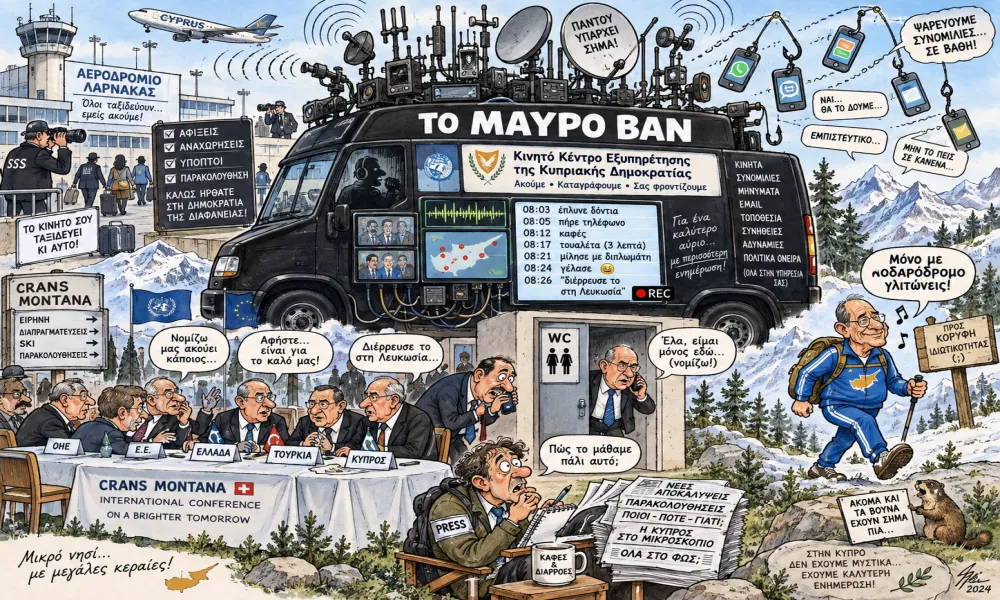
Yet that troubled picture is not reflected with the same clarity on the government’s Diakivernisi monitoring platform, promoted by Deputy Minister to the President Irene Piki as a tool showing progress on government commitments.
For the Deputy Ministry of Culture, the platform presents only two interventions for 2026: the Cultural Programme of the Cyprus Presidency of the Council of the EU, listed as completed, and the Cultural Diplomacy Strategy, shown as proceeding according to schedule.
The ministry’s 2026 Annual Action Plan, however, contains considerably more.
Projects absent from the platform
Among other commitments, the annual plan provides for completion of an Artists’ Register and an Artists’ Grant, elements of the long-awaited framework commonly referred to as the status of the artist.
It also provides for upgrading cultural grant schemes.
That process has itself faced delays. Changes to the evaluation committees for POLITISMOS III took so long that approximately half a year of cultural activity was affected.
Director-General Giorgos Papageorgiou publicly accepted personal responsibility for that situation in statements to both Parathyro and Astra radio.
The annual plan also provides for Cultural Development Programme Agreements with municipalities to progress by the end of the year.
Questions also remain over an earlier announcement by President Nikos Christodoulides concerning the Nicosia Municipal Theatre, an issue that has been raised repeatedly during the year, including at the presentation of the Nicosia International Festival programme.
Lemba Cultural Village raises questions
Another example concerns Lemba Cultural Village.
A contractor has already been announced, yet the project does not appear on the Diakivernisi platform.
The Annual Action Plan had set February 2026 as the completion date. However, the agreement with the contractor for the management and operation of Lemba Cultural Village was signed on 9 July 2026.
The discrepancy raises questions over how implementation of government commitments is being monitored by the Secretariat for the Coordination and Support of Government Work at the Presidential Palace.
More broadly, the public picture presented on the platform does not reflect all the projects the Deputy Ministry of Culture is expected to implement, nor does it allow citizens to see what is happening with the other actions included in the 2026 Annual Action Plan.
Questions put to Piki
Politis approached Piki, who had promoted the platform as a success during a podcast only days earlier.
Among the questions submitted was whether the Secretariat had assessed whether problems within the Deputy Ministry were affecting implementation of government projects and whether it had taken any coordinating action or issued recommendations.
Piki was also asked whether the Secretariat had been aware of complaints concerning Papageorgiou, which PASYDY had confirmed it was examining as early as June.
Following the staff walkout, the newspaper also asked whether the Secretariat would seek information on whether the allegations were affecting the ministry’s projects and programmes.
Since the Secretariat is responsible for monitoring annual action plans, it was further asked what criteria determine which projects appear on Diakivernisi and whether there are projects that have fallen behind schedule but are not presented as delayed on the platform.
No specific answers were provided to those questions.
During a telephone conversation, Piki described the approach taken by the newspaper as “disingenuous”.
Secretariat explains its role
In a subsequent written response, the Secretariat outlined its responsibilities rather than responding individually to the questions.
It said its mission is to monitor implementation of the government programme, including reforms, new policies and specific government commitments, as well as to coordinate the preparation and monitoring of annual action plans for ministries and deputy ministries.
The Secretariat said this role is performed horizontally and in the same way across all ministries and deputy ministries, in cooperation with the responsible ministers.
It stressed that it does not replace the political or administrative leadership of individual ministries and does not supervise their daily administrative operations.
Responsibility for the functioning and administration of each ministry remains with its respective political and administrative leadership, it said.
According to the response, issues arising within the Deputy Ministry of Culture, including matters involving its officials, are handled by the ministry itself and by the competent authorities through established procedures.
The Secretariat said its own responsibility is to ensure government planning progresses, identify deviations promptly and provide coordination where obstacles to implementing government policies need to be overcome.
It added that this is done according to objective criteria, consistently across government and with respect for the separate responsibilities of each institution.
The Secretariat also said the annual planning documents, published action plans and diakivernisi.gov.cy platform are publicly accessible and reflect the progress of implementation.
Why are delays not visible?
That response itself raises a central question.
If the Secretariat’s mission includes identifying deviations promptly and its platform is intended to reflect implementation progress, why were no specific answers given about whether delays had been identified at the Deputy Ministry of Culture and why other actions included in its Annual Action Plan are not visible?
The issue has gained further relevance following political reactions to the dispute.
DISY and AKEL raise concerns
A day after the work stoppage, both DISY and AKEL criticised the administrative functioning of the Deputy Ministry, focusing particularly on the Director-General.
AKEL called on the government and the new Deputy Minister of Culture to act to ensure the Director-General performs his duties “lawfully, impartially and, above all, with absolute respect”.
DISY described the situation as one of “months-long administrative dysfunction”.
Questions were also raised after new Deputy Minister of Culture Klea Hadjistephanou Papaellina publicly distanced herself from a letter sent to the Finance Ministry proposing the concentration of responsibilities exercised by financial control officers, functions also held by department directors elsewhere in government.
Papaellina stated publicly that she had not known about the letter.
Problems predate staff walkout
It is not for this column to decide which side is correct in the dispute between employees and the administration.
What is clear, however, is that signs of dysfunction identified by Cyprus’ two largest political parties did not begin with the work stoppage.
Delays had already been recorded, while PASYDY confirmed in June that it was examining complaints involving the Director-General.
Further questions are now being raised by outstanding cultural initiatives.
Last year, applications for the Cyprus Choreography Platform were invited between 17 April and 23 May 2025. This year, the sector is still waiting for an announcement.
According to information obtained by the column, discussions are under way to move the Cyprus Choreography Platform into a different year, with the event potentially taking place in February.
The Jury for the State Literature Awards has also yet to be announced.
The question for government officials is therefore whether these matters will be investigated and, more fundamentally, what constitutes a genuine deviation from the government programme if delayed or outstanding projects are not clearly reflected as such on the platform designed to monitor their progress.