
In politics, you should never settle for what a politician says. You need to look closely at their actions, to judge whether their words match their deeds.
The Cyprus problem is the most serious issue facing our country and our people, even if not everyone treats it as such. Actions taken in recent years have brought us to the brink of partition, which would be catastrophic if it happened.
Nikos Christodoulides took over the presidency three and a half years ago. In the early stages, he faced Ersin Tatar, a man known for his complete alignment with Turkey and his unacceptable position in favour of a two-state solution. One could reasonably say it was extremely difficult to restart talks under those conditions. Even so, Christodoulides kept insisting that he was ready to continue negotiations from where they had been left off at Crans-Montana.
Is it possible he did not realise that this was impossible given the unacceptable demand for two states held by both Turkey and Tatar? Is it possible he did not understand that this very demand was the main obstacle?
Although this was the main obstacle for three and a half years, Christodoulides made no effort to find a way to move them away from that unacceptable position. He was content to keep repeating his readiness to attend a five-party conference that would lead to the resumption of talks. Was he perhaps speaking from a position of safety, knowing full well they would not budge from their unacceptable stance?
At the same time, low-level confidence-building measures that had been agreed in the presence of the UN Secretary-General could not be implemented. On the contrary, the actions of the President and his government kept perpetuating, and further reinforcing, the lack of trust between the two communities.
The continuation of the negative stance from the Turkish side was to be expected, since its aim was to consolidate the facts on the ground. But how should we, who say we want a solution and reunification, have acted? As I said above, we needed to work on ideas that would move Turkey away from its unacceptable demand for a two-state solution.
When Tufan Erhürman emerged as leader of the Turkish Cypriot community, new momentum and expectations were created. Unfortunately, these too were dashed early on. Christodoulides's rhetoric remained positive, but in substance he continued to operate in a way that satisfied the parties and voters who supported him: ELAM, DIKO and EDEK, parties that either oppose the agreed framework for a solution or support a "hard line" on the Cyprus problem.
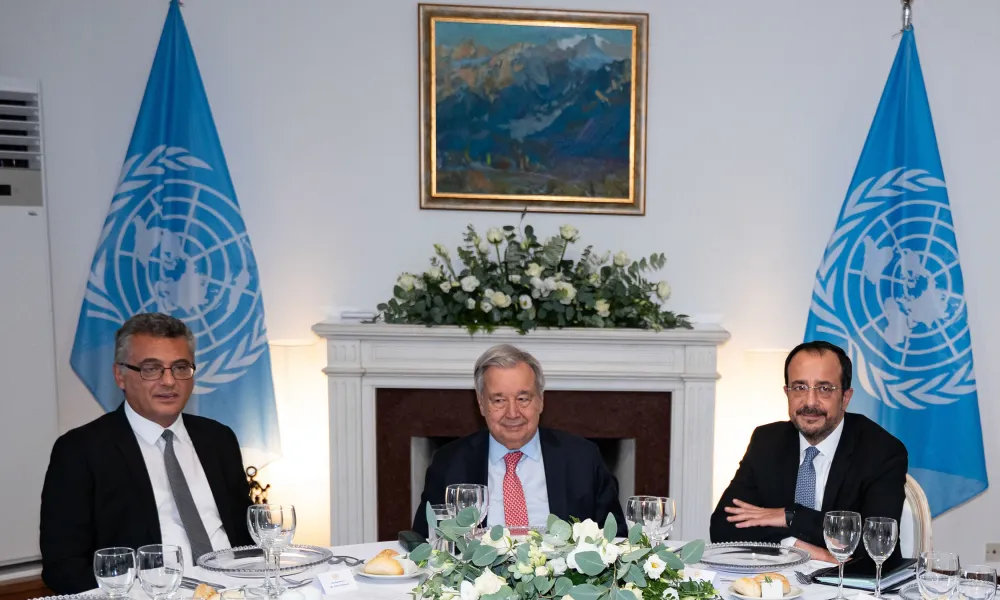
Indeed, to burnish his image of "readiness" for a solution, shortly before the UN Secretary-General's term ended, he called on him, as he himself put it, to take the initiative to restart talks. Guterres came to Cyprus, held talks with the two leaders, and steps that needed to be taken to move towards a five-party conference were agreed, and… we have been moving at a snail's pace. This ultimately forced the UN Secretary-General to rule out the prospect of a trilateral or five-party conference. At the same time, the President says that a week or so would be enough for him to resolve the Cyprus problem alongside Erhürman, only for the Turkish Cypriot leader to reply that the way he is acting not only fails to facilitate the resumption of talks, but actually makes it harder.
In saying this, I am not "absolving" Erhürman. On the contrary, I believe his own stance is not at all helpful in restarting talks either. Whether because Turkey makes things difficult for him, or for any other reason, the fact remains. And his own responsibilities are significant.
I therefore believe Christodoulides needs to be told that problems are not solved with words. They are solved through very specific actions aimed at overcoming the difficulties at the core of the problem. Unfortunately, this is something he has failed to pursue in his years in power.
PS: Since it is said that the President should be supported by everyone during this "difficult" phase of the Cyprus problem, I want to make two things clear. First, I do not believe we are facing critical developments. On the contrary, given how things are being handled, we will remain in prolonged stagnation. Second, you support someone when you believe they are acting in a way that serves your country's interests. If you judge the opposite to be true, you cannot support them.
Andros Kyprianou is a former Secretary-General of AKEL, Cyprus's Progressive Party of Working People. Born in Nicosia in 1955, he served as AKEL General Secretary from 2009 to 2021, when he was succeeded by Stefanos Stefanou.