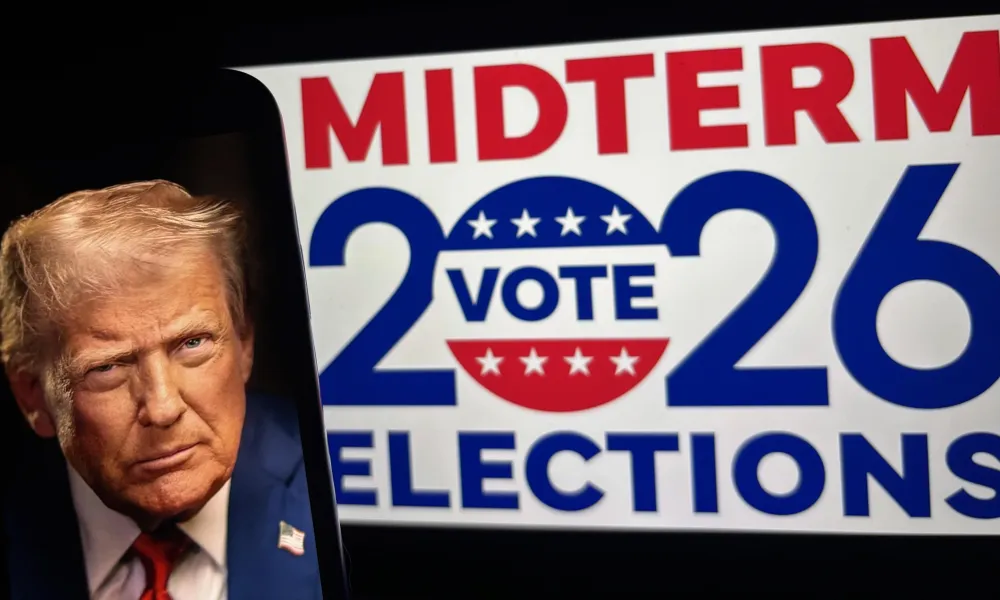

Elections in the United States always attract global attention because of the country's international influence. This year's midterm elections, however, carry particular significance, as they will determine control of both chambers of Congress and, ultimately, how much room President Donald Trump has to pursue his political agenda.
One-third of the seats in the US Senate and all seats in the House of Representatives are being contested.
According to analysis cited by The New York Times, the prospect of narrow majorities leaves open a range of outcomes that could alter the political balance in Washington and affect policymaking in the years ahead.
The impact extends beyond the United States. Analysts argue that Trump's tariff policies and the war in the Middle East have fuelled inflationary pressures felt across the global economy.
A common assumption in many forecasts is that Trump will prioritise efforts to bring down energy prices, including pushing for an end to both the war in Ukraine and the conflict involving Iran. In the case of Ukraine, pressure is also reportedly being applied on European countries to resume purchases of Russian natural gas.
Iran, oil and the Strait of Hormuz
At the same time, reports continue to emerge of a possible new wave of military action against Iran, as negotiations continue in Qatar.
Although Brent crude prices fell sharply on Monday, they remain above $105 per barrel.
Iran has confirmed that intensive indirect discussions are taking place through mediators including Qatar and Pakistan, aimed at securing a possible agreement on reopening the Strait of Hormuz and restarting negotiations with the United States.
"If the US accepts our terms, the Strait of Hormuz will reopen and negotiations will resume," Iranian Foreign Minister Abbas Araghchi told state news agency IRNA on Monday.
Meanwhile, news website Axios reported that US Vice President JD Vance sent a letter to Iranian national security chief Mohsen Rezaei regarding the possibility of renewed talks, representing the highest-level contact between the two sides in months.
Iran's Supreme Leader Mojtaba Khamenei, who succeeded his father in March and has yet to make a public appearance, warned that any new attack would trigger retaliation that would be "immediate, powerful and without geographical limits".
The continuing crisis in the Middle East remains a major source of instability for the global economy and an important political challenge for Trump and the Republican Party as voters head to the polls.
Fuel prices in the United States remain at historically high levels, a factor widely viewed as influencing voter sentiment.
Trump's political test
Recent polling has raised the possibility that Democrats could regain control of both chambers of Congress, an outcome that would allow them to block much of Trump's legislative agenda and launch investigations into his administration.
Congress also possesses the constitutional authority to pursue impeachment proceedings against a sitting president.
Only a week ago, a Democratic takeover of the Senate was widely regarded as a remote possibility.
Should Democrats secure control of one or both chambers, they would gain influence over the legislative agenda and federal budget while increasing scrutiny of the White House.
Trump, meanwhile, continues campaigning aggressively in an effort to defy polls suggesting Republicans face a difficult electoral environment.
In several traditionally Republican strongholds, Democratic candidates are running neck-and-neck with Republican opponents, driven largely by voter dissatisfaction over rising living costs and the conflict with Iran, which critics argue contradicts Trump's earlier promises to avoid what he described as "endless wars".
Another sign of growing pressure, analysts suggest, was Trump's pledge to provide $5,000 to every American citizen if Republicans prevail.
Despite projecting confidence, the president's decision to campaign in strongly Republican states such as Iowa and Kansas has been interpreted by some observers as a sign of concern about turnout.
"Nervous but optimistic," Democratic Senator Raphael Warnock told CNN, arguing that limits needed to be placed on a president who, in his words, was "literally looting our country" and "selling it off piece by piece".
Early voting surge
A potentially encouraging sign for Democrats is that more than 50 million Americans have already cast ballots, a record figure.
Preliminary analysis by the University of Florida suggests that a majority of those early voters identify with the opposition.
However, many analysts continue to urge caution, noting that polls have repeatedly underestimated the mobilisation power of Trump's MAGA base.
Democrats also suffered a setback in the key battleground state of Michigan, where Democratic Representative Haley Stevens announced support for Republican Mike Rogers rather than Democrat Abdul El-Sayed, citing disagreements over Israel.
Sources: ANA-MPA, AFP, The New York Times, Financial Times