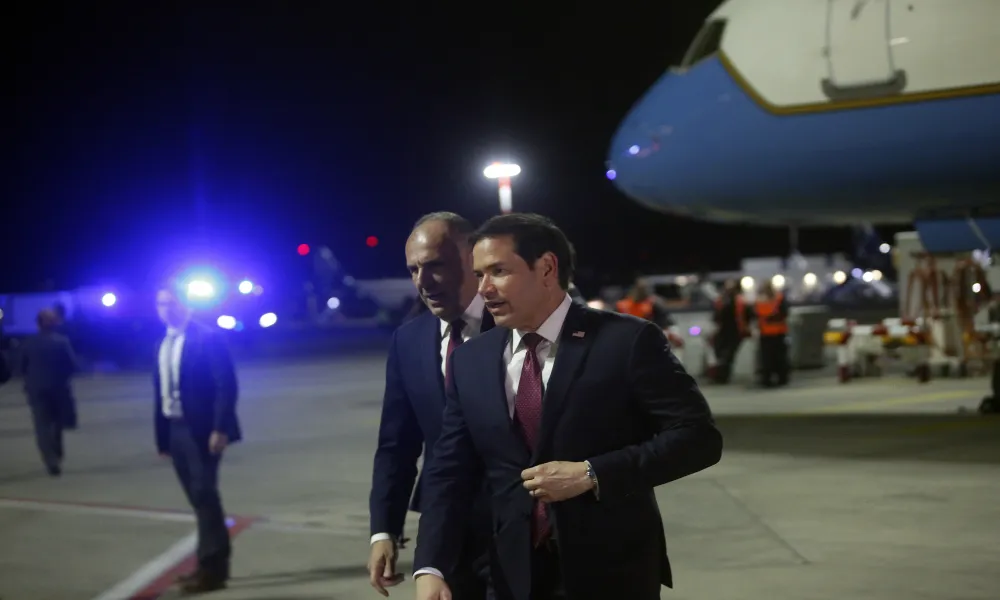

US Secretary of State Marco Rubio arrived in Athens on Tuesday evening as geopolitical developments in the region remain high on the international agenda.
He was welcomed at Athens International Airport Eleftherios Venizelos by Greek Foreign Minister Giorgos Gerapetritis. The two exchanged a warm handshake before departing together.
Rubio is visiting Greece as part of the sixth round of the Greece-US Strategic Dialogue.
The US Secretary of State begins a series of meetings with the Greek political leadership on Wednesday. According to the schedule, he will hold bilateral talks with Gerapetritis, followed by statements to the media and the formal opening of the sixth Strategic Dialogue between Greece and the United States.
In the afternoon, Rubio is expected to meet Greek Prime Minister Kyriakos Mitsotakis, with discussions focusing on regional and international developments, the Greece-Cyprus-Israel electricity interconnector (GSI), tensions with Turkey and the Cyprus issue.
The visit comes a few weeks before the US elections and at a time when the laying of the electricity interconnector cable and developments in the Eastern Mediterranean are attracting heightened attention from all parties involved.
Separate working sessions involving senior officials from both countries are also expected to cover security, defence, energy, shipping, technology, trade and investment, as well as the further strengthening of strategic cooperation between Athens and Washington.
Strategic Dialogue agenda
Defence cooperation will form a significant part of the Strategic Dialogue, having deepened considerably in recent years.
Discussions are expected to focus on the implementation of the F-35 programme, the modernisation of Greece's F-16 fleet and further strengthening of the operational capabilities of the Greek Armed Forces.
New US defence packages and support for existing systems are also expected to be discussed.
Energy will form another major part of the agenda.
The Vertical Corridor is expected to feature prominently, as Greece seeks to strengthen its role as a gateway for the transport of US liquefied natural gas to the Balkans and Eastern and Central Europe.
Exploration and investment by US energy companies ExxonMobil and Chevron in Greek offshore blocks are also expected to be discussed.
The involvement of the two American companies in Greece's energy sector strengthens the geopolitical dimension of bilateral energy cooperation, with particular interest focused on exploration south of Crete.
Three agreements expected
Three cooperation documents are expected to be signed during the sixth Strategic Dialogue.
The first will renew a memorandum of understanding concerning import restrictions on certain categories of archaeological and ethnological material dating up to the 15th century AD.
Second, Greece and the United States are expected to sign a Letter of Intent on cooperation between the Greek Armed Forces and the Florida National Guard.
Third, a memorandum of understanding will be signed for the mutual recognition of seafarers' certificates of competency under the 1978 International Convention on Standards of Training, Certification and Watchkeeping for Seafarers (STCW).
The agreement aims to make it easier for seafarers to find employment while strengthening Greek-US cooperation in shipping and maritime education.
Rubio to speak at the Pnyx
Rubio's evening speech at the Pnyx, overlooking the Acropolis, is also expected to carry significant symbolic weight.
The US Secretary of State is expected to address the future of the Western world and relations between the United States and Europe in a speech carrying strong historical and political symbolism.
The choice of the Pnyx, where the citizens' assembly met in ancient Athens, is intended to reinforce the broader message of the address.
The speech has been presented as an intervention on the need for a “great renaissance of the Western spirit”, connecting the historical legacy of Athens with the contemporary debate over the future of the West.
Source: CNA / CyBC