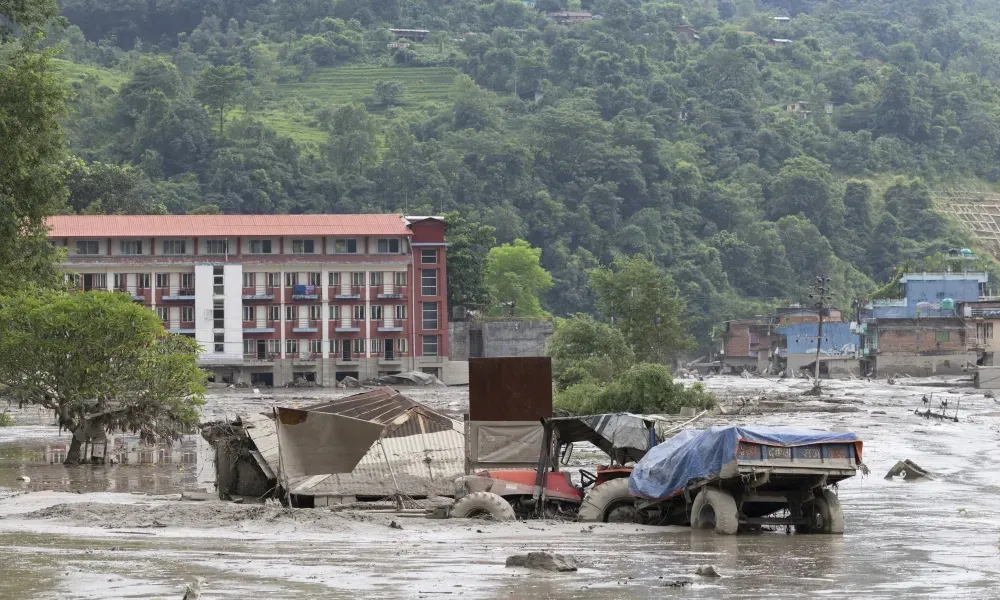

One week after a glacier collapse triggered a vast landslide and flood in the Himalayas, thousands of families are still waiting for news of their loved ones. Authorities say the chances of finding more survivors are rapidly diminishing as attention increasingly turns to recovery, rebuilding and the protection of displaced communities.
More than 4,400 people missing
Nepal’s emergency management authority said the death toll in the country had risen to 1,114, while 3,916 people remained missing.
Chinese state media have reported a further 16 deaths and 546 people missing in Tibet.
Across Nepal and Tibet, 1,130 people have died and 4,462 remain unaccounted for.
“Hopes of finding survivors are fading,” said Phanindra Paudel, a senior official at the National Emergency Operation Centre. “We pray and hope,” he added.
Search continues in hydropower tunnels
Army spokesperson Raja Ram Basnet said rescue teams were searching for workers believed to be trapped inside tunnels at several hydropower plants. Some of the tunnels contain areas where people could potentially have sheltered.
Nepalese authorities said 279 people had been rescued from hydropower construction sites, while at least 639 others remained missing. Some are believed to be trapped underground.
Retired general Binoj Basnyat, who oversaw search-and-rescue operations following the 2015 earthquake that killed about 9,000 people, said the passage of time was reducing the likelihood of survival.
He said the nature of the disaster and the scale of the flooded area meant the chances of finding survivors decreased with each passing day.
Recovery and rebuilding begin
Nepalese Prime Minister Balendra Shah said government efforts would now focus on recovery and reconstruction.
Shah said authorities were also working to protect people in the affected areas and provide the necessary medical treatment and psychological counselling.
A preliminary assessment by the United Nations Development Programme found that the landslide had left behind 2.2 million tonnes of debris.
The UN agency said the volume reflected both the scale of the destruction and the challenges facing communities as they clear homes, roads and public spaces before rebuilding can begin.
Public health concerns grow
UN spokesperson Stéphane Dujarric said aid organisations were “very concerned” about increasing public health risks caused by overcrowded shelters, contaminated water and damage to healthcare infrastructure.
Women and children are considered particularly vulnerable during the monsoon season.
In Nepal, around 3,900 people remain missing, while almost 3,500 are living in 27 displacement camps in the worst-affected districts of Nuwakot and Rasuwa, according to Dujarric.
Shah said the government had strengthened disease surveillance and response measures to prevent possible outbreaks in the affected areas.
Source: AMNA