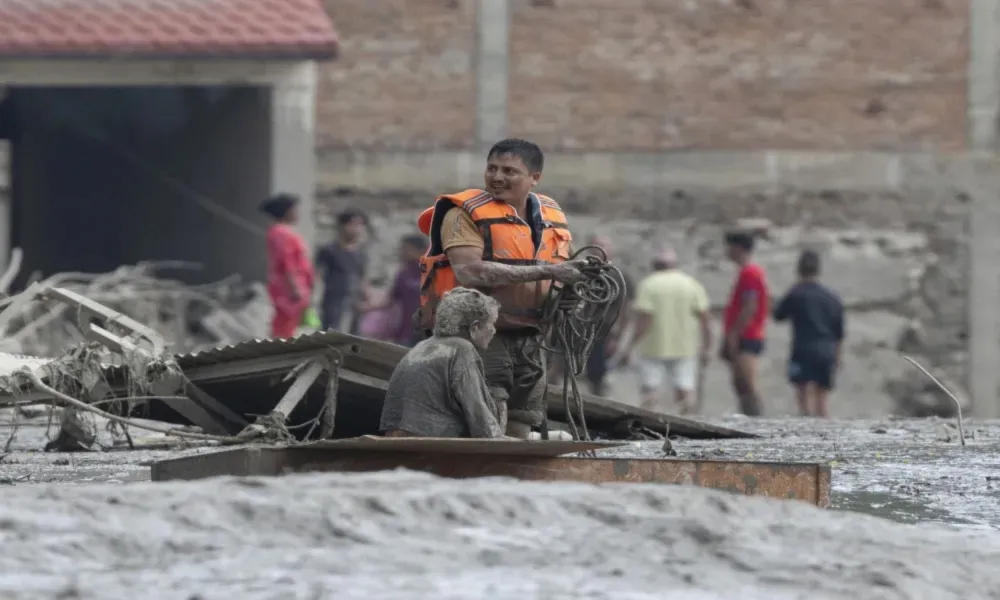

Authorities in Nepal have begun burying victims of last week's devastating floods even as search-and-rescue operations continue across the mountainous border region with China, highlighting the immense scale of the disaster.
Nearly 800 people have been confirmed dead, while more than 3,000 remain missing on both sides of the border in the remote Himalayan region popular with mountaineers and pilgrims.
Search for survivors continues
Rescue teams continue working around the clock under hazardous conditions and despite the risk posed by rising water levels.
Particular focus remains on efforts to reach approximately 100 workers trapped inside an underground tunnel at the Trishuli 3 hydropower project.
Five days after the disaster struck, however, hopes of finding additional survivors in the vast expanse of mud, debris and destroyed settlements have diminished significantly.
Families search for loved ones
Relatives of missing people continue to gather at hospitals and morgues in search of information.
In Bharatpur, southern Nepal, photographs of recovered bodies are being displayed on screens to help families identify victims.
Floodwaters carried around 250 bodies into the Chitwan district, more than 100 kilometres from the disaster zone.
One resident, Sobha Adhikari, said she believed a body recovered from a riverbank belonged to a childhood friend.
"It looks like him," she told a volunteer, who explained that only DNA testing could provide confirmation.
Temporary burials begin
With morgues overwhelmed and concerns growing over public health risks, Nepalese authorities have begun burying unidentified victims.
Officials said DNA samples are being collected before burials take place.
In cases involving Hindus, the burials are being treated as temporary, allowing families to exhume and cremate relatives later in accordance with religious traditions once formal identification has been completed.
Many bodies were already in an advanced state of decomposition, according to Amrit Bahadur Rai, secretary-general of Nepal's Foreign Ministry.
Authorities say facilities are struggling to cope with the number of victims. Bharatpur's morgue can accommodate only about 20 bodies, forcing officials to store others in a non-air-conditioned commercial facility.
In Devghat, where unidentified victims have been buried, police have marked each grave with a number.
Glacier collapse blamed
Scientists and disaster experts believe the catastrophe was triggered by the collapse of a massive glacier, which transformed a normally calm river into a destructive torrent within moments.
According to the latest official figures:
- 797 bodies have been recovered.
- 781 deaths were recorded in Nepal.
- 16 deaths were recorded in Tibet.
More than 3,000 still missing
Despite hundreds of rescues and evacuations, authorities in Nepal and China still do not know the fate of thousands of people.
Official figures show:
- 2,502 people missing in Nepal.
- 546 people missing in China.
Hundreds of foreign nationals are among those unaccounted for.
Risk of further disaster
Rescue teams remain under threat from additional flooding and landslides.
On the Chinese side of the border, rescuers were forced to move to safety after a new lake formed following another landslide, according to state media.
In Nepal, authorities urged residents to remain vigilant as water levels in the Bhotekoshi River continue to rise.
Hope for trapped workers
Emergency crews remain focused on the group of workers trapped inside the tunnel at the Trishuli 3 construction site.
Officials said rescuers have so far been unable to establish contact with those inside.
Plans are under way to use explosives to open an access route, allowing rescue teams equipped with oxygen masks to enter the tunnel.
Around 80 Nepalese disaster response personnel are taking part in the operation with support from teams sent by India, China and South Korea.