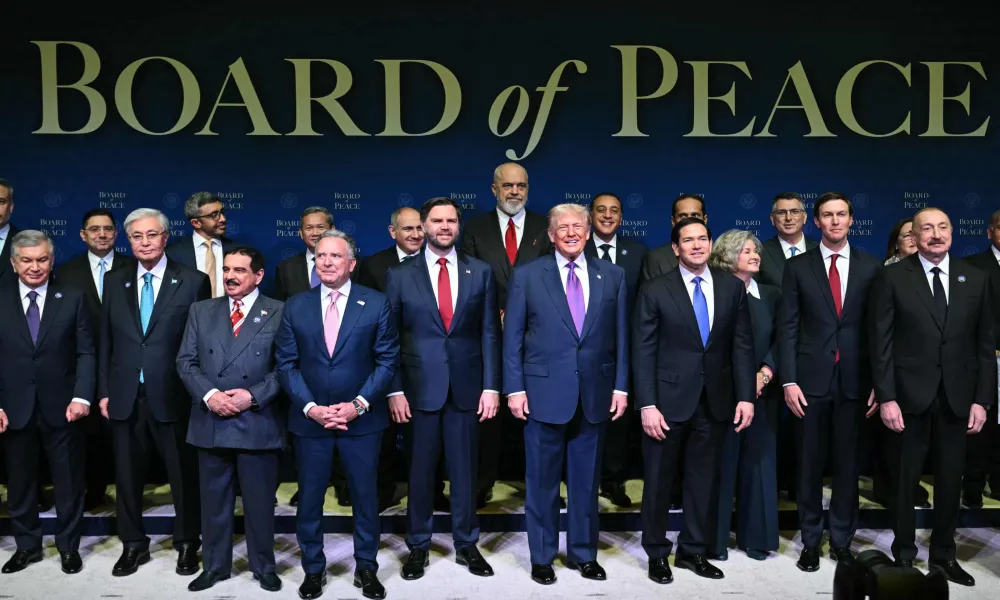

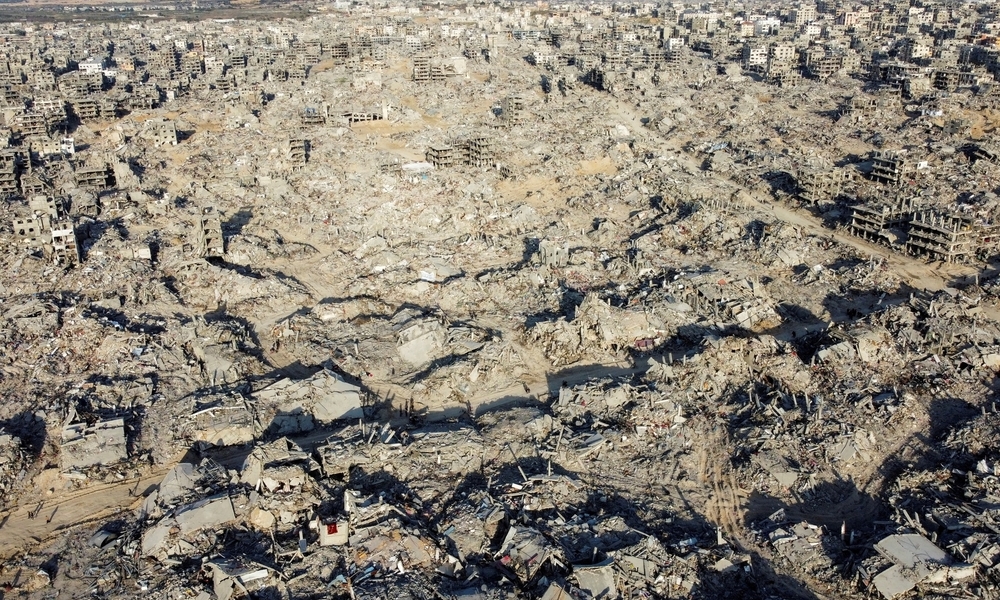
A scaled-back plan for Gaza's post-war recovery was agreed at meetings in Cyprus earlier this month, shifting focus from the reconstruction of the entire territory to a pilot project near Rafah in southern Gaza, according to a report published by the Guardian.
The Guardian reported that the revised proposal was finalised at meetings attended by Board of Peace (BoP) Gaza envoy Nickolay Mladenov, US negotiator and BoP adviser Aryeh Lightstone, advisers from the Tony Blair Institute and members of the National Committee for the Administration of Gaza (NCAG).
According to the British newspaper, the pilot scheme would involve portable housing for tens of thousands of displaced Palestinians near Rafah, security provided by an International Stabilization Force (ISF) and a specially trained Palestinian police force, and the establishment of a Palestinian administration for the site.
The plan marks a significant retreat from earlier BoP ambitions to oversee reconstruction across Gaza. The Guardian said the pilot project is not expected to be operational before the end of 2026.
The newspaper reported that a small number of Moroccan and Kosovan officers have already arrived in Israel as the nucleus of the proposed ISF, while a logistics base for the force near the Kerem Shalom crossing is nearing completion.
Preparatory work on the Rafah camp itself has not yet begun, however, and satellite imagery reviewed by the Guardian reportedly showed disturbed ground but no new structures.
Uncertainty ahead of elections
Diplomats cited by the newspaper said political uncertainty in Israel remained a key obstacle. Israeli elections are scheduled for 27 October 2026, and Western diplomats in Jerusalem believe any major progress is unlikely before then.
One diplomat told the Guardian that supporters of the project were seeking to preserve momentum despite limited gains.
"The aim is just to keep something going, keep the ball in play, because if you stop there are others with a more extreme agenda just waiting to jump in and take over, and they are talking about wholesale population transfer and colonisation," the diplomat said.
The Guardian reported growing concern among diplomats and analysts that Israeli Prime Minister Benjamin Netanyahu, facing a difficult election, could launch a broader military offensive in Gaza before the vote.
‘Potemkin village’
Muhammad Shehada, a visiting fellow at the European Council on Foreign Relations, criticised the pilot project, telling the paper:
"Israel is basically trying to build a caged and controlled Potemkin village with a tiny symbolic population who would be afforded slightly better conditions than their peers in West Gaza in order to use that facade of 'progress' to lend credence to its escalating campaign against the rest of Gaza."
The newspaper said parallel talks in Cairo involving the Board of Peace examined possible arrangements for the disarmament of Hamas and other armed groups in Gaza. However, progress appeared limited.
"As long as Israel doesn't commit to a gradual withdrawal from the Gaza Strip and to changing the reality there, there's no basis for talks," a Palestinian source told Haaretz.
The Guardian also reported that Israeli authorities have not approved requests made privately by Lightstone in June for the eventual deployment of the ISF, the entry of a vetted Palestinian police force into Gaza, and the easing of restrictions on certain humanitarian supplies.
Cyprus talks expose division in NCAG
According to the newspaper, the Cyprus discussions, held on 30 June and 1 July, exposed divisions within the NCAG, a 13-member body of Palestinian professionals and technocrats established by the BoP and currently based in Cairo after being barred by Israel from entering Gaza.
An official familiar with the Cyprus talks told the Guardian that committee members were divided over the Rafah proposal, fearing it could create inequalities among Gaza's 2.1 million population by prioritising aid and services for residents of the pilot zone.
Shehada told the newspaper that only selected NCAG members attended the Cyprus meetings after the full committee repeatedly rejected the proposal, citing fears that better conditions in the pilot camp could provoke a stampede, leading to a repeat of instances when Israeli forces fired into crowds seeking food from a US-Israeli run distributor.
Funding for Gaza peace plan
Funding also remains uncertain. The Guardian reported that only a small portion of the $17 billion originally pledged for the Board of Peace's broader Gaza initiative has materialised. The organisation is reportedly seeking to direct part of $11 billion in Palestinian tax revenues and frozen assets held by Israel towards the project.
Palestinian Foreign Minister Varsen Aghabekian rejected that idea.
"These are not Israeli funds to withhold or bargain with," Aghabekian said. "These funds must be released immediately and unconditionally."
She also warned against allowing the pilot scheme to replace a broader settlement.
"The humanitarian catastrophe cannot be managed through fragmented or partial measures. At the same time, every effort that genuinely saves Palestinian lives deserves careful consideration," said Aghabekian.
"Our concern, however, is that temporary arrangements must never become a substitute for a comprehensive solution or serve to normalise an unacceptable reality."
An official familiar with the planning told the Guardian that the project remained months away from implementation.
"I think you're looking at late 2026. If we got this done, in place, by December, I'd be very happy," the official said.
Source: Guardian