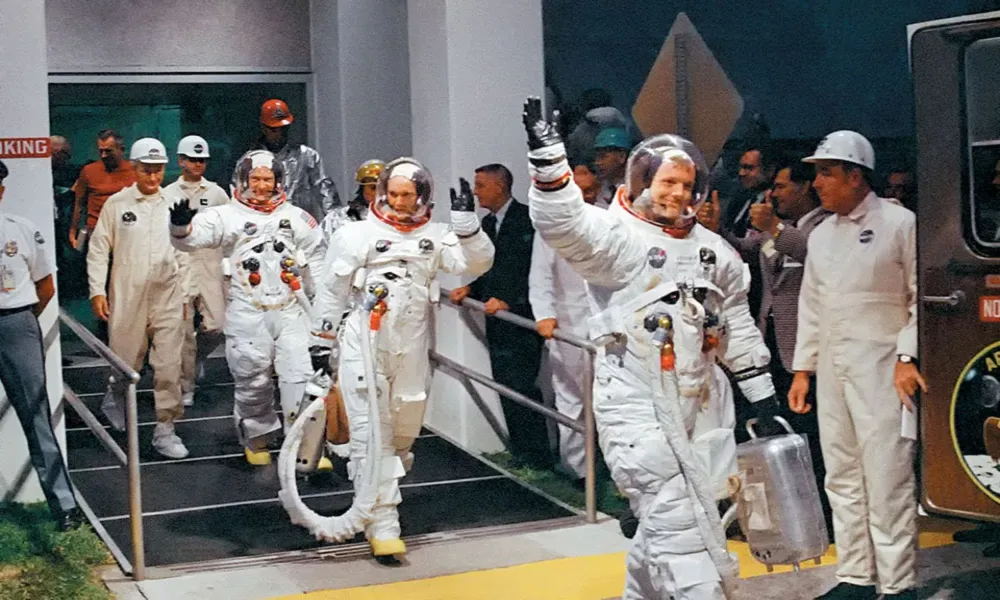

The landing of Eagle on 20 July 1969 was, in many ways, the culmination of the Cold War rivalry in space.
Eight years earlier, on 25 May 1961, the 35th President of the United States, John Fitzgerald Kennedy, had declared in a special address to Congress: "I believe that this nation should commit itself to achieving the goal, before this decade is out, of landing a man on the Moon and returning him safely to the Earth. No single space project in this period will be more impressive to mankind, or more important for the long-range exploration of space, and none will be so difficult or expensive to accomplish."
The USSR Was Ahead
Reading between the lines, it is not difficult to recognise the political significance of this declaration. From the very beginning of the Space Age, the Soviet Union was consistently one step ahead of the United States.
- 1957: Sputnik 1 became the first artificial satellite, while Laika, aboard Sputnik 2, became the first living creature in space.
- 1959: Luna 1 became the first spacecraft to approach the Moon. Luna 2 became the first spacecraft to reach the Moon. Luna 3 returned the first photographs of the Moon's far side.
- 1960: Sputnik 5 became the first space mission to carry various animals into space and return them safely to Earth.
The decisive blow came in April 1961 with the first human spaceflight. The Soviet achievement, embodied by Yuri Gagarin, dealt a severe blow to American national pride unlike anything seen before. The United States urgently needed an effective and convincing response.
Accelerating the programme
The result was Kennedy's announcement to Congress, made roughly six weeks after Gagarin's historic flight.
It is worth noting that Kennedy had opposed the manned space programme before becoming President of the United States. As a senator and later as President-elect, he had sought its cancellation, primarily because of its high cost.
However, following Gagarin's dramatic achievement, Kennedy reversed course, deciding to place the United States at the forefront of the space race for reasons of strategy and international prestige.
The view of Kennedy's special adviser Ted Sorensen and Vice President Lyndon Johnson, who had discussed the matter with rocket programme architect Wernher von Braun, was that the "conquest of the Moon" should become a national objective for two main reasons.
First, achieving the goal would bring unparalleled international prestige to the United States.
Second, the technical challenges involved were sufficiently great to give the United States enough time to overtake the Soviet Union.
400,000 people
The Apollo programme began in 1960 as a continuation of the Mercury programme, taking its name from Apollo, the ancient Greek god of light. The name was chosen by NASA engineer and division chief Abe Silverstein.
Kennedy's announcement dramatically transformed the programme, as the objective of spaceflight became highly specific: a manned landing on the Moon.
A total of $107 billion (in 2016-adjusted dollars) was spent on the Apollo programme, making it the largest national expenditure ever undertaken during peacetime.
At its peak, the programme employed 400,000 people and involved 20,000 companies and universities.
If the article continues beyond that point in the newspaper, paste the remaining text and I'll translate the rest as well.