
Germany's political centre absorbed its heaviest blow in decades on Sunday, when voters in two states delivered results that stripped Chancellor Friedrich Merz's Christian Democratic Union (CDU) of parliamentary representation in one and pushed it into a distant second place in the other. The twin elections in Mecklenburg-Western Pomerania and Berlin, held on the same day, capped a run of three state votes in three weeks that has left Merz's authority in serious doubt and confirmed the far-right Alternative for Germany (AfD) as the most consequential political force east of the old Cold War border.
In Mecklenburg-Western Pomerania, the CDU took just 4.9% of the vote, a collapse of 8.4 percentage points from 2021 that put the party below the 5% threshold required to enter the Landtag. It is the first time in the CDU's postwar history that it has failed to win seats in any German state parliament. The AfD topped the poll with 38.2%, more than doubling its 2021 result, while the Social Democrats (SPD) of incumbent state premier Manuela Schwesig held on for second place with 35.5%, a narrower margin than pre-election polling had suggested. Turnout reached 78.1%, up more than seven points on the last election, a sign of how sharply the contest had polarised the electorate.
In Berlin, the result was different in character but comparably severe for Merz's party. Die Linke finished first with 25.7% of the vote, a surge of 13.5 points driven almost entirely by its campaign against the city's private rental housing market, ahead of the CDU on 18.8%, down 9.5 points from the previous election. The AfD recorded its best-ever result in the capital with 16.3%, overtaking the Greens, who fell to 14.3%, and the SPD, which slipped to fourth place with 12.1%. Die Linke's result was strong enough that the party could now lead Berlin's next government, replacing a CDU-led administration whose incumbent mayor, Kai Wegner, chose not to seek re-election after widespread anger over his decision to play tennis during a major power outage last winter.
A pattern set two weeks earlier
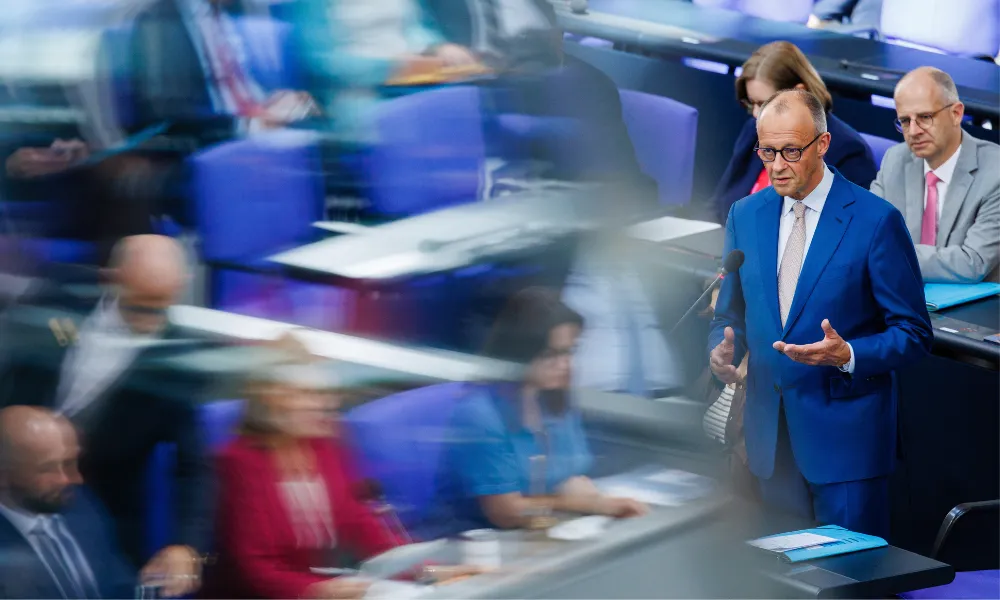
Sunday's results extended a trend that had already been established on 6 September, when the AfD won almost 44% of the vote in Saxony-Anhalt, more than double the CDU's roughly 17%, falling just three seats short of an outright majority in the state parliament. Merz described that result as the heaviest defeat his party had suffered "in years, in decades." Two weeks on, he used the same word, disaster, to describe Sunday's outcome in Mecklenburg-Western Pomerania, telling reporters shortly after polls closed that the loss demanded "backbone, steadfastness and patience."
Taken together, the three votes represent the AfD's strongest run of results in a decade of German state politics. The party has now finished first in two of the three eastern states that voted this autumn and posted record numbers in the third. Analysts describe this less as a series of isolated protest votes than as a structural realignment. Louis Perron, a Swiss-based political consultant, told Newsweek that the AfD had achieved "the best score of any party in any German state election during the past ten years," calling it real and sustained momentum rather than a single dramatic spike.
Why the CDU collapsed in the east
The scale of the CDU's defeat in Mecklenburg-Western Pomerania cannot be explained by Merz's unpopularity alone, though pollsters' interviews with voters on Sunday confirmed he remains a significant drag on his party's standing. The state has structural vulnerabilities that predate his chancellorship: economic growth has lagged behind the national average, a disproportionate share of the workforce earns minimum wage, and reliance on the state pension in retirement is markedly higher than in western Germany. The federal government's pension and tax reforms, which Merz has defended as necessary to revive a stagnant export-driven economy under pressure from Chinese competition, have proven especially unpopular in a region where voters have not built up the savings cushions common in the west.
Schwesig, who is likely to retain power in her state with the support of other left-leaning parties, was notably critical of the federal coalition during her own campaign, accusing Merz of indifference towards voters struggling with high fuel costs and calling for changes to pension reforms that would extend working years. Her success in containing AfD gains relative to the party's performance in Saxony-Anhalt was attributed by analysts partly to tactical voting: centre-right voters abandoning the CDU specifically to consolidate behind the party best placed to keep the far right out of the state chancellery.
Housing, not immigration, in Berlin
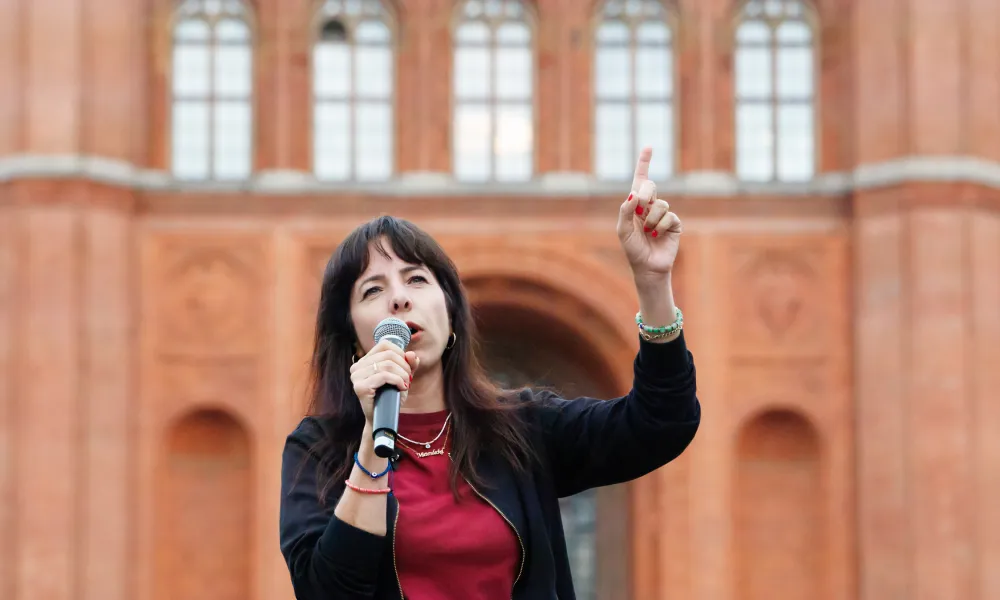
Where the eastern vote turned on economic insecurity and migration, Berlin's contest was shaped by a single, concrete grievance: the cost of housing. Die Linke built its campaign around a pledge to bring roughly 270,000 apartments currently held by large private landlords into public ownership and to cap rents, a platform that drew comparisons to the campaign of New York mayor Zohran Mamdani. The party's lead candidate, Elif Eralp, born in Munich to two left-wing activist parents from Turkey, became the face of that campaign. The federal government's own intervention worked against the CDU here too: in July, Merz's coalition ruled that further state-level socialisation of rental housing would no longer be legally permissible, a move widely read in Berlin as a direct attempt to blunt Die Linke's central promise ahead of the vote. It appears to have had the opposite effect.
The firewall under strain
The results have reopened a debate inside the CDU over the so-called firewall, the policy under which mainstream German parties refuse to govern with the AfD despite the party's growing vote share nationally and its classification as a suspected right-wing extremist organisation by domestic intelligence services. Leif-Erik Holm, the AfD's candidate in Mecklenburg-Western Pomerania, argued after the vote that the strategy "hasn't done anything for the CDU," while national co-leaders Alice Weidel and Tino Chrupalla have urged the party's state branches to treat their recent wins as a blueprint for the 2029 federal election. For now, the firewall holds. Even where the AfD finished first, as in Mecklenburg-Western Pomerania, no other party has shown willingness to enter a coalition with it, and it is expected to remain in opposition there despite its historic result.
Within the CDU itself, Merz's position appears bruised rather than broken. Several state premiers issued a public letter of support last week, and the party's general secretary, Franziska Hoppermann, offered a further vote of confidence after Sunday's results. But the mood among the party's grassroots is markedly less forgiving. One CDU campaigner in Mecklenburg-Western Pomerania told Reuters that voters had repeatedly said they would not support the party "as long as he had a say in things," a comment that speaks to a communication problem analysts say goes beyond any single policy. Merz has struggled with authority since a routine parliamentary confirmation vote after his election required an unprecedented second round, and he has since drawn criticism for comments urging Germans to work longer hours and for describing himself as "middle class" while serving as a highly paid board member of BlackRock Asset Management.
A German expression of a wider European pattern
Analysts increasingly frame the AfD's rise as part of a broader pattern across Europe rather than a uniquely German phenomenon. The party's appeal, commentators argue, rests less on policy detail than on a narrative of lost identity, a nostalgia especially pronounced in the former East Germany, where the sense of having been absorbed into a reunified country run by a western elite remains a live grievance more than three decades after unification. Sociologist Steffen Mau, who was born in East Germany, has argued that AfD figures such as Björn Höcke exploit this by suggesting West Germans have become, in effect, culturally American, a framing that offers eastern voters a claim to greater authenticity. Political scientist Yascha Mounk has described the resulting contest over how to interpret German history, and specifically the country's post-war culture of remembrance around Nazi crimes, as amounting to a national psychodrama playing out through the ballot box.
That pattern echoes across the continent. France's National Rally has built its platform around a similarly selective national memory ahead of next year's presidential election, and comparable dynamics are visible in Geert Wilders' Freedom Party in the Netherlands, the Sweden Democrats and Reform UK. Economist Daron Acemoglu has argued that this democratic backsliding stems from two intertwined failures of liberal democracies: rising economic inequality left unaddressed, and a "top-down cultural politics" that has treated less-educated and economically insecure voters with what he characterises as contempt, leaving an opening the far right has been quick to fill.
The next political chapter
The immediate practical consequences of Sunday's results are limited. Schwesig is expected to remain in office in Mecklenburg-Western Pomerania, likely requiring a coalition partner beyond her previous alliance with Die Linke. In Berlin, coalition talks will determine whether Die Linke can translate its first-place finish into control of the mayoralty, a prospect that would have been difficult to imagine before this year. Nationally, Merz has pledged to press ahead with the tax, pension and healthcare reforms he argues are essential to reviving German growth, even as tension with the SPD, his junior coalition partner, intensifies over the pace and shape of that agenda.
The larger question is what a further weakened chancellor can still deliver. A series of state elections in western Germany is due next year, and analysts including Sudha David-Wilp of the German Marshall Fund warn that the country may be entering a period in which viable governing coalitions become structurally harder to build, with consequences reaching beyond Germany's borders given its role as the European Union's largest economy and, in practice, its most influential member state. Merz, in his own remarks on Sunday, framed the stakes in similarly wide terms, warning that trust in the country's institutions is falling and being "actively undermined by radical parties on the left and right," and calling on European leaders to speak more directly "about freedom, about security in everyday life, about peace and about our own strengths as well as our weaknesses."
Source: Reuters, The New York Times, AFP, Newsweek