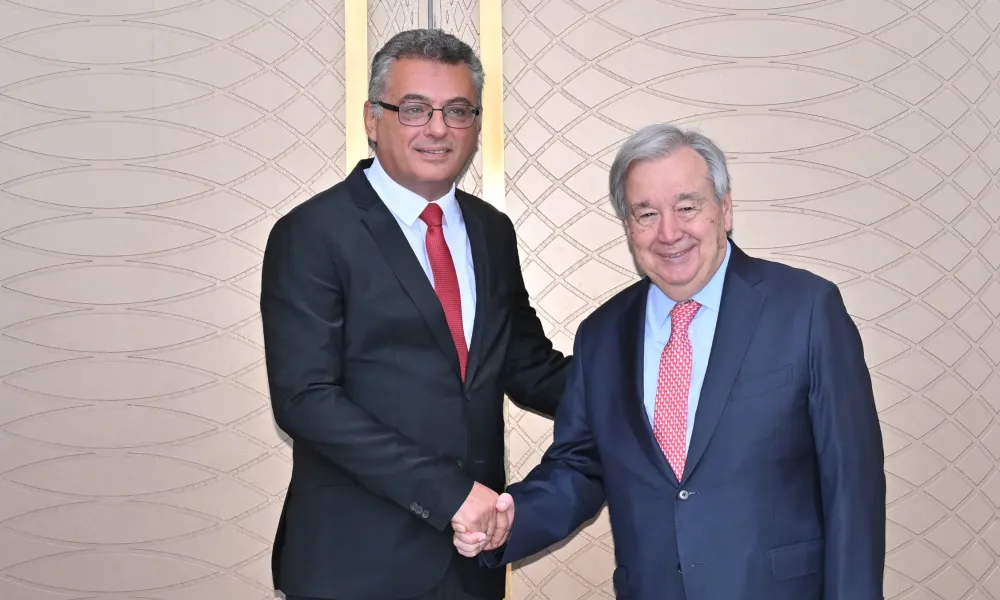

Fresh diplomatic activity around Cyprus has revived the prospect of substantive talks after years of stalemate. For Turkish Cypriot leader Tufan Erhürman, however, any renewed process must have a clear method, a defined objective and a focus on results.
Speaking ahead of his 26 August meeting with President Nikos Christodoulides, Erhürman also outlined continuing differences over new crossing points and demining, while calling for practical confidence-building steps to bring the two communities closer.
Guterres visit described as successful
In an interview with Kıbrıs Postası TV, Erhürman rejected two opposing interpretations of United Nations Secretary-General António Guterres’ visit to Cyprus. He said it would be equally wrong to describe it either as a “farewell holiday visit” or as an attempt by the UN chief to resolve the Cyprus problem during his stay.
Guterres arrived with a substantial delegation and devoted considerable time to the issue, Erhürman said. He also requested preparations for another meeting in the 5+1 format, covering confidence-building measures as well as the methodology and substance of any renewed negotiations.
“I do not want negotiations simply for the sake of negotiations. I want a process focused on results,” Erhürman said, adding that he believed the UN Secretary-General shared that approach.
After eight or nine years without a substantive negotiating process, he said, confidence-building measures were needed to help reconnect the two communities. At the same time, the sides must agree on how a new round of talks would be conducted.
Erhürman said Guterres viewed the four-point methodology he had proposed not as a “precondition”, but as a framework for the negotiations.
Mixed marriages raised in Guterres meeting
Erhürman said the issue of mixed marriages was also discussed during his private meeting with Guterres and was raised by the Secretary-General himself.
The matter has also been brought up by the UN Secretary-General’s Personal Envoy on Cyprus, María Ángela Holguín, he added.
According to Erhürman, a genuine effort to reach a settlement would make it easier to take practical steps on such issues, provided the process was based on mutual benefit.
Weekly meetings proposed
Following Guterres’ visit, Erhürman proposed that he and Christodoulides meet at least once a week.
“Since we have been given work to do, let us meet at least once a week,” he said.
Christodoulides was available on 26 August, Erhürman added, although no specific agenda has been agreed for the meeting.
Differences over crossings and demining
Erhürman said discussions on confidence-building measures had focused largely on new crossing points and the removal of mines.
On the crossings, he said the Turkish Cypriot side wanted talks to continue on the basis of proposals previously discussed in New York and the map presented by the United Nations. It did not want matters it believed had already progressed to be reopened.
He claimed, however, that Christodoulides proposed different crossing points, preventing the two sides from reaching an agreement.
On demining, Erhürman said Christodoulides had treated the issue as one to be addressed after a comprehensive Cyprus settlement.
According to Erhürman, the President argued that removing anti-tank mines from an area where tanks remain deployed was a matter for the post-settlement period.
Criticism over property-related arrests
Erhürman also criticised Christodoulides over arrests linked to transactions involving Greek Cypriot properties in the Turkish-occupied areas.
He argued that the President’s statement that “if necessary, we will make arrests” demonstrated what he described as the political nature of the issue.
Erhürman claimed that the law was being used as a political instrument in property cases and described Christodoulides’ remark as an acknowledgement of their political dimension.
He also referred to Germany, claiming that concerns had been raised there over the issue.
Call for Turkish Cypriot inclusion
Erhürman accused the Greek Cypriot side of using its international standing in a way that disregarded the Turkish Cypriot community on issues including missing persons, property and the historical context of the conflict.
He pointed specifically to a monument for missing persons at the European Parliament, arguing that the failure to include Turkish Cypriot missing persons was unacceptable.
On property, he said it should be acknowledged that population movements affected both communities. He also argued that the historical discussion could not be confined to 1974 while overlooking the period between 1963 and 1974.
Coordination with Ankara
Erhürman placed particular emphasis on the Turkish Cypriot side’s relationship with Turkey, saying a meeting in the 5+1 format could not take place without Ankara’s participation.
The Turkish Cypriot side must therefore act in coordination with Turkey, he said.
“There is no alternative but to act in harmony with Turkey,” Erhürman added.
He said no settlement agreement could enter into force without Turkey’s consent, adding that the same applied to the other guarantor powers.
According to Erhürman, no substantive divergence of views with Ankara has emerged so far because genuine discussions on the content of a possible agreement have yet to begin.
Focus on substance, not labels
Erhürman also sought to shift the discussion away from the name given to a settlement model and towards its actual content.
Terms and labels can often be divisive and are not, by themselves, enough to define a settlement, he said.
“What we must discuss is a permanent, functional and sustainable model that will make life easier for the people of this country,” Erhürman said.
He recalled that in 2004, some Greek Cypriots who described themselves as supporters of a federation nevertheless voted against the Annan Plan. This showed, he argued, that the name attached to a model was not enough to determine how either community would respond.
Greater importance should therefore be placed on the substance of the settlement and the management of the transitional period, he said.
Erhürman concluded that the Cyprus problem was beginning to return to the international agenda, with regional and global developments reinforcing the view that a settlement could contribute to peace and stability in the Eastern Mediterranean.
He also said he was open to interviews with Greek Cypriot journalists. Although he had initially intended to meet Greek Cypriot political leaders first, he did not rule out changing that schedule.