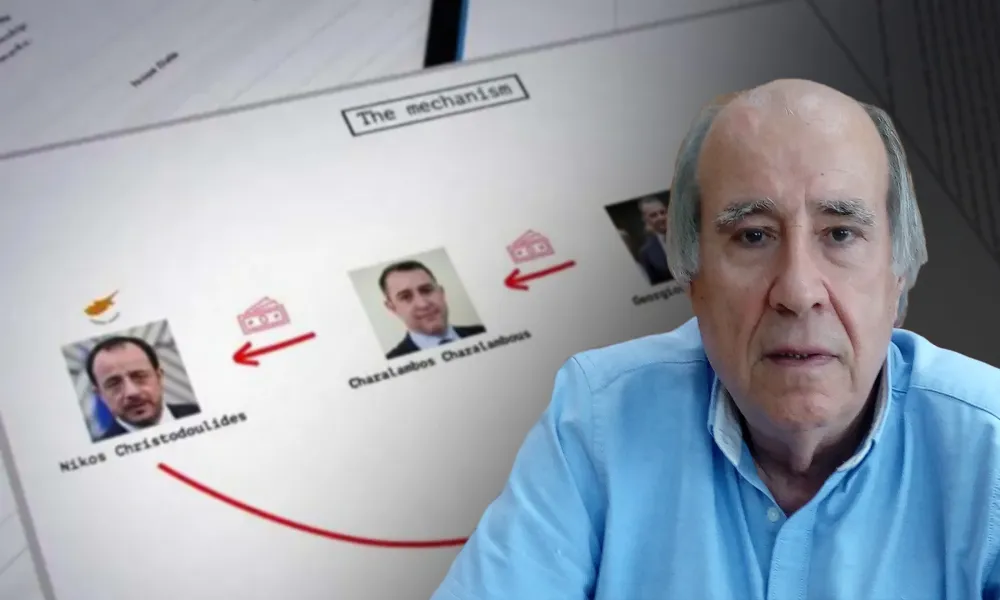

Independent criminal investigator Andreas Paschalides acknowledged on Friday that issuing his initial statement on the “videogate” findings may have been a mistake, while also accepting that parts of its wording may have been unclear.
Assistant Attorney General Savvas Angelides told Parliament’s Institutions Committee that the criminal investigation remains ongoing and described the hearing as premature. He warned that discussing the evidence could affect the process before leaving without taking further questions.
Legal Service warns of risk to investigation
Angelides stressed that the Legal Service did not question Parliament’s oversight role, but said the case remained under investigation.
“The demand for information about the findings creates a serious possibility that the investigation could be affected,” he said, warning MPs that even seemingly innocent questions could “contaminate the entire process”.
He explained that the Legal Service is still assessing the evidence and could return the file for further investigation, proceed with criminal charges or conclude that there is insufficient evidence to prosecute.
Angelides also cited legal principles preventing the disclosure of the findings at this stage. Asked about a timetable, he said developments were expected after the summer break, provided no further investigation was required.
Paschalides acknowledges mistakes
Paschalides said he had issued the initial statement after concluding that one aspect of the investigation had been completed. He stressed that the decision was his and was based on the evidence available at the time.
“I issued the statement. I should not have issued it, but I did,” he said. “It is possible that I also made a mistake in the wording.”
He nevertheless disputed suggestions that the statement was intended to protect the government, saying such claims questioned his integrity.
Paschalides explained that his term as criminal investigator expired on 20 July and that he had completed the findings on Friday, 17 July. Without submitting them by the deadline, he said, he would have needed another extension.
He also clarified that his assessment of a possible hybrid attack was not final and could change if new evidence emerged.
“If the first statement did not explain it properly, the second one did. The findings are the same,” he said.
Questions over edited video
Paschalides said experts who examined the publicly circulated video had concluded that it had been edited. In his view as a former judge, this greatly reduced its evidential value.
AKEL MP Konstantinos Konstantinou responded that television news reports are also edited, while Committee Chair Dimitris Dimitriou said the statement should clarify whether the material was considered inauthentic solely because it had been edited.
Paschalides said he had also reviewed 26 hours of footage and maintained that the publicly released video did not carry the same evidential weight.
Antonis Dimitriou, a lawyer representing Black Cube, told the committee that the full 26 hours of footage were authentic. He said his role was limited to representing the company and that he would not knowingly represent an organisation involved in a hybrid attack against the Republic of Cyprus.
Asked by AKEL MP Giorgos Loukaides how he could rule out such an attack without knowing the client, Dimitriou replied that his clients had assured him it was not one.
MPs challenge the investigator
At the beginning of the hearing, Dimitriou asked why the 20 July statement had been issued, whether criminal investigators usually make public announcements and how Paschalides had reached his initial assessment of a hybrid attack.
Loukaides questioned whether the people shown in the video had actually made the recorded statements and asked whether artificial intelligence or editing had been used to place words in their mouths.
DIKO MP Zacharias Koulias warned against creating legal difficulties while the investigation remained ongoing.
ALMA MP Eirini Charalambidou criticised the timing of the announcement and said its wording had allowed the Presidency to present the findings as an exoneration.
Paschalides rejected Loukaides’ suggestion that the statement had been political or written in defence of the government. Asked whether he would consider resigning as president of the Independent Authority for the Investigation of Allegations and Complaints against the Police, he said he had admitted only that issuing the statement was a mistake.
“If that is a sin, condemn me,” he said.
Appointment of Paschalides addressed
Deputy Minister to the President Eirini Piki also addressed questions about Paschalides’ appointment to the police complaints authority.
She said a 2016 legal opinion by the then attorney general concluded that allowing the justice minister to nominate the authority’s five board members was incompatible with its independence. The opinion recommended that appointments instead be made following a proposal from the attorney general.
Piki said both the 2021 appointment and the latest one followed such a recommendation. She added that the attorney general submitted the names of the five current members in a letter dated 27 May 2026. Following a one-month extension, the Cabinet approved the authority’s new term from 1 July, with Paschalides as president.
Anti-corruption authority disputes reference to report
Nikos Zambakides, a member of the Independent Authority against Corruption, said the body had no knowledge of either the findings or the video and had conducted no investigation of its own.
The authority’s legal associate, Chrystalla Sokratous, provided a police statement in response to specific questions but did not prepare a formal report, he said.
Paschalides described her answers as detailed and substantiated, similar to a regular report. However, Zambakides insisted that the authority did not recognise the statement as a report, despite Paschalides referring to it as a “comprehensive report” in his announcement.
Committee chair criticises Legal Service
After the hearing, Dimitriou accused the Legal Service of attempting to restrict parliamentary scrutiny.
He said MPs understood the limits of parliamentary oversight and did not need to be lectured. Had Paschalides not issued his statement on 20 July, he added, the extraordinary hearing might not have been necessary.
Dimitriou said Paschalides had admitted that issuing the statement was a mistake and that it contained drafting ambiguities. He also described the Presidency’s political handling of the announcement as “naive”.
“The political discussion will not be restricted by any criminal issues that may arise,” he said, adding that the committee would continue monitoring the case while respecting the legal process.
Political reactions
Loukaides said the political and institutional responsibilities of President Nikos Christodoulides and his government remained unaddressed. He argued that the hearing had raised further questions about the investigation and criticised the Legal Service’s refusal to provide answers.
ELAM MP Marios Pelekanos said Paschalides had answered several questions willingly, although others remained unanswered because the criminal process was continuing.
He identified three outstanding issues: whether those who commissioned the video intended to harm the Republic, whether criminal or other offences were committed, and the broader political and ethical questions. He called for the full findings to be released after the investigation concludes.
Koulias said he believed Paschalides had acted in good faith but that the announcement was open to different interpretations. He described him as a respected former judge and said the courts would ultimately determine whether the investigation had been conducted properly.
Charalambidou said several points in the first statement remained unexplained and criticised both the release of the findings on the anniversary of the Turkish invasion and the Legal Service’s refusal to provide a timetable.
Direct Democracy MP Diana Constantinidou called the continued withholding of the findings problematic. She said a redacted version excluding personal data and national security information should be released to help restore public confidence.
Source: CNA.