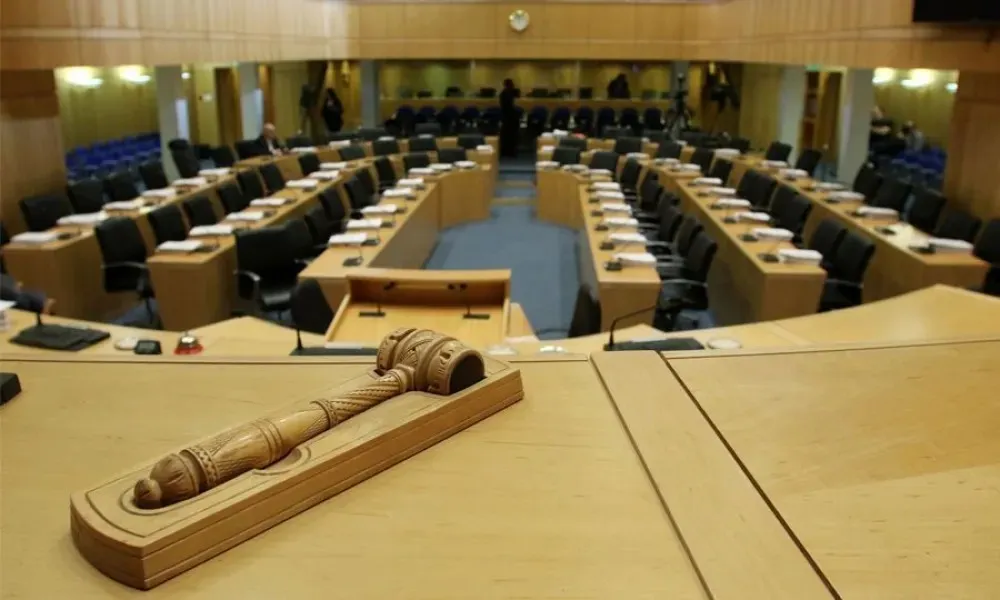

The ballot of 24 May produced a six‑party parliament, and the six parliamentary forces are now required to find ways of cooperating in order to elect a House President. In theory, all parties want to win this battle by securing the post for their own candidate. In practice, however, there are objective difficulties related to each party’s size and its capacity to form alliances.
The larger parties enjoy a negotiating advantage due to the number of seats they hold. Yet no party can elect a House President without the backing of others, a fact that also gives smaller political forces room to manoeuvre. Because the outcome of any party’s choices depends on the choices of the other five, a framework of strategic interaction emerges that places the parties squarely within the logic of game theory. Each player attempts to anticipate the moves of the others in a competitive environment, shaping a winning strategy. The process resembles a hard game of poker.
Confidence
DISY, the largest party in parliament with 17 seats, has already formally decided to contest the speakership with its party leader, Annita Demetriou, as its candidate. While the right‑wing party insists that the election result created a sense of euphoria among its supporters and a grassroots demand to reclaim the speakership, the decision was not taken solely on the basis of party sentiment.
On the contrary, it was a carefully calculated move, reflecting DISY’s reading of the election results and the dead ends facing other parties. The decision carries significant risk and is therefore seen as a move of confidence rather than triumphalism.
DISY is well aware that DIKO is unable to form viable alliances with the remaining parties. It was already known that ALMA excludes any DIKO candidacy, including that of Nicolas Papadopoulos, because DIKO is part of the governing coalition. At the same time, DISY understands that AKEL cannot credibly justify to its base the decision to support the DIKO leader. The political cost would outweigh any benefit, as AKEL’s credibility would be damaged by backing what it views as the ‘the bodyguard of the banks’.
DISY therefore has the first round firmly in mind. It calculates that DIKO, with eight votes, would need both ELAM (eight) and Direct Democracy (four) to reach the second round with 20 votes, against DISY’s 17 and the 19 potentially held by AKEL and ALMA. DISY also believes that, at a time of deep public distrust towards traditional parties, political credibility and public image matter more than the House Presidency itself. Even in defeat, DISY believes it would emerge strengthened, with an eye on the next electoral contest.
The enigma
All eyes are now on AKEL, which is expected to take final decisions on the House Presidency next Tuesday. The Secretariat of the Central Committee will meet in the morning to examine all scenarios and possibly submit recommendations to the Political Bureau, which will then decide on a strategic course of action.
Last week, AKEL general secretary Stefanos Stefanou met with the DIKO leader, the head of ALMA and the leader of Direct Democracy. AKEL entered the talks with an open agenda, without putting forward a candidate of its own or proposing names from other parties. It did, however, express reservations about the names suggested by others.
On Friday, Stefanou stated that “everything is on the table and nothing is on the table”. In reality, AKEL’s room for manoeuvre is limited. The party achieved a very strong result under the circumstances, largely due to its strategy of restoring political credibility. Its emphasis on social and economic issues resonated with its electorate, as did its consistent stance on the Cyprus problem. Any alliance with parties holding opposing positions would be seen as a step backwards.
A historic opportunity
For DIKO leader Nicolas Papadopoulos, the House Presidency represents a historic opportunity, and he appears determined to exhaust all options. This explains his dialogue with all parliamentary parties, without exclusions.
The ideal scenario would be backing from DISY. However, DISY is not a doormat. As the largest party, it has its own demands. Such a scenario would only be feasible if DIKO were prepared to take a major risk: withdrawing from the Christodoulides government and aligning with DISY ahead of the presidential election. That would all but guarantee Papadopoulos’ election, as ELAM would abstain.
DIKO’s overtures to AKEL and ELAM have so far yielded little. Stefanou made clear how difficult it would be for AKEL to support Papadopoulos. At the same time, DIKO cannot secure support without political cost. Its strong electoral performance was partly based on rhetoric favouring continued cooperation with DISY in parliament. Voters endorsed that direction, and relations with DISY would suffer if Papadopoulos joined an alliance aimed primarily at defeating Annita Demetriou.
Abstention
ELAM has already decided to field its own candidate in the first round, most likely party leader Christos Christou. With only eight votes, it cannot reach the second round, nor does it appear capable of securing support from other parties. ELAM has ruled out backing AKEL’s MPs or DISY’s leader. If the second round features candidates from DISY and AKEL, ELAM will abstain.
Political isolation does not trouble ELAM. On the contrary, it believes it reinforces its anti‑system image and boosts support. The party appears to instrumentalise exclusion and is not seeking cooperation. ELAM will likely decide in 2028 whether it wants to become a conventional political actor.
A wet cat
ALMA entered parliament with four MPs – a notable success for a new party lacking a traditional party machine. Yet the result does little to support Odysseas Michaelides’ longer‑term presidential ambitions.
Today, the ALMA leader resembles a wet cat. His party’s 5.8 per cent falls short of the influence suggested by pre‑election polling and prevents ALMA from playing a decisive role in the House Presidency contest. Nevertheless, ALMA entered talks with a concrete proposal, putting forward Irene Charalambidou’s name – a move met with hesitation by AKEL, given the recent history.
ALMA’s options are limited. To retain relevance and credibility, it must seek cooperation with AKEL and win the respect of left‑wing voters. Friendly overtures towards AKEL are effectively a one‑way street.
A puzzle
Fidias Panayiotou’s party, with four MPs and 5.4 per cent, also fell short of major ambitions. While parliamentary entry counts as success, the loss of 50,000 votes compared with the 2024 European elections weakened Panayiotou’s role. Still, Direct Democracy remains the most unpredictable player in the speakership race, having declared it will decide last.
The party had promised that citizens would decide key issues, yet now appears reluctant to consult its supporters on the House Presidency. If it avoids putting the question to its digital platform, its credibility will suffer.