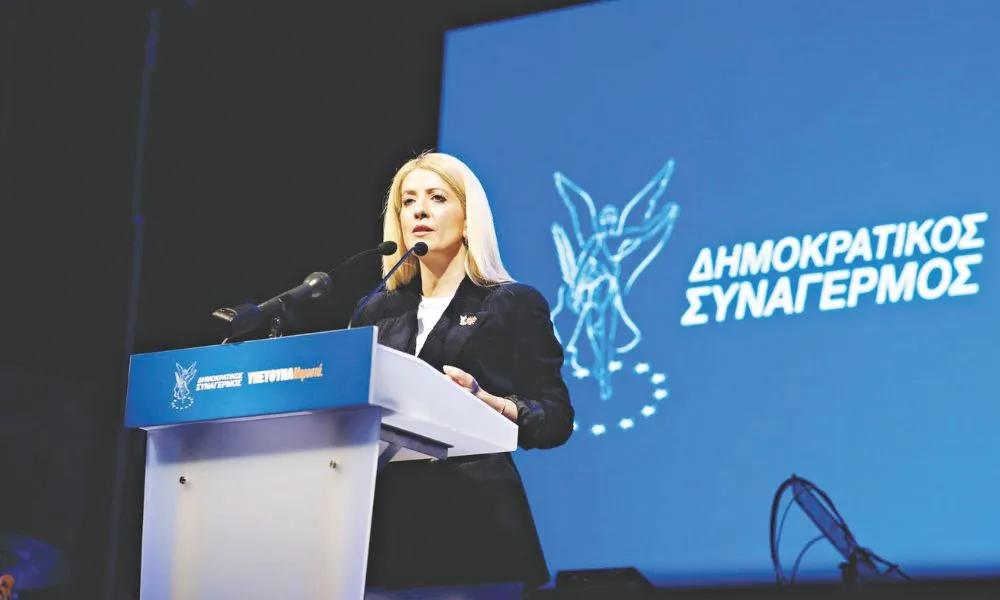
Presenting DISY as the main pillar of political stability and seriousness in a fragmented political landscape, party president Annita Demetriou delivered her message during the party’s final pre‑election rally.
Just days before polls open on 24 May, Demetriou sent a multi‑layered political message addressed both to the party’s traditional base and to undecided voters.
In particular, she sought to shift public debate towards governance issues, presenting DISY as the force capable of guaranteeing “security in change” and preventing, as she said, a return to instability and political experimentation.
The central message of the evening was that the elections are not simply a contest of party percentages, but a crucial decision about the country’s direction.
“Cyprus does not have the luxury of experiments today. It does not have the luxury of sliding into division, toxicity and cost‑free populism,” Demetriou stressed.
She identified the functionality of the next parliament as the key stake, warning that political instability could undermine Cyprus’s international credibility, the economy and decision‑making capacity.
Within this framework, she placed particular emphasis on the concept of “responsibility”, presenting DISY as the force of seriousness in contrast to populism, toxicity and easy promises.
“We must correct weaknesses without devaluing what we have built together with effort. We must change what harms us without tearing the country down. That is our duty. Our patriotic duty,” she said.
At the same time, she outlined the party’s ideological priorities for the next day, highlighting economic stability, reforms, competitiveness and the attraction of quality investment. The economy emerged as a central axis of her intervention, with emphasis on supporting the middle class, creating better jobs and linking growth to social policy.
She also sought to project a modern reformist profile, emphasising the digital transformation of the state, the reduction of energy costs, investment in renewable energy and major strategic projects which, she argued, can enhance Cyprus’s geopolitical role.
Particular emphasis was also placed on national security and the Cyprus issue. Demetriou reiterated her support for the resumption of meaningful negotiations based on United Nations resolutions and European Union principles, rejecting any form of “normalisation of the occupation”. She also underlined the importance of deterrence and the international alliances of the Republic of Cyprus.
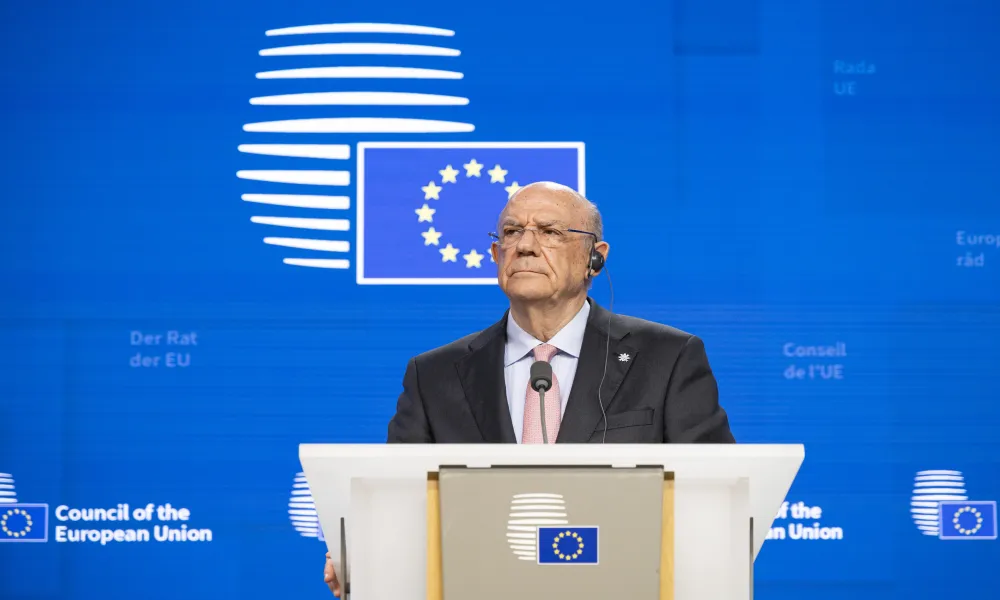
Representing the Greek government and New Democracy, Minister Margaritis Schinas, in his speech, stressed that the upcoming elections are critical not only for political balances or for Cyprus’s next day, but also because populism is once again attempting to re‑emerge.
“All of us, all of you, must raise a wall,” Schinas noted.