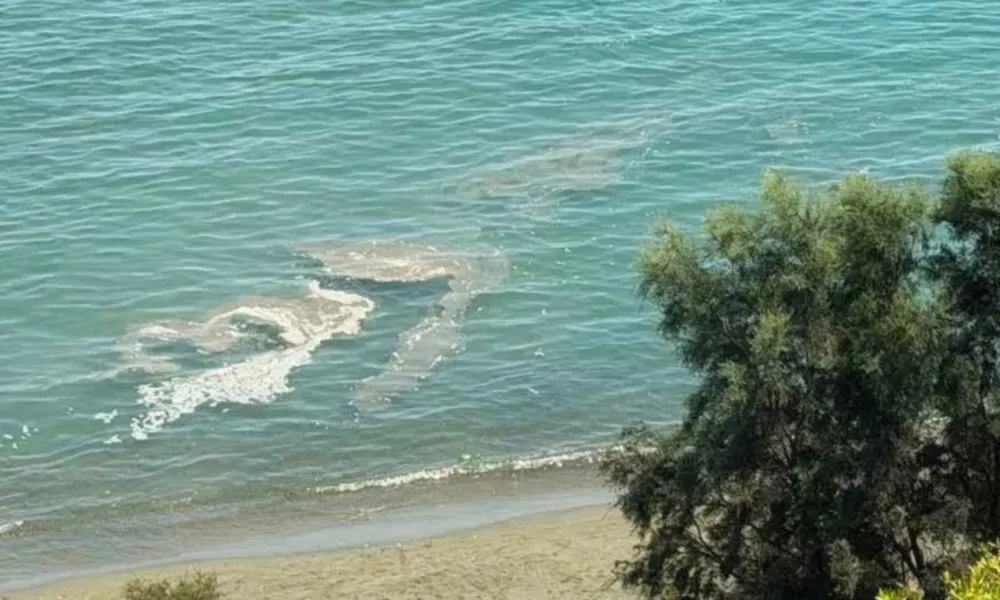

Marine pollution affecting Limassol's beaches is increasingly becoming an unresolved mystery, with the problem appearing particularly severe once again this summer.
Bathers continue to report unpleasant conditions along the otherwise renowned waters of Limassol Bay, while complaints, particularly on social media, have increased significantly over the past two to three weeks. In addition to existing concerns, a major malfunction at the Limassol EOA wastewater treatment plant in Moni has added to concerns.
One of the most puzzling aspects of the phenomenon is its intermittent nature. Beaches can appear completely clean before signs of pollution suddenly emerge and then disappear again as currents and wave action disperse them.
Despite efforts to contain the problem through the use of pollution-control vessels hired by local authorities, the scale of the issue appears to exceed available resources.
Most complaints relate to the appearance of white foam in coastal waters, with some officials suggesting the phenomenon may in part be natural. However, beyond the visual impact, authorities stress that water quality remains classified as excellent. Water samples are collected almost daily under established protocols and, even when samples were taken directly from affected areas, laboratory analyses did not identify suspicious contamination.
All possibilities under examination
Another coordination meeting is scheduled for 9:30am today at the Deputy Ministry of Shipping, which is responsible for overseeing cooperation among the many departments and agencies involved.
Officials are expected to examine all possible sources of pollution and review the effectiveness of measures implemented so far.
The large number of agencies invited to attend reflects the fragmented responsibilities surrounding the issue.
According to experts, the problem may involve multiple factors.
Particular attention is focused on:
- Leisure craft and yachts.
- Commercial vessels.
- Limassol Marina.
- Limassol Port.
- The Limassol anchorage area.
Although inspections have increased over time, authorities acknowledge that monitoring still contains gaps and weaknesses.
At the same time, various pipelines discharging into Limassol Bay remain under scrutiny, whether they involve stormwater systems or other permitted discharges.
Questions have also been raised about drainage systems in high-rise buildings. Some developments are authorised to pump groundwater discovered beneath building sites into the sea through offshore pipes, but concerns remain over what substances may be present underground before reaching coastal waters.
Other coastal and marine activities are also being considered, including:
- Fish farms.
- Hotels.
- Other beachfront establishments.
- Various coastal or marine construction activities.
Wastewater plant malfunction raises concern
Although officials insist it is a separate issue, serious recent problems at the EOA Limassol wastewater treatment plant in Moni are causing significant concern.
Approximately two weeks ago, the plant suffered a major malfunction, resulting in hundreds of cubic metres of insufficiently treated wastewater being discharged into Limassol Bay through emergency outfall pipelines.
The wastewater did not complete the required treatment process and remained well below tertiary-treatment standards.
From the outset, EOA informed the Department of Environment, which has been closely monitoring the issue and conducting a series of actions, including intensified sampling in potentially affected areas.
The incident is regarded as extremely serious and has already been the subject of several high-level meetings. However, no definitive solution has yet been found.
While the plant remains operational, it continues to experience significant difficulties.
According to information obtained by Politis, the malfunction appears to be linked to increased wastewater volumes reaching the Moni facility in recent months. The plant is reportedly struggling to cope with the higher inflows, preventing completion of the required tertiary treatment process.
As a result, the Water Development Department temporarily stopped accepting treated water from the facility, cutting supplies to farmers in the area.