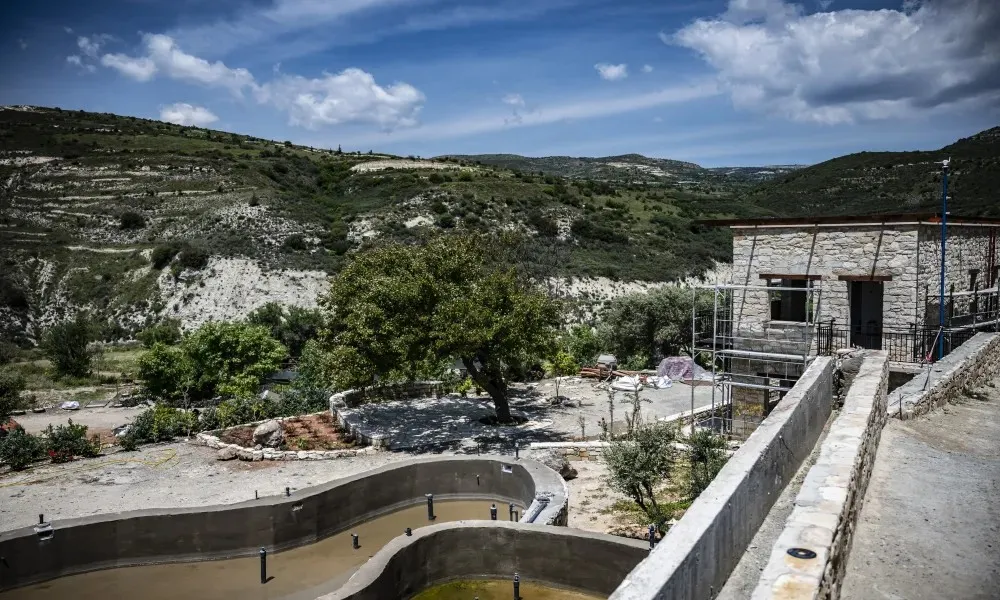

Full confirmation of Politis’ front‑page report on Trozena was provided yesterday by the Limassol District Organisation (EOA) and the Department of Environment, both publicly acknowledging illegal works at the site and the execution of construction without the required permits.
Speaking to RIK, the President of the Limassol EOA referred to unauthorised works that have been identified as having begun without permits, stating that the organisation’s orientation is to proceed with a suspension order and enforce planning legislation.
The issue concerns a large development being promoted by a foreign investor in the abandoned settlement of Trozena, in Limassol district, an area that falls within the Natura 2000 protection zone and is considered environmentally highly sensitive. Following reports revealing illegal works, the Department of Environment and the Limassol EOA were mobilised, with officials from the former already visiting Trozena.
The President of the Limassol EOA, Giannis Tsoulouftas, said instructions have already been issued to the organisation’s competent officers to enforce planning order in cases where works are being carried out without licensing. As he said, within the coming days a team from the EOA will visit the area for an on‑site assessment of the situation, while acknowledging that violations do exist.
At the same time, the Limassol EOA appears to favour the preparation of a comprehensive regulatory development plan for the area. According to Mr Tsoulouftas, the issue will be approached in coordination with the Department of Environment, as it concerns the overall redevelopment of the settlement and requires the definition of a broader development framework through a master plan, in order to ensure holistic and proper evaluation of the project.
From the Department of Environment, Deputy Director Elena Stylianopoulou also confirmed, in statements to CNA, that works have been identified in the settlement, making it clear that the Limassol EOA, as the competent authority, is obliged to apply the legislation. As she noted, the aim is to suspend works where permits have not been issued, in order to clarify the overall picture of the project and examine what is required for lawful and comprehensive licensing.
She further revealed that, to date, applications have been submitted to the Department of Environment for twelve individual projects related to the development, while the special ecological assessment study remains under examination. She pointed out that evaluation becomes more difficult when interventions in the natural environment precede the assessment process, since a proper appraisal requires knowledge of the site’s pre‑existing condition.
According to information made public, the development includes residences, camping facilities, a winery and a restaurant. The Department of Environment underlines that any revitalisation of rural areas can proceed only under strict conditions, without impact on the natural environment and with particularly careful planning, due to the area’s high ecological value.