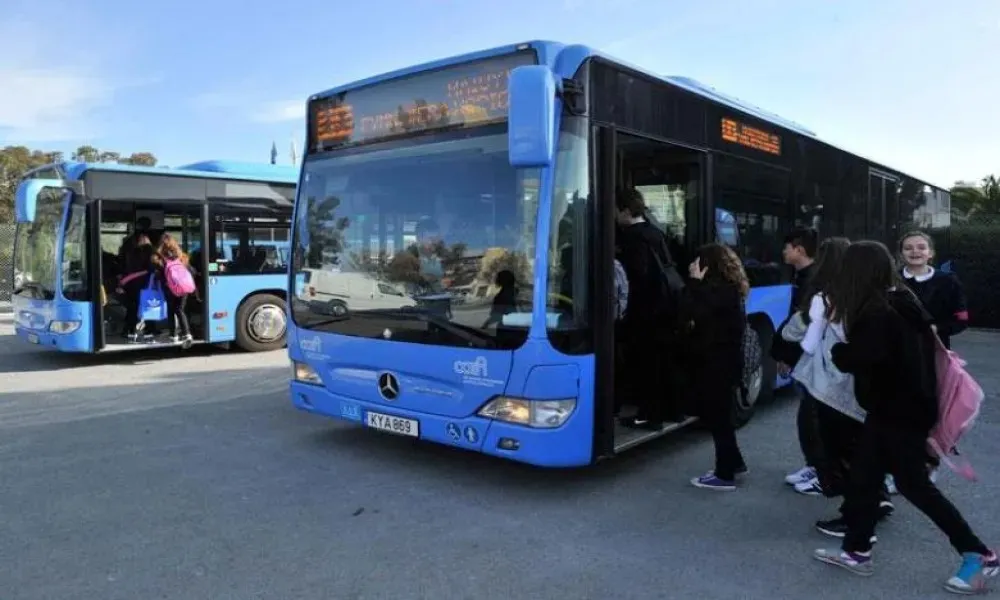

On 10 May 2023, a bus carrying students on a school trip lost two wheels while in motion on the Nicosia–Larnaca motorway, near the Athienou exit. One of the wheels struck a second bus, which was also transporting students. No injuries were reported.
On 25 May 2023, the issue reached the Parliamentary Transport Committee. What was discussed there was not an isolated incident. It was noted that wheels had come off buses while in motion before, that a similar incident had occurred six months earlier, and that in recent years there had been “three to four” cases of fires on moving buses and “two to three” cases of tyres detaching. The warning was clear: next time, we may not be so lucky.
On 1 December 2023, a school bus in Aglantzia caught fire while carrying students. The fire broke out at the rear, in the engine compartment, and spread internally. The driver managed to stop in time and the students exited safely.
On 23 September 2025, a student bus in Chloraka caught fire as it approached a stop where students were waiting to be transported to Empa Regional Lyceum.
On 11 March 2026, a fire broke out in a bus outside a primary school in Limassol. The driver noticed the fire as the bus was starting and managed to exit, while the vehicle suffered extensive damage in the engine compartment.
These were not merely “incidents.” They were warnings. The latest report by the Audit Office, and especially the response of the Ministry of Transport to its findings, confirm the view that it is by sheer luck that no lives have been lost so far.
Among other findings, the Audit Office notes that 53% of school buses did not present themselves on time for the mandatory special technical inspection, while buses that had already been deemed unfit continued to operate student routes without a valid roadworthiness certificate.
The law provides that any vehicle called for an extraordinary inspection that fails to appear loses the validity of its roadworthiness certificate until it is checked and approved. However, the full implementation of this measure was not carried out. In its response, the Ministry of Transport cited the risk of paralysing student transport. In simple terms, faced with the possibility of schools being left without buses, the safety of children was placed second.
Half were not inspected
According to the Audit Office, student transport in Cyprus is served by more than 600 buses nationwide. Following incidents that came to light in 2025, the Ministry of Transport issued instructions on 22 August 2025 requiring that all buses used for the 2025–2026 school year undergo an extraordinary technical inspection.
The checks were to be carried out in two phases. First, older buses aged 15 to 19 years were to be inspected by 30 September 2025. In the second phase, buses up to 14 years old were to be inspected by 28 November 2025.
The outcome was revealing: by the deadline, 53% of the fleet had not presented for inspection. In other words, more than half of the school buses remained outside the very inspection process the state itself had deemed necessary. No district achieved full compliance. Limassol recorded the highest participation at 70%, followed by Larnaca at 49%, Nicosia at 35%, Paphos at 34% and Famagusta at just 29%.
Those inspected were rejected
The situation becomes even more troubling when examining the results of those buses that were inspected. Of these, 35% were deemed unfit at the first technical inspection.
In Famagusta, 76% of inspected buses failed. In Larnaca and Paphos, the failure rate reached 47%, in Limassol 39%, and in Nicosia 8%.
The Audit Office also notes that the majority of buses presented for inspection came from the newer fleets of contractors, despite instructions to prioritise older vehicles. This suggests that the real condition of the older fleet may be even more concerning.
Passed privately, failed publicly
One of the most serious findings concerns the reliability of inspections carried out at private vehicle testing centres. The Audit Office records that 19% of school buses deemed unfit at state testing centres had previously passed inspections at private centres.
In several cases, the two inspections took place within a very short period, even within a week, with minimal difference in mileage. This raises serious questions regarding the strictness, quality and reliability of private technical inspections.
The Audit Office notes that the Registrar of Motor Vehicles has the authority to suspend or revoke operating licences of private testing centres in cases of non-compliance and calls for clarification on whether the ministry intends to investigate these cases.
Ministry response
In its response, the Ministry of Transport states that the Department of Road Transport took a number of actions to ensure contractor compliance, including issuing instructions, conducting checks and imposing penalties in cases of non-compliance.
However, the key point in the ministry’s response lies elsewhere. It states that the immediate and universal suspension of roadworthiness certificates for buses that had not presented for inspection would, in practice, have paralysed student transport, with serious operational and social consequences.
In other words, the state was aware that strict enforcement of the law would expose the system’s inability to guarantee adequate and safe transport. Rather than ensuring in advance that a sufficient and safe fleet existed, it found itself managing the problem only once it had already become a risk.
The Audit Office calls for meaningful and deterrent sanctions against private testing centres where inadequate inspections are identified, consequences for contractors who failed to comply, immediate withdrawal of any unfit bus and intensified road checks, particularly at the start of the school year.
“No excuse for negligence”
The report triggered strong reaction from organised parents. The Pancyprian Confederation of Parents of Secondary Education expressed serious concern, describing the situation as “bordering on mockery” and calling on the Ministry of Transport to impose exclusions and penalties on those who broke the law.
At the same time, it made clear that “the safety of students will never be a game” and that it will not remain indifferent to a situation which, as it said, puts children at risk.