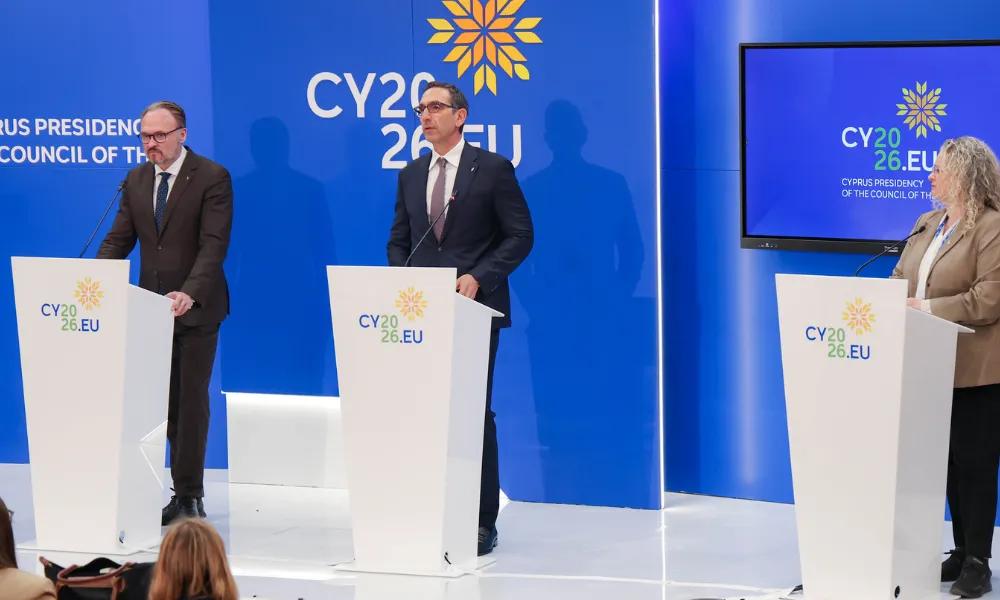
Almost 3,000 residential units are expected to be added to Cyprus’ housing stock over the next two years through an existing housing programme, Interior Minister Constantinos Ioannou said on Tuesday.
Speaking after the Informal Ministerial Meeting on Housing in Nicosia, held under Cyprus’ Presidency of the Council of the EU, Ioannou said investment in affordable housing must be made more attractive. The meeting focused on the need to increase housing supply across the EU, mobilise funding, simplify planning and building procedures, and address the impact of short-term rentals in areas under housing pressure. European Commissioner for Energy and Housing Dan Jørgensen expressed concern over the rise in short-term rentals, saying their number almost doubled between 2018 and 2024. In some neighbourhoods and tourist areas, he said, they now account for up to 20% of the housing stock.
Jørgensen said the Commission’s forthcoming Affordable Housing Act would give local authorities tools to limit the negative impact of short-term rentals in areas facing housing problems, alongside broader measures to strengthen affordable housing. “Our ambition to make concrete efforts in areas facing housing problems will be realised when we present our Affordable Housing Act,” he said, adding that the aim is to ensure that “ordinary people with ordinary jobs can actually live where they serve”.
The Commissioner also referred to the wider housing crisis in Europe, noting that house prices have risen by more than 60% since 2013, while average rents have increased by around 20%. He said simplifying bureaucracy for new housing permits and renovation projects is essential to speed up new construction and the use of existing buildings. He also pointed to a pan-European investment platform intended to help market participants cooperate and mobilise funding.
According to Jørgensen, housing-related investment initiatives are expected to mobilise an additional €10 billion, while financial institutions have committed to mobilising €375 billion by 2029. He also said EU state aid rules had been too rigid and had been changed to allow member states to support housing more broadly.
“In Europe, we want a housing policy that puts people above profit, social inclusion and wellbeing above profit,” Jørgensen said, adding that Brussels alone cannot solve the crisis. He also announced the launch of the European Housing Alliance, saying experts from member states, regions, cities, stakeholders and local communities should help shape the future of housing policy.
Ioannou: Incentives and cooperation needed
Ioannou, who chaired Tuesday’s meeting, said discussions centred on the urgent need to increase housing supply. He said reduced investment in housing across Europe is linked to rising construction costs, high interest rates and economic uncertainty. Addressing these imbalances, he added, requires “targeted policy interventions, stronger incentives and closer cooperation between the public and private sectors”.
The Minister also stressed the need to tackle administrative complexity, which continues to delay new developments and renovations. “Simplification does not mean deregulation,” he said. Ioannou welcomed European-level initiatives aimed at improving coordination and unlocking new financial opportunities, while underlining that member states remain responsible for shaping their own affordable housing plans. “By changing state aid rules and through the other proposed measures, we are being given the tools to make it more attractive,” he said.
He added that the meeting allowed ministers to exchange views and best practices, referring to Estonia’s fully digitalised permit process as an example. “At the end of the day, by simplifying the licensing process, administrative costs are reduced, making investment more attractive for the private sector because it saves time and money,” Ioannou said.
The Minister also referred to innovative construction methods, including modular and off-site construction, as well as digital tools such as building information modelling. These, he said, can significantly speed up housing delivery, reduce costs and improve transparency. At the same time, he added, investment in sustainable building materials and the integration of circular economy principles are necessary for meeting climate targets.
Asked whether there had been positive feedback from the construction sector so far, Ioannou said it was still too early to say. He noted that countries are now adapting their national housing plans following the presentation of the European affordable housing plan. He referred, however, to a housing programme in Cyprus which he said is already proving successful, with almost 3,000 residential units expected to be added to the housing stock over the next two years.
Source: CNA