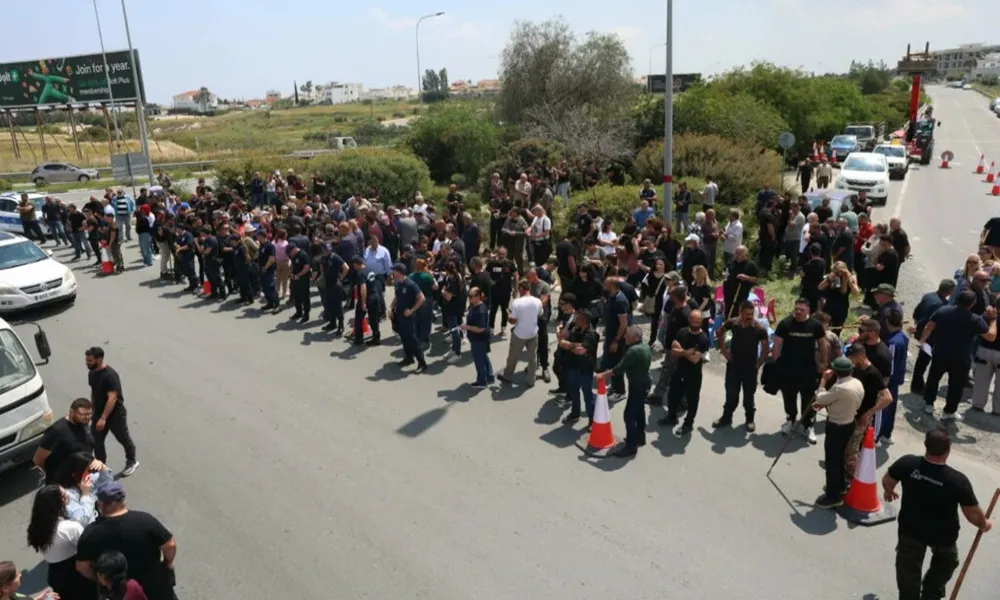

Cyprus's Veterinary Services and Police have drawn up a joint action plan to be activated if tensions with protesting livestock farmers escalate, following an incident in which Veterinary Services officials were prevented from taking samples at a farm in Pachna and an attack on a RIK television crew by demonstrators. Police spokesperson Vyronas Vyronos told Politis that as of Thursday afternoon, following a morning meeting between the Limassol police chief and a farmers' delegation at the Pachna Community Council, there were no signs of escalation and a degree of cooperation was being observed. He made clear, however, that "if something like that is observed, there is an action plan and in every case the law will be enforced."
The incident in Pachna, in which Veterinary Services officials attempting to take samples were obstructed, is now under police investigation.
Veterinary Services hold the line
Veterinary officer at the Ministry of Agriculture Nadia Kalli said the services have a protocol and a legal framework they are obliged to implement, and that no exception or deviation from those protocols is foreseen. "The decisions taken are not unilateral," she explained, adding that as of now, and on the basis of current data, the Veterinary Services are proceeding as planned. On the question of whether the culling of animals at the Pachna farm found to be positive might be postponed, the services are keeping their options open and monitoring developments before taking any further decision. According to information obtained by Politis, should officials attempt to enter the farm, they are expected to do so under police escort for security reasons.
'Greater destruction for our economy'
The Ministry of Agriculture's director-general, commenting on the Pachna case earlier on Thursday, described it as a deterioration that makes the situation considerably more difficult. "There is great concern and worry about how the virus reached a small, isolated unit. The virus does not travel on its own. Someone transported it through their activities, their movements, possibly through carelessness or negligence," he said. He stressed that strict implementation of biosecurity measures is the only way to stop the spread, pointing to other countries that have successfully managed similar outbreaks by doing precisely that. On the farmers' group "Voice of the Livestock Farmers" and its calls to obstruct cullings, he was direct: "If we continue with these activities, unfortunately the problem will spread, with greater destruction both for our livestock sector and our economy, with negative consequences expected across all sectors."
A meeting between the Ministry of Agriculture, livestock farmers and farming organisations scheduled for Monday at the ministry is expected to be decisive for the tone of what follows. A ministry source told Politis the aim is to work through dialogue and communication "to prevent and resolve problems."