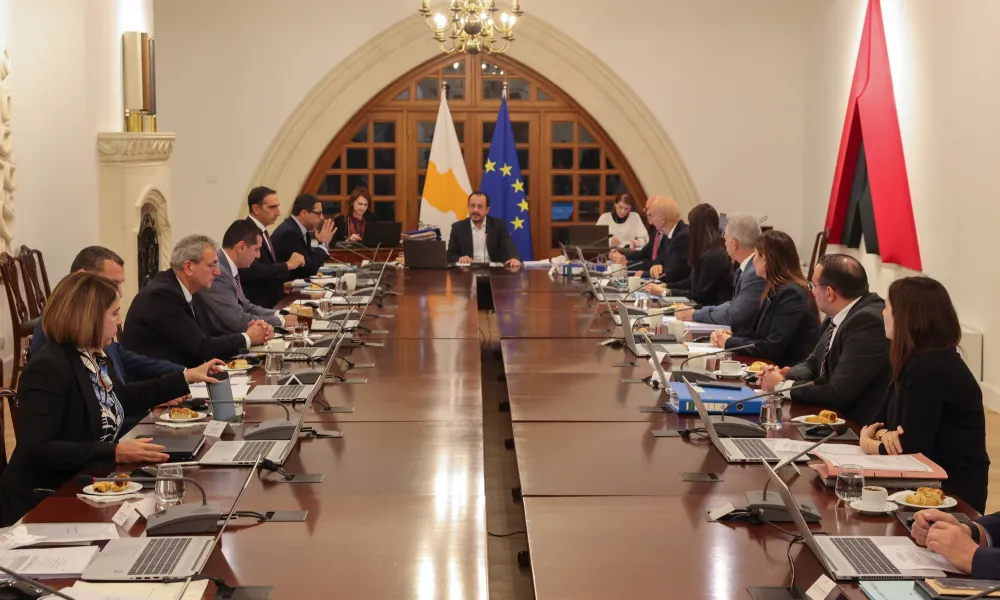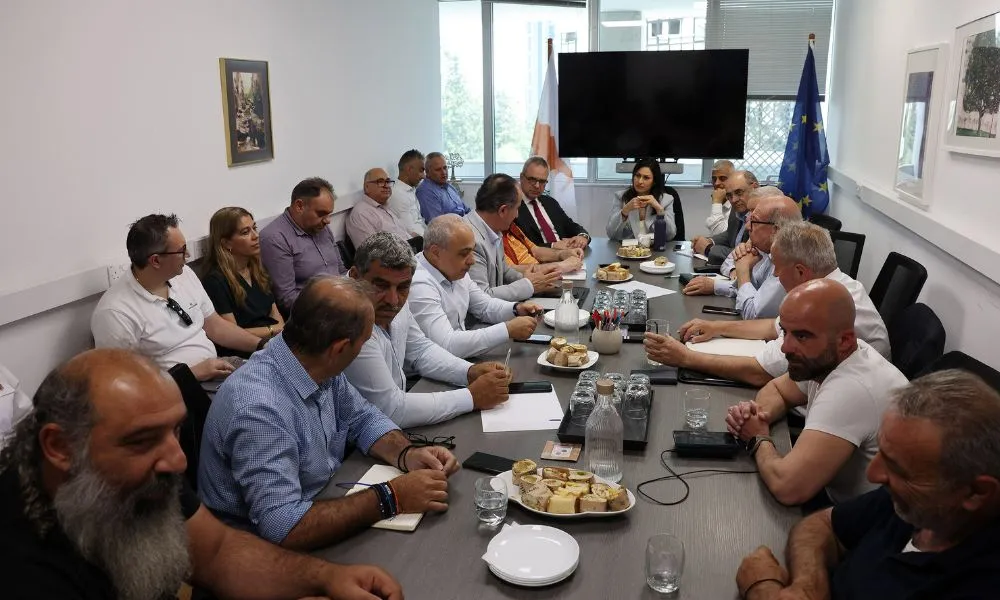
The need for continued dialogue on the issues facing the livestock sector in the shadow of foot‑and‑mouth disease was highlighted by the expanded meeting held in the afternoon at the Ministry of Agriculture under Minister Maria Panayiotou. Despite progress on certain issues, objections remain from the group 'The Voice of Livestock Farmers' regarding the compensation package, as agreed between the Ministry of Agriculture and the organised agricultural organisations.
After the meeting, 'The Voice of Livestock Farmers' announced that it will convene to decide on its next steps. Neophytos Neophytou, president of the group, stated that “today, we saw that we all agreed with one another, but in the end, from what I understand, we did not agree on anything.”
The situation in the occupied areas
During the meeting, the organised agricultural organisations and the livestock farmers’ group found themselves on common ground regarding the absence of a unified policy towards the virus across the entire island, Politis has learned. Specifically, they reiterated their concern that the measures currently taken by the Republic of Cyprus are ineffective, as long as the European protocol of mass culling is not implemented in the occupied areas, allowing the virus to re‑emerge in the future and be transferred to the free areas.
At that point, the Greek Cypriot negotiator for the Cyprus problem, Menelaos Menelaou, who was invited to participate in the meeting, said that the Republic of Cyprus is making efforts through the European Commission to provide Turkish Cypriots with incentives to adopt the European protocol. He also referred to work being carried out at the level of the bicommunal Health Committee, where the two sides exchange information and hold discussions on foot‑and‑mouth disease.
Compensation
Another issue raised by 'The Voice of Livestock Farmers' concerned the payment of compensation, on which the group found itself at odds with the agricultural organisations. Following lengthy dialogue with the Ministry of Agriculture, the agricultural organisations expressed satisfaction with the final package announced last week, which is scheduled to be submitted to the Cabinet tomorrow.
The demands raised concerned both the level of compensation and the criteria and procedures for determining it, with calls for 'less bureaucracy.' According to information, this prompted the Minister of Agriculture to propose postponing today’s submission of the compensation package to the Cabinet and initiating a new round of dialogue in the presence of both the organised agricultural organisations and the livestock farmers’ group. This, however, led the agricultural organisations to express reservations, citing concerns about serious delays.
They explained that the compensation levels are very satisfactory and correspond to the breed of animals held by each farmer, allowing the amounts to be distributed in what they consider a fair manner. According to Politis, a representative of an agricultural organisation asked a representative of the livestock farmers’ group what level of compensation per animal category would be satisfactory. Upon receiving the answer, the representative assured him that, based on the agreement between the organisations and the ministry, the amounts would be significantly higher than those mentioned.
Since the Minister of Agriculture did not receive a response to her proposal, the decision remains in force to submit the compensation package to the Cabinet tomorrow.
The livestock farmers’ group was also briefed by the Veterinary Services and the special scientific committee on the way the virus spreads and how the scientific approach to tackling it operates, based on the European protocol.
“The meeting was mainly informative”
In statements after the meeting, Michalis Lytras, honorary president of the Cyprus Agricultural Union, said that the meeting was mainly informative. He noted that the compensation rates to be submitted to the Cabinet today for approval, to compensate producers for the culling of animals, had been finalised a week ago by the Advisory Committee appointed by the Ministry of Agriculture.
“We will see the results tomorrow, once they are approved by the Cabinet, and then we will discuss the remaining issues concerning the reactivation of producers who wish to continue in our profession,” he added.
Responding to a question, Mr Lytras said that during the meeting they were informed about certain actions being taken to address the problem of foot‑and‑mouth disease in the occupied areas. As he explained, “if the appropriate measures are not taken in the occupied areas, the virus will persist. Animals are culled in the free areas, they are restocked, and the virus returns”.
Regarding the issue of animal culling, he said that this “is being examined by the Veterinary Services in line with the protocols, so nothing has changed in the decisions.”
“In the end, we did not agree on anything”
For his part, Neophytos Neophytou, president of 'The Voice of Livestock Farmers.' stated that “today, we saw that we all agreed with one another, but in the end, from what I understand, we did not agree on anything.”
As he said, “at the end of the meeting we raised the issue of compensation, animal welfare and so on, and we were told that these have already been decided. Tomorrow we all know that we are going to the Cabinet,” he said. “We believe that without having something official to read, to refer to, to discuss the results that they themselves have put on paper, we cannot agree,” he stressed.
Responding to a question on the issue of compensation, Mr Neophytou said that “for sheep and goats, we discussed amounts ranging from €47 to €420, and we realised along the way that because of the difference between these amounts, various documents need to be submitted to certify certain situations. We do not know exactly, and we cannot agree with something. They may well be perfect, the best that could be done. However, as long as we do not know them, we cannot agree”.
He also said that he raised the compensation issue at the end of the meeting, adding that there were several reactions from most of those present. “The atmosphere was very good,” he noted, stressing that “we spent a lot of time on Turkish Cypriot issues.” Referring to Turkish Cypriots, Mr Neophytou said that “everyone agrees with us, and if we are lying anywhere, let them contradict us. Everyone agrees with us on how things are being handled, on European Union funds and on illegal grazing, but in the end we fell out over compensation, where we should have been present and were not.”
He added that the group submitted a proposal regarding the ages of the animals, which would apply generally to cover compensation and, when compared with the compensation already decided, might prove fairer for everyone. “We do not want to wrong anyone. We want to preserve the sector. We all need to take on board the message, and we should not say that we agree and then nothing happens and the next day things become worse,” he concluded.