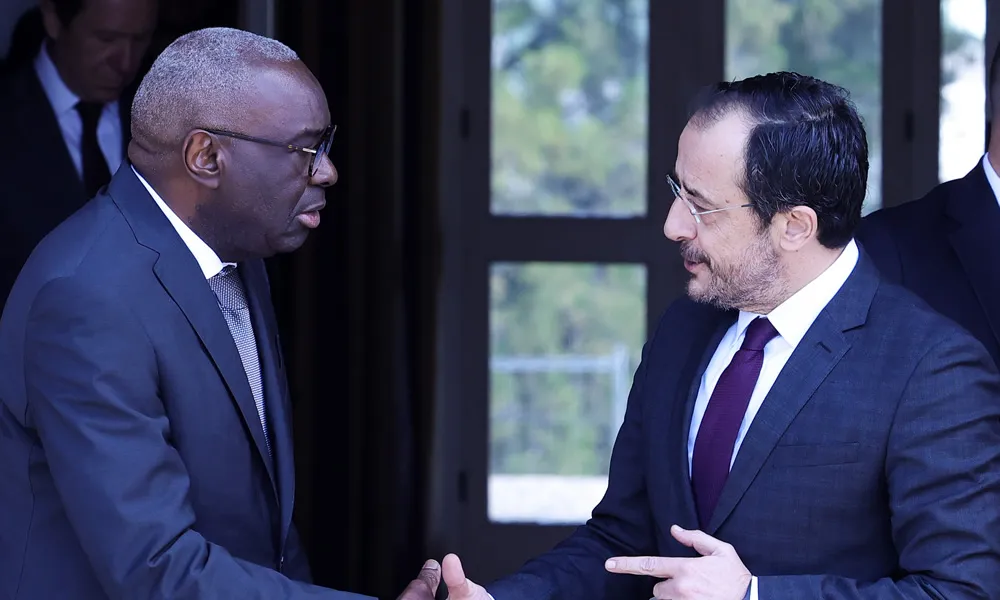



The Special Representative of the UN Secretary-General and head of the United Nations Peacekeeping Force in Cyprus (Unficyp), Khassim Diagne, said on Tuesday that the past several months have seen limited but substantive developments on the Cyprus problem.
Speaking at an EU Policy Forum held to mark the 20th anniversary of the EU Aid Programme for the Turkish Cypriot community, at the Ledra Palace in Nicosia, Diagne reaffirmed that the United Nations remains firmly committed to facilitating a Cypriot-led and Cypriot-owned negotiation process aimed at a comprehensive settlement of the Cyprus problem.
"In this context, there have been limited but substantive developments in recent months. Since October 2025, we have seen greater willingness and commitment from both leaders to engage in dialogue, to reach consensus on confidence-building measures and to cooperate on a wide range of issues that cut across the dividing line," he said.
Last week's leaders' meeting
Diagne described the outcome of last Friday's leaders' meeting as particularly encouraging. The two sides reached a framework agreement on an advisory body for civil society participation, agreed to work on a plan to improve and safeguard the conduct of religious services across the island, committed to a coordinated response to foot-and-mouth disease, and agreed to examine economic matters including the designation of products as Protected Designation of Origin (PDO) and Protected Geographical Indication (PGI).
The United Nations, Diagne said, believes that "these gradual steps matter and that sustained engagement is needed for a meaningful political process." He added that the Secretary-General and his Personal Envoy, Maria Angela Holguin, "are fully committed to building on the recent positive steps, with the aim of enabling all parties to engage in substantive political discussions in the coming months."
Diagne noted that Unficyp will continue to work closely with the Secretary-General's personal envoy and to support her critical efforts to advance the peace process. The force will also continue working with both sides "to maintain calm and stability in and around the buffer zone and to minimise incidents, so that developments on the ground do not distract the leaders from the broader political process."
Reflecting on Europe Day, he said that peace, reconciliation, solidarity and cooperation are values of particular importance in Cyprus, where the European project is directly linked to the search for a comprehensive and lasting solution to the Cyprus problem. He noted that this year's celebrations coincide with the 20th anniversary of the EU aid programme for the Turkish Cypriot community. "For two decades, the aid programme has contributed, among other things, to improving living conditions, strengthening civil society, preserving cultural heritage and supporting bicommunal cooperation across the island," he said, adding that these efforts align closely with the UN's confidence-building work, recognising that peace is sustained not only through negotiations but through trust, opportunity and everyday cooperation between communities.
Greek Cypriot negotiator: 'A slow, spiral path'
Greek Cypriot negotiator Menelaos Menelaou spoke of "a slow, spiral path towards the consensual model." He said the significance of what has already been achieved, and what continues to be achieved, should not be underestimated.
"We must constantly bear in mind and be guided by the need to answer effectively the most pressing question that must be addressed, which relates to the critical dilemma we inevitably face. And that is the choice between a federal, reunited Cyprus with functioning institutions of consensual governance within the European Union, or the continuation of a competitive, conflict-based paradigm that would consign Cyprus to a troubled future," he said.
Reflecting on settlement efforts from 2004 to the present, which he said have produced convergences on key chapters, and observing the momentum developing at the societal level, Menelaou said he believes Cyprus is "on a slow, spiral path towards the consensual model, which of course needs to become more cohesive and more concrete."
On the occasion of the 20th anniversary of the EU aid regulation for the Turkish Cypriot community, Menelaou underlined the opportunities Cyprus holds as an EU member state. He expressed doubt as to whether, following the unsuccessful settlement attempts to date, the prospect of reunification would have remained alive without the dimension offered by Cyprus' EU membership. "This capacity laid the foundations not only for a framework of policy, economic support and engagement for the Turkish Cypriot community, but also for the development of cooperation, interaction and joint activities between people in their daily lives," he said. The more that is achieved in this regard, he added, the better it will be for reunification efforts.
Turkish Cypriot representative
Turkish Cypriot Special Representative Mehmet Dana noted that over the past 20 years the EU aid programme has made a significant contribution through support for infrastructure, education, environmental protection, public health, cultural heritage, capacity building, civil society and confidence-building initiatives, while also helping to maintain the Turkish Cypriot community's connection to the European Union. He added that the programme has also funded joint actions, including the work of the Committee on Missing Persons and the Technical Committee on Cultural Heritage.
Dana said the anniversary offers an opportunity to re-examine how the international community in general, and the European Union in particular, can contribute more effectively to building trust between the two sides, paving the way for an eventual solution to the Cyprus problem.
Source: CNA