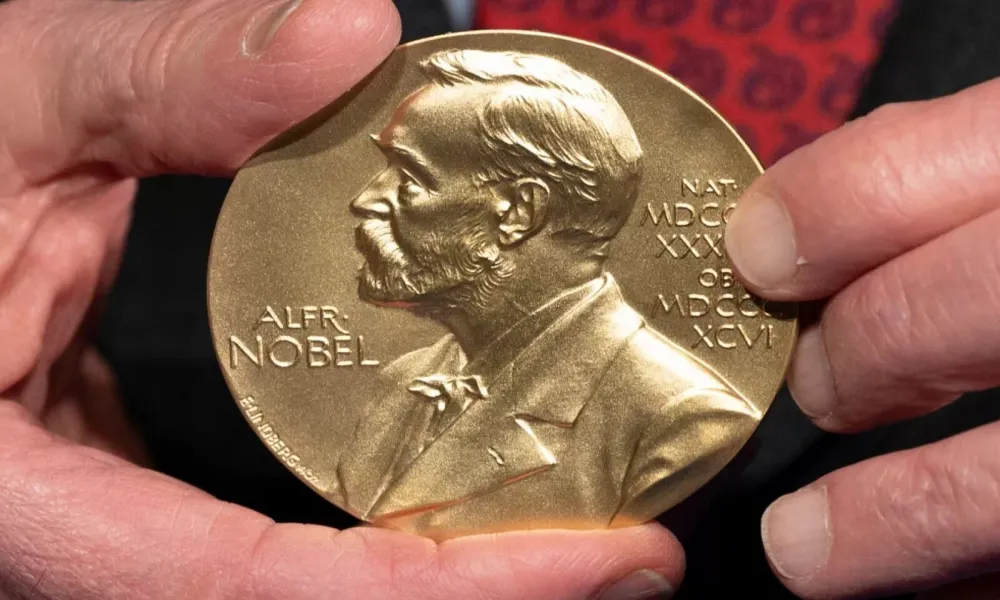

Sweden's Nobel Foundation announced on Thursday that it will increase the prize money for this year's Nobel Prizes by 9%, raising the award to 12 million Swedish kronor (about $1.22 million) for each of the six categories. The decision comes as the Foundation marks the 125th anniversary of the first Nobel Prizes.
Why the Foundation is raising the prize money
"By increasing the prize money, we are supporting the long-term significance of the Nobel Prize and ensuring that the monetary part of the prize retains its value over time," said Hanna Stjärne, Executive Director of the Nobel Foundation, in a statement.
This year's laureates in Physics, Chemistry, Peace, Literature, Economics and Physiology or Medicine will be announced between 5 and 12 October.
A prize with a 125-year history
The first Nobel Prizes were established under the will of the Swedish inventor of dynamite and businessman Alfred Nobel and were first awarded in 1901, accompanied by a prize sum of 150,782 Swedish kronor per category, according to the Foundation.
Greece's Nobel laureates
Greece's own history with the prize stretches back more than sixty years. Giorgos Seferis won the Nobel Prize in Literature in 1963, followed by Odysseas Elytis in 1979. Greek literature came close to a third Literature prize in 1957, when Nikos Kazantzakis lost the award to Albert Camus by a single vote. Camus later said Kazantzakis deserved the honour "a hundred times more" than himself.
Cyprus's Nobel record
Two laureates of Greek Cypriot descent have also been recognised by the Nobel committees. Sir Christopher Pissarides, born in Nicosia, won the Nobel Prize in Economic Sciences in 2010 and remains the only Cypriot-born Nobel laureate to date. Demis Hassabis, the British computer scientist of Greek Cypriot descent, shared the Nobel Prize in Chemistry in 2024 for his work on protein structure prediction. Cyprus has also had a Nobel presence beyond its winners: in 2019, the investigative journalist Sevgül Uludağ, a former columnist for Politis, was nominated for the Nobel Peace Prize for her work documenting the fate of people who went missing during the intercommunal conflicts of 1963-64 and 1974.
Which countries have won the most Nobel Prizes
Since 1901, the Nobel Prizes and the Nobel Memorial Prize in Economic Sciences have been awarded 577 times to 889 recipients in total. The United States leads by a wide margin with 425 laureates, followed by the United Kingdom with 144, Germany with 116 and France with 78. Sweden, the home of the prize, has produced 34 laureates, ahead of Japanwith 33, Russia and the former Soviet Union with 30, Canada with 29, Switzerland with 27 and Austria with 25.