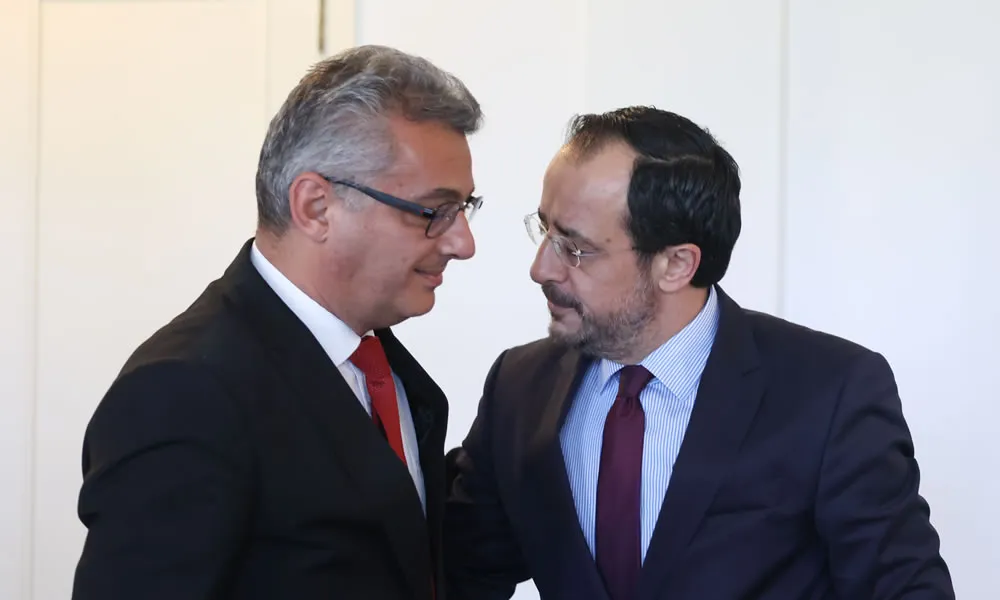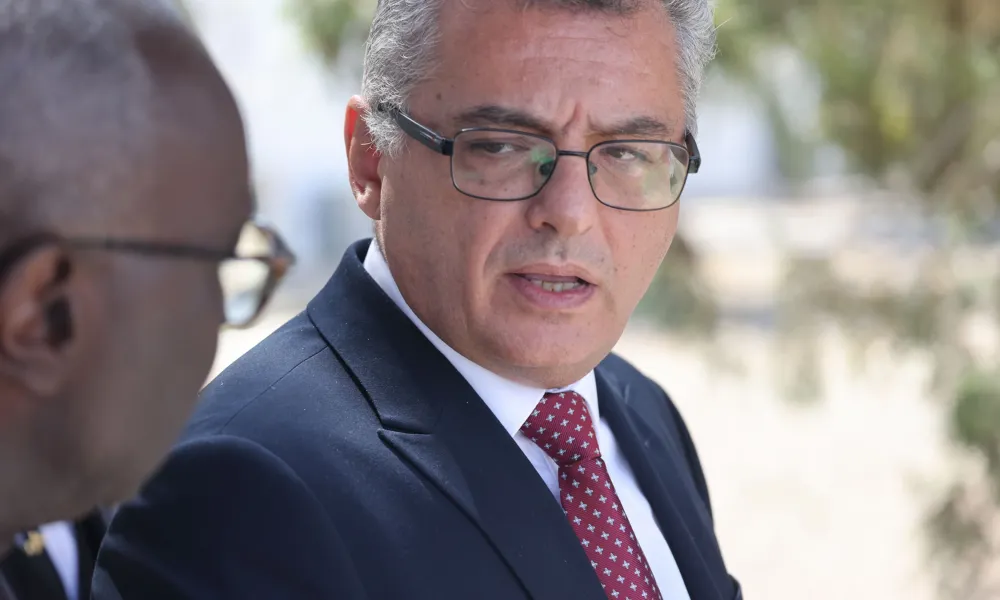

Turkish Cypriot leader Tufan Erhürman has called for efforts to focus on the seven areas in which UN Secretary-General António Guterres asked for progress after leaving Cyprus in July, following a meeting with Guterres in New York that lasted about 40 minutes. Speaking live on the Turkish Cypriot broadcaster BRT after the meeting, Erhürman said the UN was also concentrating on confidence-building measures (CBMs). He listed the seven areas as new crossing points, demining, a joint disaster response mechanism, a joint mechanism to tackle irregular migration, a coordination council with civil society, sport, and the right of children of mixed marriages to EU citizenship. He said he attached particular importance to the last two. Erhürman repeated that he had told Guterres at their meeting in Nicosia that the Turkish Cypriot side accepts six of the seven measures, with the exception of new crossing points, and said he had made the same point at the leaders' trilateral meeting with the Secretary-General in Nicosia. On crossings, he said the options presented were worth working on and his side had not rejected them, but accepting them as they stand was out of the question.
Dispute over the 19 points
Erhürman claimed that the Greek Cypriot side has still not said whether it accepts the six measures other than the crossing points. Instead, he said, it tabled a new 19-point proposal at the leaders' last meeting in Nicosia before they travelled to New York, remarking that his side had not counted 19 points but would call it that. He stressed that time was limited because Guterres' term ends soon, and said that for this reason the Turkish Cypriot side favoured concentrating on implementing the seven measures. Broadening the agenda and shifting attention to new issues would make results harder to achieve, he said, adding that he had told the Secretary-General that both sides should focus on the seven points and try to find solutions on them.
Actions he says erode trust
Erhürman said that instead of the climate of trust Guterres had called for, actions were being taken that, in his words, poison trust. He cited the cancellation of two festivals and of a youth camp run by the Barcelona football academy, as well as European arrest warrants issued in property cases, and said he had raised these issues with Guterres. He also spoke of backsliding on the acceptance of the 'Immovable Property Commission' as an effective domestic remedy. He described European Parliament resolutions as biased in every respect and claimed they were adopted on the initiative of what he called arrogant Greek Cypriot MEPs. He also pointed to a series of international agreements, mainly with Israel and other countries. "It is as if there are no Turkish Cypriots on the island at all," Erhürman said. He argued that any resulting danger would affect Turkish Cypriots as well as Greek Cypriots, and that none of this helped the efforts of the Secretary-General, who has said he will work tirelessly until the end of December.
Erhürman said he had chosen not to make statements to the media during his three days in New York, because he did not consider negotiating through the press consistent with seriousness or good faith, and that the Turkish Cypriot side had been very patient on this. He said he had avoided speaking even about serious matters discussed on both sides, such as the title used for Mehmet Harmancı, the 'mayor' of north Nicosia, at the Cyprus Forum, in the hope that a result or a step forward might emerge in New York. He claimed that the Greek Cypriot side chooses to make statements every day and that an attempt had been made to create the impression that the Turkish Cypriot side had rejected a 2+1 meeting. He recalled that Guterres had recently said there was still much work to be done and that there was no prospect of a 2+1 or 5+1 meeting in New York.
Erhürman also claimed that, while he was in New York, the Greek Cypriot side tried in writing, through the Security Council and the UN, to block the Turkish Cypriot side's contacts with representatives of the international community. He said a similar incident had occurred after Guterres' visit to the island, when his special representative Mehmet Dânâ was due to meet foreign diplomats in the buffer zone in Nicosia. He said he told the Secretary-General that these were examples of what his side calls actions and processes that erode trust. According to Erhürman, the attempts failed both in Nicosia and in New York. He said Dânâ met representatives of several countries, mainly permanent members of the UN Security Council such as Russia and France, while Erhürman himself met the secretaries-general of the Organisation of Islamic Cooperation and the Organisation of Turkic States. He claimed that on the Cyprus problem the Greek Cypriot side prefers to present only its own positions to the international community and to put obstacles in the way of the Turkish Cypriot side.
Concrete progress needed before a 5+1
Erhürman said he agreed with Guterres' earlier remark that the mistakes of the past must not be repeated and that this time things must be different. He repeated that holding a new 5+1 meeting without substantive progress would not be right. As in previous processes, he said, simply holding a meeting is not enough, because it has to rest on a basis that produces concrete progress. He added that had something results-oriented emerged in New York, the Secretary-General would have wanted a 2+1 meeting, but it did not. Erhürman said Guterres told them he would continue working on the Cyprus problem until the end of December, and he stressed the importance of creating an environment that supports the Secretary-General's efforts. Asked by the presenter about Guterres' position on the CBMs, Erhürman said the Secretary-General expected progress and made that expectation clear from the start of the meeting.
According to a statement from the Turkish Cypriot 'presidency', Erhürman was joined at the meeting by his special representative Mehmet Dânâ, Murat Soysal, the north's 'representative' in New York, Senihe Birand Çınar, coordinator for confidence-building measures and technical committees, and İpek Borman, his adviser on diplomatic affairs.
Source: CNA