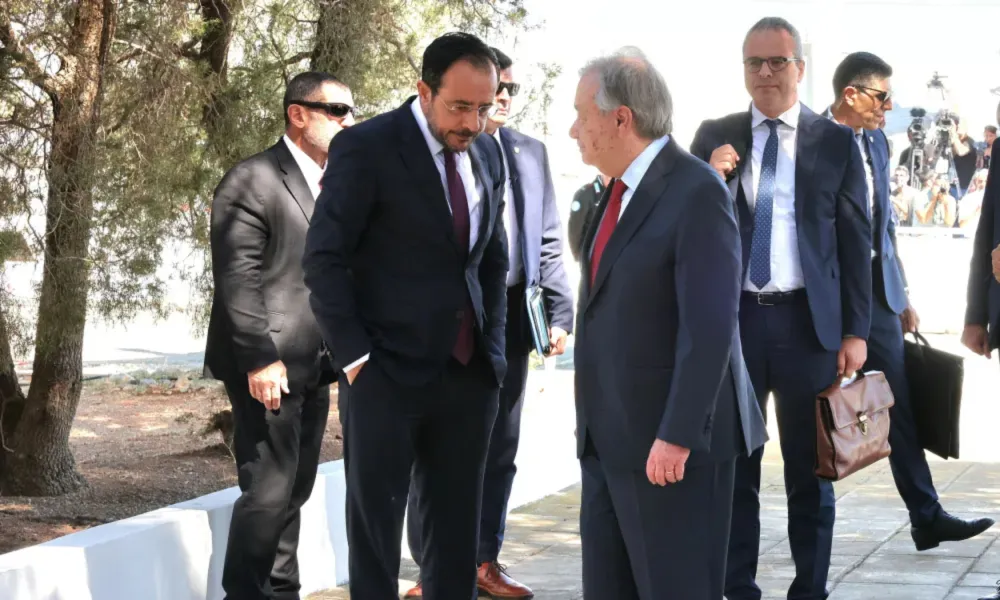

It was clear from the outset that António Guterres' visit to Cyprus was not primarily aimed at announcing the launch of a new round of negotiations. Its purpose was to determine whether the political conditions exist for the Cyprus settlement process to regain momentum.
The Secretary-General's message was carefully worded but equally clear: a new informal 5+1 conference will take place only if there are genuine prospects for progress within the negotiating framework.
To that end, Guterres set out three key conditions: progress on Confidence-Building Measures (CBMs), agreement on methodology, and adequate preparation on the substance of the negotiations.
In essence, he shifted responsibility to the two sides, and particularly to the two leaders, calling on them to demonstrate in practice that they possess the political will necessary for compromise and for completing the "last mile" towards a comprehensive settlement, as emerged nine years ago at Crans-Montana.
Prospect, not abandonment
This approach does not amount to the United Nations abandoning the effort.
On the contrary, the Secretary-General is leaving the prospect of a new initiative open, but he is not prepared to convene yet another conference without a realistic prospect of success.
His comment that he does not want "a 5+1 that would fail and produce no results" reflects the new philosophy underpinning his approach.
This caution can be explained by two main factors.
The first concerns the credibility of both sides when it comes to implementing even limited Confidence-Building Measures.
For years, meetings and discussions have taken place without meaningful results, even on low-politics issues such as the opening of new crossing points.
The current leaders have failed to implement any of the most recent recommendations made by António Guterres himself, both during previous five-party meetings and in his reports to the Security Council.
It is therefore reasonable for international mediators to question how a comprehensive agreement can be achieved when progress cannot even be secured on relatively low-level issues.
The second obstacle is sometimes less visible and relates to the diverging political perceptions of the two communities.
On the one hand, there is a view that the Greek Cypriot leadership, despite its public statements, does not appear fully convinced about political equality in the way it is understood by the Turkish Cypriot side.
On the other hand, there is a perception that Turkish Cypriots do not appear willing to move away from Turkey's decisive influence, or at least to pursue the elements that would gradually allow greater autonomy from Ankara during the negotiation process, based on both the experience and example of former Turkish Cypriot leader Mustafa Akinci.
This gap remains the most significant political obstacle to restarting meaningful negotiations.
Turkey's consent
Based on developments in recent days, it is clear that the Secretary-General's initiative has created the impression that Turkey has consented to discussions on a new informal five-party conference.
At the same time, Ankara continues to link its relations with the European Union to the Cyprus issue, seeking an upgrade of the Customs Union, visa facilitation and participation in European defence programmes.
In contrast, the Republic of Cyprus maintains that Turkey must first fulfil its Cyprus-related obligations.
Whether a mutually acceptable framework of trade-offs can be developed will be a decisive factor in shaping developments over the coming months.
Equally significant is the difference that emerged in public statements regarding the negotiating acquis.
The President of the Republic explicitly referred to continuing the process from the point where previous negotiations had been interrupted, although there remains some ambiguity as to whether he also includes the convergences reached at Crans-Montana.
By contrast, the Secretary-General limited himself to referring to the history of the negotiations, without committing to a process that would resume specifically from the Crans-Montana point.
This difference could become important if and when negotiations restart.
Continuing, but...
The main conclusion from the Secretary-General's contacts in Nicosia is that the process is not ending, but is entering a critical preparatory phase.
The United Nations is not prepared to invest political capital once again in an initiative that risks failing before it even begins.
The next conference will not precede political will on the part of the two sides. Rather, it will be the result of that political will.
That, essentially, is the Secretary-General's message.
Time, however, is not unlimited.
If both sides continue to focus solely on managing the deadlock, responsibility for yet another missed opportunity will not be attributable to the United Nations or the international community.
It will rest, first and foremost, with the parties directly concerned.