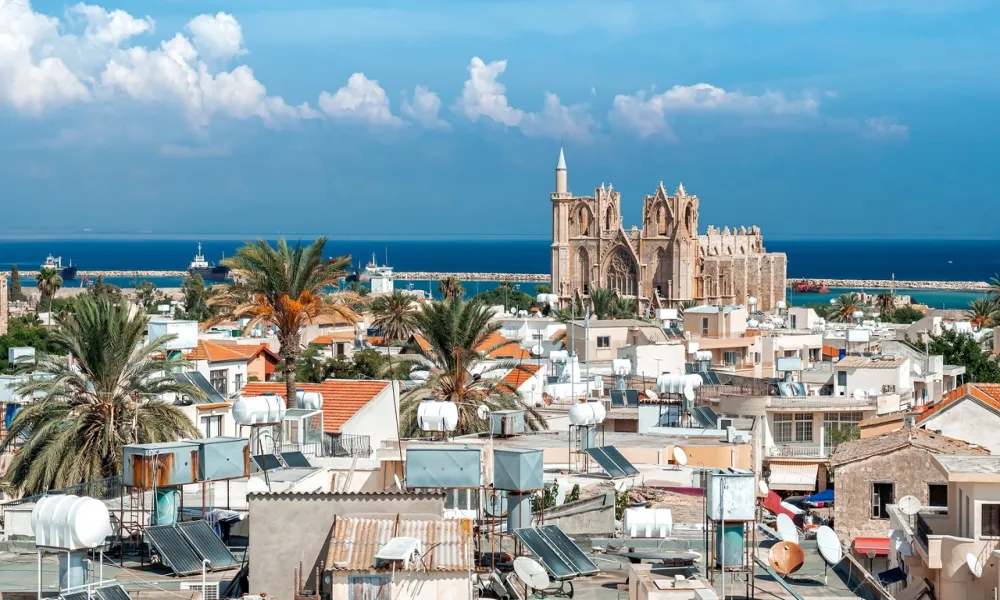

Greek Cypriot and Turkish Cypriot Famagustans have submitted a joint memorandum to UN Secretary-General António Guterres, asking him to place the implementation of relevant Security Council resolutions on Famagusta at the centre of his new initiative on the Cyprus problem, as the first substantive step toward a settlement.
At a press conference in Nicosia, Christakis Nikitas and Hulusi Kilim, two of the 11 people who signed the memorandum by name on behalf of other Famagustans, called on Guterres to hear their shared appeal for a return to their city. "We are civil society, a group formed over many years... fighting for the reunification of our homeland," Nikitas said, adding that the issue of Famagusta had, over half a century, come to resemble a proverbial unfinished bridge, a priority in the 1979 Kyprianou-Denktash high-level agreements now reduced, he said, to "dark tourism" along stretches of road inside the fenced-off city.
Nikitas recalled that Famagustans had prepared to return to their city in November 1978 under the American-British-Canadian plan, and on seven further occasions since, up to the Crans-Montana talks, alongside unfulfilled references to the city's return within various confidence-building measures. "We seized this opportunity, with the Secretary-General's visit to Cyprus, to raise the issue of Famagusta again," he said, under the slogan "Let Famagusta become the first symbol of the solution to the Cyprus problem."
Hulusi Kilim, another signatory, said Turkish Cypriots living in Famagusta have long stated clearly that Greek Cypriot Famagustans should return to their homes, and that the two communities should live together again in their shared city. He noted that Famagusta is also home to people displaced from other parts of the island, who understand what it means to be forced to leave behind a home, a neighbourhood and a past, saying that shared pain "should not distance us, but bring us closer."
Kilim described the situation in the fenced-off area of Famagusta as a form of "dark tourism," saying the practice does not represent Famagustans, calling it "completely wrong and unacceptable," and urging an end to what he called this psychological war. He said Cyprus needs more empathy, adding that only by understanding each other's pain and longing could meaningful, fair steps be taken.
The memorandum
The memorandum, already delivered to the UN Peacekeeping Force in Cyprus for handover to Guterres on his arrival, describes Famagusta as a unique case within the Cyprus problem, the only major urban area to have remained uninhabited for half a century and the subject of clear UN Security Council resolutions. It notes that the city has for decades served as a reference point for nearly all UN confidence-building efforts between the two communities.
"We call on you to place the implementation of the relevant Security Council resolutions on Famagusta at the centre of your new initiative on the Cyprus problem, as the first substantive step toward resolving it," the memorandum states, adding that the return of Varosha to its lawful residents would benefit not only them but could benefit the whole of Cyprus, through the revival of a historic city, the restoration of its economic and social life, cooperation between the two communities and the creation of a new climate of trust.
Famagusta, the memorandum adds, "is not a prize to be won by one community at the other's expense," and could instead become "the first major joint step toward Cyprus's reunification after half a century of division, and the beginning of new momentum." The signatories say it is not their place to specify what particular steps should follow or to pre-empt negotiations, but that the city's return should be accompanied by initiatives strengthening communication, economic cooperation, mobility and prosperity for both communities, building the trust needed for further mutually beneficial steps toward a comprehensive settlement based on UN resolutions and convergences reached to date.
Their joint presence and shared voice, the memorandum states, demonstrate that people from the same city can cooperate, trust one another and share a common vision for the future. The signatories express hope that their request will be met positively, on the basis of a mutually constructive approach from both sides toward a swift resolution of the Cyprus problem for the benefit of all island residents, and that Guterres's new initiative will encourage the two leaderships to resume a substantive peace process to cover, in their words, "the last mile" toward a final settlement.
The memorandum is co-signed by Ahmet Hıdıroğlu, Andreas Kazamias, Andri Epifaniou, Erhun Şahali, Christakis Nikitas, Anna Marangou, Hulusi Kilim, Hüseyin Bahça, Marianna Epainetou, Okan Dağlı and Pieros Karoulla.
Source: CNA