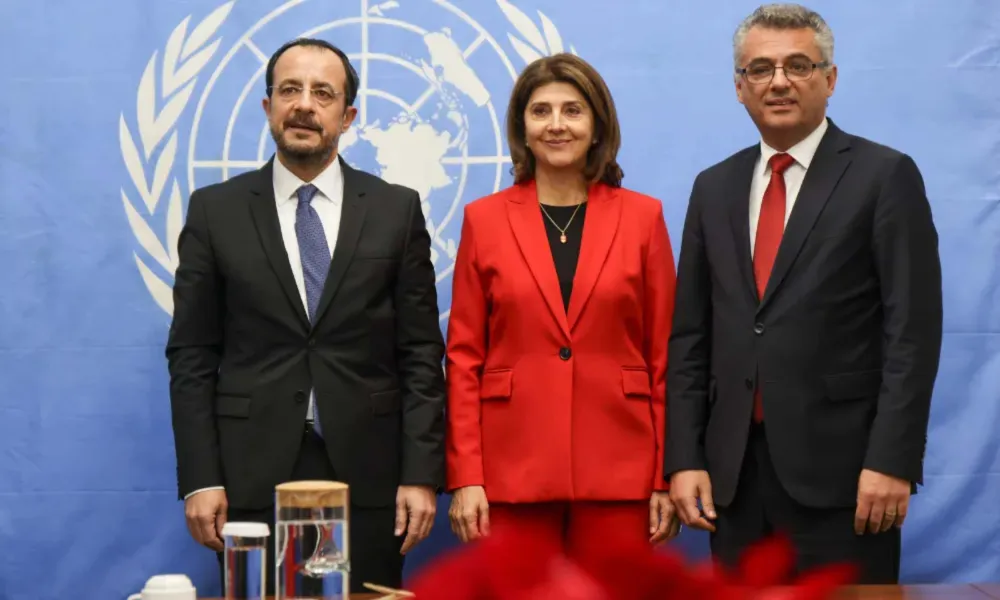

A flexible model for settling the Cyprus issue is reportedly being worked on by María Ángela Holguín, the UN Secretary-General's Personal Envoy for Cyprus, in an effort to narrow the gap between the two sides, according to a report by the British newspaper The Independent. The report echoes an earlier article in Politis regarding the settlement framework said to be under consideration by UN Secretary-General António Guterres.
The newspaper claims that the draft currently being discussed departs from the classic federal model and moves towards a looser form of federation, one that could be interpreted differently by each community.
According to the report, María Ángela Holguín is seeking to formulate an agreement that is sufficiently flexible for both the Greek Cypriot and Turkish Cypriot sides to argue that they have achieved their core objectives.
It is suggested that the proposed structure could allow Greek Cypriots to describe the solution as a federation, while Turkish Cypriots could present it as a confederation, through what is described as deliberate "constructive ambiguity."
The Independent notes that any potential agreement would also be of particular significance to the United Kingdom because of the presence of the two Sovereign British Base Areas in Cyprus and the role they play in developments and crises in the Middle East. The newspaper, however, refers to Turkey's 1974 invasion of Cyprus as an "intervention."
Two Constituent States and Limited Common Powers
The Independent, which claims to have knowledge of the draft proposal, says that it envisages the creation of two constituent states enjoying political equality and broad autonomy.
Most governmental powers would be exercised separately by the two constituent states, while the central government would have a limited role, dealing only with matters that cannot be managed independently.
Regarding common institutions, a rotating presidential council is reportedly being considered, consisting of the two leaders, with a ratio of either two-to-one or three-to-one in favour of the Greek Cypriot side.
Rather than a fully elected federal parliament, the proposal calls for a joint body comprising Greek Cypriot and Turkish Cypriot legislators.
The framework also envisages a joint cabinet with five or six ministries, including the ministries of Foreign Affairs, Defence, Interior, Finance and European Affairs.
Also under consideration is a provision granting at least one Turkish Cypriot minister a decisive vote within the cabinet. This arrangement is presented as a key guarantee of meaningful political equality and a safeguard for the Turkish Cypriot community.
Territorial Returns and Varosha
The report states that, in exchange for recognition and extensive autonomy, the Turkish Cypriot side would be expected to return territory, including Varosha.
The framework reportedly also includes replacing the 1960 system of guarantor powers with a NATO-linked formula involving a limited multinational presence.
A transitional period of two to three years is also said to be under consideration, during which territory would be returned gradually.
At the same time, discussion reportedly includes advancing Turkish Cypriot demands for direct trade, direct flights and direct contacts.
According to the newspaper, a Cyprus solution could also be linked to broader issues such as the exploitation of natural gas resources, the upgrading of EU-Turkey relations and the modernisation of the EU-Turkey customs union.
The Independent further claims that Turkish Cypriot leader Tufan Erhürman appears more willing to discuss such a framework, in contrast to President Nikos Christodoulides, who is portrayed as more cautious and influenced by domestic political pressures.
Reservations from Nicosia
The report also includes the position of the Republic of Cyprus, conveyed through Cyprus' Deputy High Commissioner in London, Spyros Miltiades.
According to his comments, there is, to his knowledge, no official UN proposal on which either side has been asked to express a position.
He noted that the ideas currently circulating appear to be closer to speculation than to a specific and comprehensive plan.
He also stressed that any meaningful progress on the Cyprus issue should emerge through the established United Nations-led process and within the framework agreed under UN auspices.