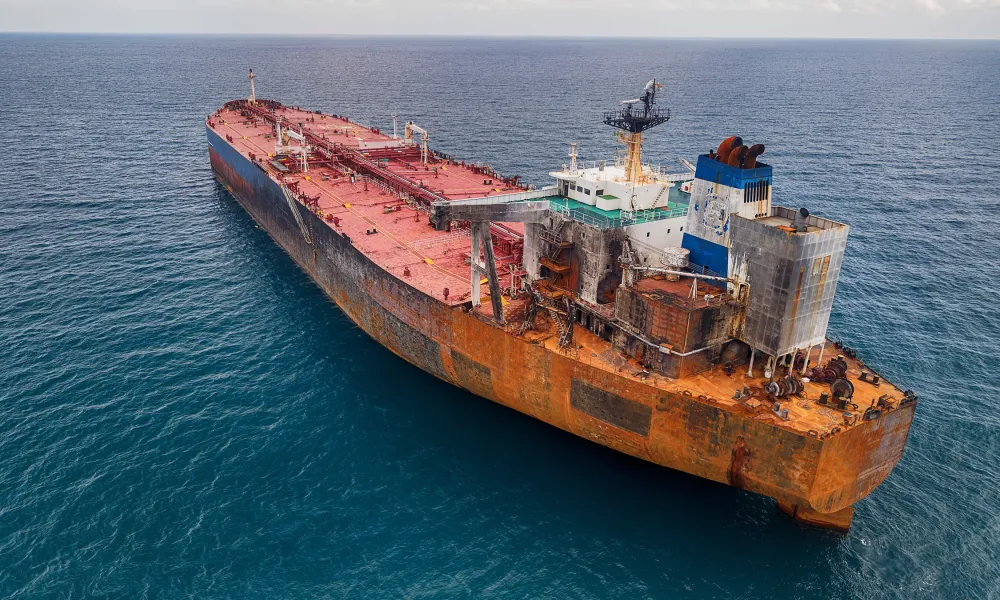

There is no official definition of a ‘shadow fleet’, but the title alone conjures up images of nimble, stealthy vessels operating in darkness, with tainted windows on the bridge. The reality is somewhat different.
The shadow fleet is a loosely organised network of vessels – typically large oil tankers with 15-plus years at sea – used to transport goods while evading sanctions, regulations or transparency requirements, often hiding ownership, origin or destination.
They operate day and night. Despite their size, they can be difficult to track, and even harder to stop when suspected of illicit activity – especially when protected by the navy of a sanctions-busting state.
Evasion techniques
Shadow fleets often use tactics such as disabling tracking devices – Automatic Identification System (AIS) transponders – manipulating tracking data (spoofing), conducting covert ship-to-ship transfers to conceal cargo origin, changing names repeatedly, and registering under different flags of convenience with weak oversight to evade sanctions and international controls. They use obscure or shell company ownership to hide who controls them and work with unregulated insurers or financiers, essentially leaving them uninsured in case of accidents, collisions or costly, damaging oil spills.
Significant risks
Experts argue that increased use of substandard, inadequately insured vessels operating under opaque ownership structures with reduced regulatory oversight, – that is, the shadow fleet – poses significant risks to maritime safety, navigation and environmental protection.
Apart from environmental damage to the ecosystem and impact on the economy of a coastal state (fisheries, tourism), in the case of uninsured tankers, an oil spill can cost around one billion euro to clean up.
In some cases, a shadow fleet vessel immobilised at sea, possibly due to mechanical failure, is simply abandoned, along with its crew, without adequate supplies.
The shadow fleet also enables illicit trade, including in arms, which can intensify conflict zones while impacting migratory flows.
Shadow fleet vessels have also been known to damage undersea data and interconnector cables, causing considerable losses in connectivity and power provision. This has influenced the debate on hybrid warfare in European halls of power, with specific concern for the risk posed to undersea cables, pipelines and critical offshore infrastructure.
While Iran and Venezuela are well versed in utilising the shadow fleet ecosystem to evade sanctions on their energy sectors, it is Russia, since 2022, that has mastered the art of scaling up. The majority of its oil is exported through the shadow fleet, which allows Russia to circumvent sanctions on oil exports and bypass price caps while providing significant revenue for its full-scale war of aggression against Ukraine, currently entering its fifth year.
Cyprus and the shadow fleet
Under the latest EU sanctions framework, 632 vessels were identified as falling under the ‘shadow fleet’ network, subjected to bans on port access and other maritime transport services. In addition, actors operating within this ecosystem have also been targeted under relevant EU restrictive measures.
As an EU member state and maritime nation, Cyprus deals with the issue through collective action by the Shipping Deputy Ministry (SDM), the Ministry of Foreign Affairs (MFA) and the Cyprus Port and Marine Police. Despite being the national focal point on the shadow fleet, the MFA referred Politis to the SDM for questions.
According to the Shipping Deputy Ministry, Cyprus promotes compliance with UN sanctions and EU restrictive measures, promptly issuing Sanctions Information Notices (SINs) and Circulars to Cyprus-flagged vessels, their ship management and the local shipping industry.
So far, the EU has adopted 20 sanctions packages connected to the war in Ukraine, covering restrictive measures against Russia and Belarus. Since January 2022, Cyprus has issued 34 SINs and 5 Circulars relevant to the issue.
Following the introduction of EU restrictive measures adopted against Russia in 2022-2023, the Cyprus Ships Registry deleted 70% of its tanker fleet. However, in the last three years, the registry has grown by more than 25% in gross tonnage, confirming its status as one of the leading registries in the world.
The SDM also notes that there have been no reported cases of Cyprus-flagged vessels failing to comply with the applicable EU restrictive measures.
Greater coordination needed
Politis was recently invited to a discussion on the issue, organised by Politeia think tank, in partnership with the French Embassy in Cyprus.
The discussion – held behind closed doors – brought together experts from government, diplomacy, shipping, environmental policy and international business to explore how to tackle the urgent challenges posed by unregulated maritime networks.
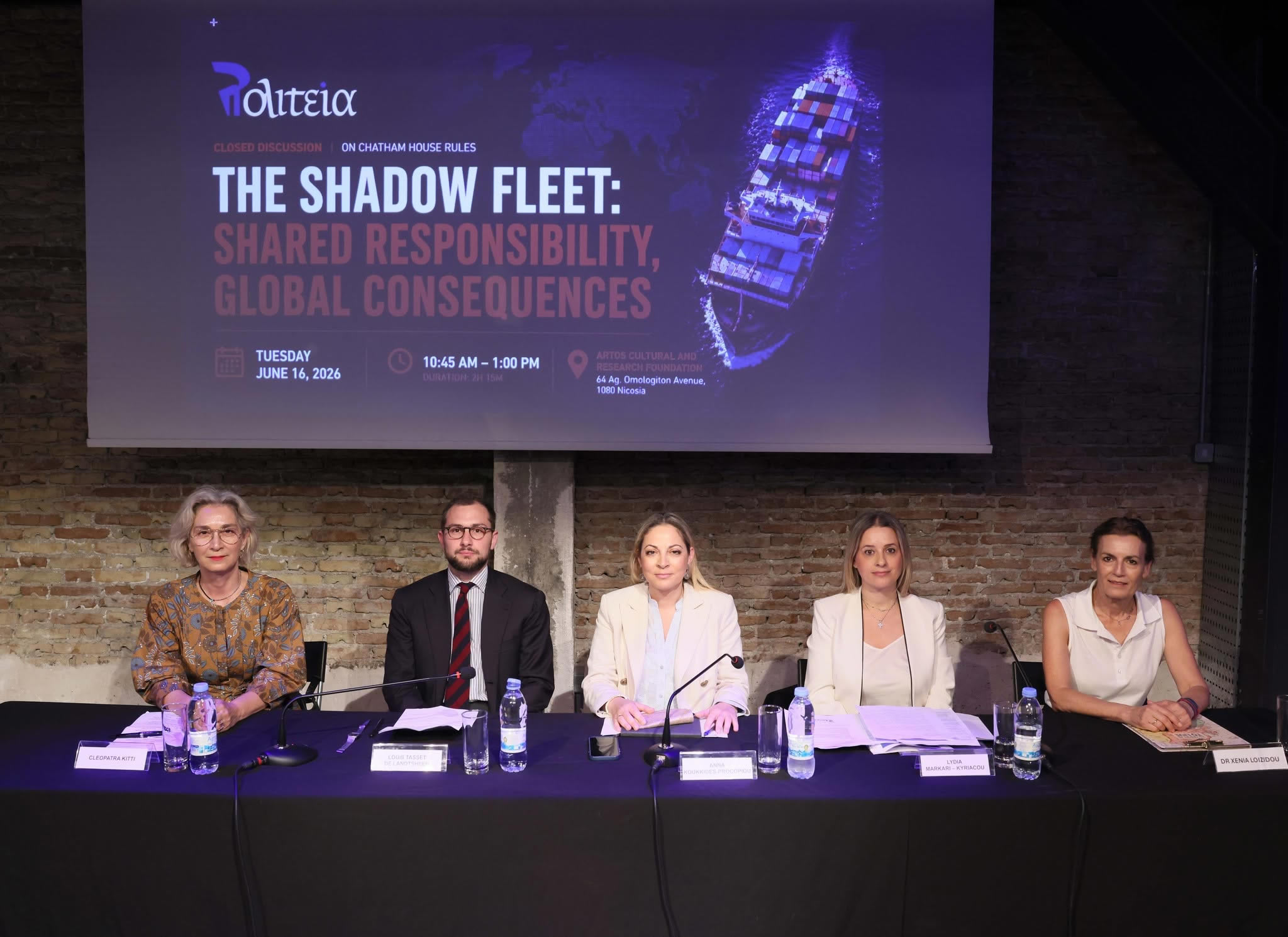
Politeia head Anna Koukkides-Procopiou highlighted the need to build stronger coalitions between international actors and the public and private sectors.
“As a primary EU shipping hub, Cyprus remains central to driving compliance, securing maritime trade routes, and safeguarding the marine environment,” she noted.
In August 2025, the Shipping Deputy Ministry issued a circular to shipping stakeholders informing them of the new package of national legislative measures concerning the sanctions framework, including the creation of a National Sanctions Implementation Unit and laws imposing stricter penalties for serious violations of sanctions, including fines of up to €40 million and prison sentences of up to five years.
At the UN’s International Maritime Organisation, Cyprus supports efforts to address regulatory gaps, including new guidelines for flag states concerning due diligence and information sharing.
Cyprus continuously monitors vessel traffic in its Exclusive Economic Zone (EEZ), within the parts under its effective control. Last year, the authorities noticed an increase of shadow fleet movement in the area. If the authorities receive a report that a vessel left a Cypriot port and then, outside Cypriot territorial waters, was approached by a shadow fleet vessel – likely for a ship-to-ship transfer of cargo – it will report that vessel to law enforcement. Under EU measures, the provision of services is prohibited to any vessel under investigation.

Bolder approach to end impunity
As Russia continues to receive significant oil revenue, European states, including France, the UK, Nordic and Baltic states have become increasingly active in pursuing these large, suspect vessels – usually through the Baltic-North Sea corridor – looking at fraudulent registration, forged documentation, whether the vessel is flying no flag or a false flag. By boarding, inspecting or detaining tankers, they hope to increase the cost of sanctions evasion. At the same time, there is an effort to convince flag states – particularly flags of convenience – to strike off suspect vessels from their registries.
Closing the net on vessels without a flag or flying a false flag pushes the shadow fleet somewhat out of the shadows. More vessels are now being registered with Russia, subjecting them to increased controls and the sanctions framework. At the same time, Moscow may now provide naval escorts for its commercial vessels – making the option of boarding a Russian-flagged ship unlikely. But naval escorts and longer, diversionary maritime routes cost in treasure and complicate oil exports, which is what the Europeans are banking on.
Legal basis
As for interdiction, the Cyprus Republic has no coastguard or sizeable warships to speak of. It is not really in a position to board, inspect, or seize suspect vessels within its EEZ, and certainly not on the high seas, as France did on 31 May 2026 when it boarded the TAGOR oil tanker 400 nautical miles west of Brittany. The French navy’s suspicion that the vessel was flying a false Cameroonian flag was confirmed on inspection of documents, leading to its diversion and anchorage.
France’s legal basis for the interception is Article 110 of the UN Convention on the Law of the Sea (UNCLOS) which requires serious grounds for suspecting that a vessel is stateless before boarding. If suspicions prove unfounded, the vessel must be compensated. Article 92 of UNCLOS notes that a ship sailing under several flags, using them interchangeably, may be treated as a stateless ship.

The Cyprus Republic’s view is that any interdiction measures would need to be undertaken in full conformity with international law, including the law of the sea.
Here, there seems to be a question not just of capacity, but legal interpretation as to whether Cyprus would consider boarding vessels outside of its territorial waters as falling within the law of the sea or not.
In any case, Cyprus can still play a regulatory and compliance role, implementing sanctions, withdrawing services from shady vessels under investigation, and working towards stricter EU and global rules to clamp down on the shadow fleet.
Blocking supply of ageing vessels
The country’s desire to protect the shipping sector – contributing around 7% of GDP (approximately 1.9 billion) – may at times put Cyprus in a position where it resists tighter rules not in its favour, or put another way, that do not take a more holistic approach.
The concern in Brussels is that shipowners can too easily sell an old tanker – despite suspicions it may end up in the shadow fleet – and walk away without risk.
Previous efforts to regulate this reportedly saw pushback from Cyprus, Greece and Malta. A new effort is currently under discussion as part of the latest draft of the EU’s 21st sanctions package.
Additionally, another option could be to make it less bureaucratic or burdensome – and more financially attractive – for shipowners to retire these ageing vessels to the scrapheap.
In any case, given the size of Cyprus’ ship registry and maritime zones, its contribution to the fight against the shadow fleet remains a significant factor on multiple levels – from supporting the rules-based order to protecting the Eastern Mediterranean’s marine environment and the livelihoods that depend on it.