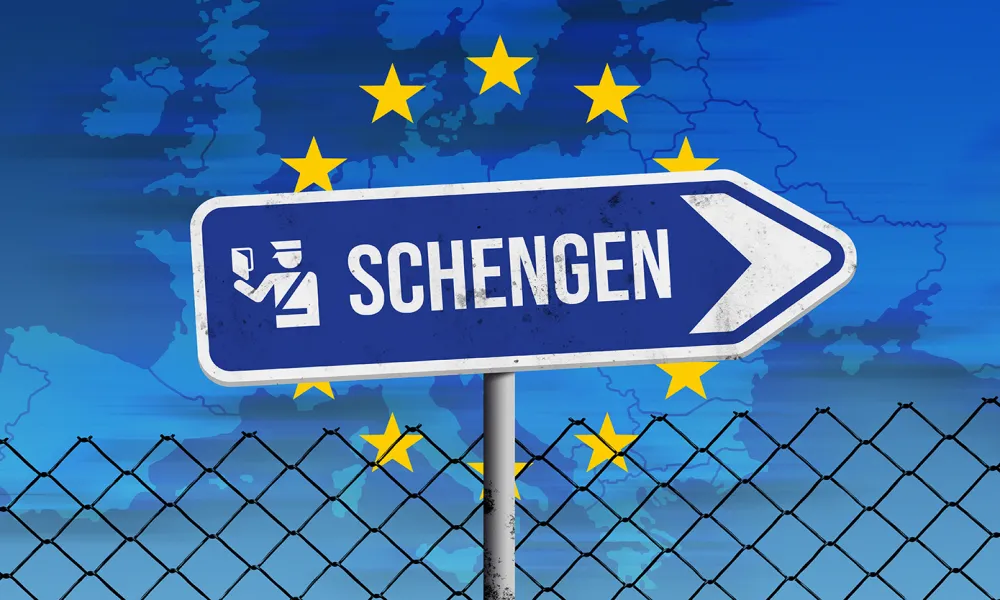
The Schengen Agreement, signed on 14 June 1985, became one of the most ambitious and transformative projects in modern European history. What began as an experiment between five countries gradually evolved into one of the world’s largest areas of free movement, allowing millions of people to travel across borders without passport checks.
Today, forty years later, the Schengen Area has become so integrated into European life that many younger Europeans have never experienced the border controls that once divided the continent. Yet behind the simplicity of crossing borders freely lies a deeply political project rooted in post-war reconciliation, mutual trust and the idea of a more united Europe.
The Birth of Schengen
The Schengen project emerged during a Europe still marked by the divisions of the Cold War.
The memory of the Second World War remained deeply present across the continent. European leaders increasingly believed that peace and stability could only be secured through stronger cooperation and greater interconnectedness between nations.
Against that backdrop, five countries — Belgium, France, Germany, Luxembourg and Netherlands — signed the Schengen Agreement in 1985.
The agreement aimed to gradually abolish internal border controls between participating countries while simultaneously strengthening the management of common external borders.
At the time, the idea was bold and controversial. Borders had long been seen as central symbols of national sovereignty and state control. Removing them required an extraordinary level of political trust.
The agreement reflected a broader European ambition: to overcome historical divisions and make the movement of people easier, safer and more integrated.
Why Schengen Was Revolutionary
Before Schengen, travelling across Europe often meant repeated passport checks, customs inspections and long delays at borders.
The Schengen Agreement changed the meaning of mobility inside Europe. It allowed citizens, workers, students and tourists to move more freely between participating countries, reshaping not only travel but also economics, culture and daily life.
The project was based on a simple but powerful principle: if countries removed internal border controls, they would need stronger cooperation in areas such as:
- Police cooperation
- Judicial cooperation
- Visa policy
- Information-sharing
- External border management
Schengen therefore became much more than a travel arrangement. It evolved into a system of shared governance and collective security.
The Schengen Convention of 1990
While the 1985 agreement established the political vision, the Schengen Convention signed in 1990 created the legal and operational framework necessary to make the system function.
The Convention introduced detailed mechanisms for:
- Police and judicial cooperation
- Cross-border information exchange
- Standardised visa policies
- Coordination between national authorities
One of the most important developments was the creation of the Schengen Information System (SIS), a large-scale database enabling participating countries to exchange security and border-related information in real time.
The SIS became a cornerstone of Schengen cooperation, helping countries coordinate on issues related to crime prevention, migration management and public security.
Schengen Becomes Part of EU Law
A major turning point came in 1997, when the Treaty of Amsterdam incorporated the Schengen rules into European Union law. This transformed Schengen from a separate intergovernmental initiative into a central pillar of EU policy on borders and movement. The integration of Schengen into EU law strengthened institutional cooperation and expanded the legal basis for common border management across Europe. It also reinforced one of the EU’s defining freedoms: the free movement of people.
For millions of Europeans, this freedom gradually became one of the most tangible expressions of European integration.
A Border-Free Europe
Today, the Schengen Area without internal border controls includes 29 countries.
This includes 25 EU member states and four non-EU countries:
- Iceland
- Norway
- Switzerland
- Liechtenstein
The expansion of Schengen over the decades reflected growing trust and integration between European countries.
Recent enlargements include:
- Croatia, which joined the border-free Schengen area in 2023.
- Bulgaria and Romania, which saw internal border controls abolished in 2024.
- Meanwhile, Cyprus participates in Schengen cooperation, including the Schengen Information System, although internal border controls have not yet been fully lifted.
- Ireland also participates selectively in some Schengen mechanisms, particularly in judicial and police cooperation.
Schengen and the Daily Lives of Europeans
For many Europeans, Schengen has transformed everyday life in ways previous generations could hardly imagine.
Students participate in exchange programmes across borders with ease. Workers commute daily between countries. Families travel freely without checkpoints. Businesses move goods more efficiently. Tourism flourishes through simplified travel. The Schengen Area has effectively reshaped geography itself, reducing the psychological and practical significance of borders across much of Europe. For younger Europeans especially, the ability to cross multiple countries without showing a passport often feels entirely normal. Yet that normality represents one of the EU’s most extraordinary political achievements.
Security and the Challenge of Open Borders
From the beginning, Schengen was built on the understanding that open internal borders required stronger external coordination.
As a result, the Schengen system places significant emphasis on:
- External border protection
- Shared databases
- Migration management
- Cross-border policing
- Judicial cooperation
The Schengen Information System plays a particularly important role, enabling national authorities to share alerts and cooperate more effectively on law enforcement and border security.
At the same time, Schengen has faced repeated political and operational challenges over the years.
Migration pressures, terrorist attacks, organised crime and geopolitical crises have periodically triggered debates over the balance between free movement and security.
Several countries have temporarily reintroduced border controls during moments of crisis, including during the COVID-19 pandemic and periods of heightened migration pressure.
These moments revealed both the strengths and vulnerabilities of a border-free Europe.
How Countries Join Schengen
Joining Schengen is not automatic, even for EU member states.
Candidate countries must first develop a national governance system fully aligned with Schengen rules and standards.
This includes building the administrative, legal and technical capacity necessary to manage:
- External borders
- Visa systems
- Police cooperation
- Information systems
- Data protection
Once a country joins the EU, Schengen rules become legally binding, though some parts may apply gradually.
Before full accession to the border-free area, countries undergo detailed evaluations coordinated by the European Commission together with member states under the Schengen evaluation mechanism.
Only when a country is considered fully prepared can the Council approve the abolition of internal border controls.
Importantly, this decision requires the agreement of all EU member states applying Schengen rules.
The Political Meaning of Schengen
Schengen is often discussed as a technical system of border management. But politically, it represents something much larger.
It is one of the clearest symbols of the European project itself: the idea that countries can cooperate so closely that borders become less visible in daily life.
The Schengen Area reflects decades of efforts to replace division with interdependence, suspicion with trust and barriers with mobility.
At a time when nationalism, migration debates and geopolitical instability are once again reshaping Europe, Schengen remains both celebrated and contested.
Supporters see it as one of the EU’s greatest achievements. Critics argue that open borders create security vulnerabilities or increase pressure on national systems.
Yet despite repeated crises, Schengen has endured.
Forty Years Later
As Europe marks the 40th anniversary of the Schengen Agreement in 2025, the project stands as one of the most ambitious experiments in regional integration ever attempted.
From a ship on the River Moselle to a continent-spanning area of free movement, Schengen fundamentally transformed how Europeans experience borders, identity and mobility.
For millions of people, crossing borders without controls is no longer remarkable. It is simply part of life.
That quiet normality may be the greatest sign of Schengen’s success.