Since the US and Israel struck Iran on February 28, 2026, killing its senior leadership, the region has spiralled into crisis. Iran retaliated with missile and drone attacks on Israel and US‑aligned states, shutting the Strait of Hormuz and driving global energy prices sharply higher. Thousands have been killed, including children, the conflict has spread to Lebanon, and nearly a million people have been displaced. Targeted strikes on refineries, gas fields and desalination plants have prompted climate groups to accuse the warring sides of “ecocide.”
European allies have rejected President Donald Trump’s call to help reopen the Strait. According to reports, previous nuclear talks with Iran in Geneva had reportedly progressed, with Tehran agreeing to halt stockpiling highly enriched uranium. Omani mediator Badr Albusaidi wrote that a deal had “appeared really possible”.
So how did we get here? And how does it end?
‘History of deception’
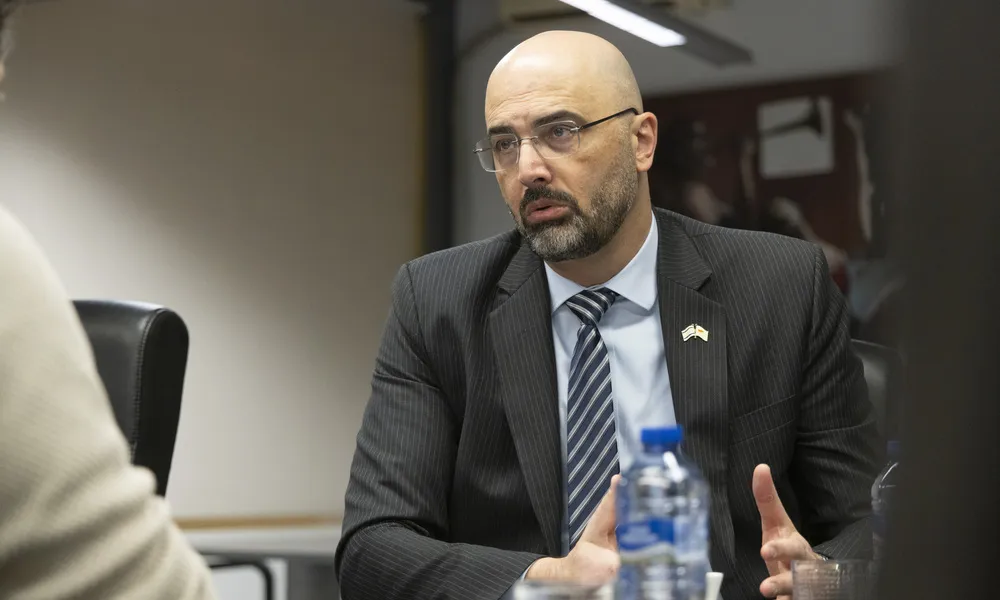
Speaking to Politis to the point on Friday, Israeli Ambassador to Cyprus Oren Anolik said the history of this conflict did not start with the US-Iran nuclear talks in Geneva.
“There's a history of deception by Iran for many, many years regarding their (nuclear) programme,” he said.
The Israeli diplomat argued that Iran hid the real purpose of its nuclear programme through various means. “And the real purpose of this programme was always to try to reach military nuclear capabilities.”
“They have a mission,” he said, arguing that nuclear capability is “their insurance policy for the survivability of this horrible regime”.
If Iran had wanted to enjoy the benefits of a civilian nuclear programme without wanting to control all those elements required for a military programme, there were “plenty of solutions” that could have allowed that to happen, said Anolik.
He noted that Israel has always opposed “temporary” measures that put a freeze on Iran’s nuclear programme, including the 2015 Joint Comprehensive Plan of Action (JCPOA).
“We said from day one, there has to be zero enrichment in Iran. We cannot have this regime having those capabilities.”
Action or inaction?
According to the ambassador, Iran was buying time during negotiations – progressing on both its nuclear and ballistic missile programmes, while trying to build them as deep underground as possible.
“We reached a point where we thought, we have two options. Action or inaction. What is more dangerous for us now? […] And we concluded that inaction is more dangerous.”
Both the US and Israel agreed that if they kept waiting, they might find themselves in a situation where they would no longer have options, said Anolik.
Regarding reports of progress in Geneva, he argued that unless Iran committed to giving up enrichment forever, the risk would always be there that it would continue secretly enhancing its capabilities.
From military to 'civilian' programme
Asked why Iran has not developed military nuclear capability to date, the Israeli diplomat said the seizure of Iran’s nuclear archive by Mossad in 2018 showed that pre-2003, Iran had a fully-fledged nuclear military programme called the AMAD Project.
Following the US invasion of Afghanistan and then Iraq, Iran changed strategy, fearing it would be next in line. It started working under the “façade” of developing a civilian nuclear programme. But all the elements it was developing pointed to its aim of obtaining a nuclear weapon, he said.
“The excuses for the civilian programme are almost ridiculous. But we know what they are doing.”
The ambassador acknowledged that the 2015 JCPOA had a “positive impact” on Iranian enrichment but considered this “short-term”.
‘We need you to finish this’
“Nobody's questioning the fact that Iran had a strategy that was supposed to lead it eventually to a nuclear weapon.”
At the same time, some countries have labelled the US and Israel’s war on Iran “unlawful” or “premature”, with Iran not posing an “imminent threat”.
To this, Anolik said: “I don't think there's a single person in the West that will shed one tear if this regime actually goes away. Behind the scenes, not publicly, they would come and say to us, ‘it's very important that you finish this, we need you to finish this’. […] Nobody wants to come out and say, we support this war, because nobody wants to make itself a target to the Iranians as well.”
‘Ongoing armed conflict’
Regarding violations of international law, the ambassador said Israel’s position is that it is operating within international law, because it did not just start a war, it is engaged in an ongoing armed conflict with Iran, albeit a new chapter.
“The Iranians have been attacking us for decades,” he said, referring to terrorist attacks abroad but also hostility from Iranian proxies such as Hezbollah, the Houthis and the Palestinian Islamic Jihad.
“They were financed, directed, got all their support and encouragement from the Iranians.”
End goal?
As the war entered its third week, media reports suggested the US and Israel had differing objectives – the US wants to wipe out Iran’s missile and nuclear capabilities along with its navy while Israel wants regime change.
Anolik said Israel and the US see “completely eye-to-eye” on some goals, such as on the security capabilities of the Iranian regime. At the same time, the Israeli government also talks about “creating the conditions for the Iranian people to choose their own leadership”.
He insists regime change is “not the goal” and cannot be achieved in this manner. However, degrading the capabilities of the regime’s security mechanisms – “eliminating the leadership of those mechanisms, hitting their headquarters, degrading their munition capabilities” – creates a much weaker opposition to those Iranians who wish to bring about change in their country, he argued.
“But the Iranian people are the only ones that have the right to decide eventually who is going to rule Iran.”
Asked how likely this was, the ambassador said the regime may still be in power, but it is not as strong as it was, and this might embolden Iranians who want to see change.
At the same time, the diplomat said the war’s goal remains to eliminate Iran’s military nuclear capabilities and ballistic missile programme.
“This is why we act in the way we did,” said Anolik, arguing that Iran has been very clear about its plan to destroy Israel. It is not a theoretical, ideological notion, but a practical plan, he said.
“This is why they created what we call this ring of fire around us. With Hezbollah, Hamas and Islamic Jihad, […] the pro-Iranian militias in Iraq, the Houthis.”
The ambassador argued that Iran’s goal remains to export the Islamic revolution to other countries in the Gulf and Middle East. “There’s a reason why their neighbours feel so threatened by them.”
‘We'll do it again if needed’
Anolik could not put a time on how long it would take to the war’s goals. He also acknowledged that the Iranian government could simply rebuild its nuclear and missile capabilities again.
However, this would simply take the country back again, instead of forward, and invite new attacks, he argued. Israel “will not shy away from doing what we think we need to do” to protect the country. “If needed, we will do it again.”
Energy infrastructure escalation
On the targeting of energy infrastructure, Anolik said Israel targeted installations connected to the Iranian military machine but did not wish to make this an energy war.
“There’s an effort to find the right calibration in this regard that would make it harder for the regime to fulfil its military goals without destroying infrastructure that will be needed later on for the Iranian people.”
The cost of assassinations
Asked about Israel’s tactic of political assassinations, the ambassador challenged the term, arguing that Israel was “eliminating” people connected to the Iranian military apparatus, not simply political figures.
“We can degrade Iran’s military capabilities” by removing the leadership, expertise and knowhow of these targets.
Asked whether this would simply embolden resistance, Anolik said: “Nothing that we do is without cost. But the question is, does the benefit outweigh the cost? We believe it does.”
Holding Lebanese and Syrian territory
Asked about the prospect of Israel moving deeper into southern Lebanon during its ongoing conflict with Hezbollah, the Israeli diplomat said: “We have no territorial claims on Lebanon. Whatever we are doing militarily is just temporarily for the sake of defence. Nothing there is permanent.”
He added: “The same for Syria. All of this is temporary. I’m not talking about Golan, that’s different.”
Regional relations
Anolik said the conflict has seen relations with the Abraham Accords’ signatories get “stronger”, adding they share the same enemy. “They are furious with the Iranian regime. And they understand that we have relevant capabilities for them in different aspects.”
On Turkey, the ambassador said: “Unfortunately, our relationship with Turkey is not good. It's not a secret. Everybody can see this. But we have no desire to make Turkey an enemy.”
‘Excellent’ bilateral relations
Asked if relations with Cyprus have been affected by the war, the diplomat said Israel has an “excellent relationship” with Cyprus and sees “eye-to-eye” on many things.
“There is a strong partnership and understanding that some of the threats are similar and also that we can be relevant on issues that are helpful for Cyprus as well.”
Regarding security collaboration, he said: “I can only say we have plenty of capabilities, advanced ones, and we are always more than happy to share with our partners those capabilities that might be helpful for them as well.”