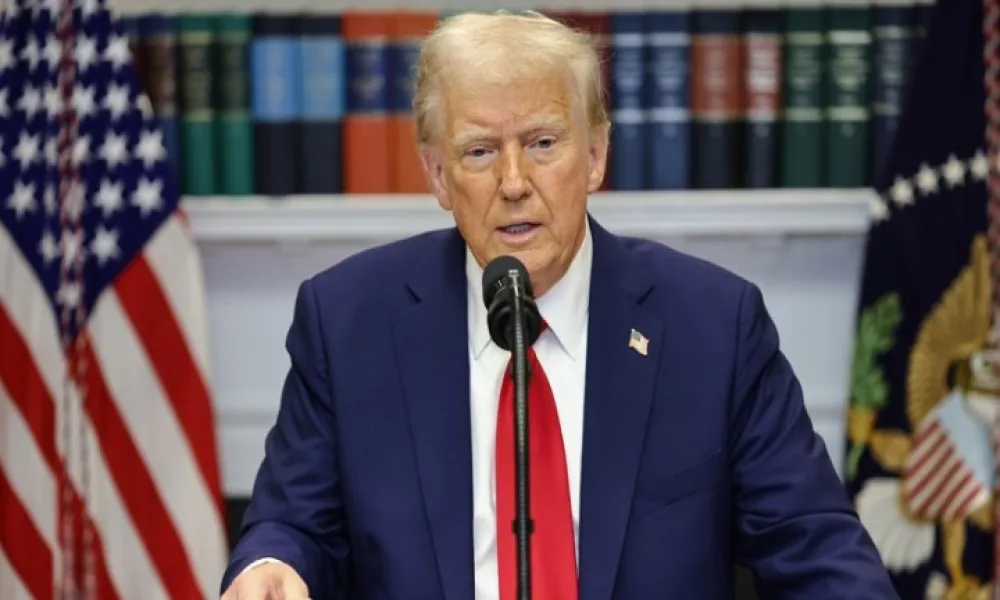
Just hours before the countdown expired, Donald Trump announced on Tuesday that he is extending the ceasefire in the US Israeli war against Iran until further notice, while making clear that the blockade of Iranian ports will remain in force.
Two weeks after the ceasefire came into effect on 8 April, Iran had said the truce would end at midnight between Tuesday and Wednesday, while the US president stated it would expire on Wednesday evening Washington time, early Thursday morning in Tehran.
No serious incidents were reported overnight in the region.
Citing what he described as divisions within Iran’s leadership, the Republican billionaire announced via Truth Social that he was extending the ceasefire until further notice at the request of Pakistan, which has taken on a mediating role. He said he would wait until Iran “can come up with a unified proposal” for ending the war.
Just one day earlier, he had described the possibility of extending the ceasefire as “very unlikely."
In the meantime, however, the blockade of Iran’s ports will continue, he underlined.
Pakistan’s prime minister, Shehbaz Sharif, welcomed the extension of the ceasefire.
“I sincerely hope that both sides will continue to observe the ceasefire and be able to conclude a comprehensive ‘Peace Deal’ during the second round of talks scheduled at Islamabad for a permanent end to the conflict." Mr Sharif said in a post on X.
On my personal behalf and on behalf of Field Marshal Syed Asim Munir, I sincerely thank President Trump for graciously accepting our request to extend the ceasefire to allow ongoing diplomatic efforts to take their course.
— Shehbaz Sharif (@CMShehbaz) April 21, 2026
With the trust and confidence reposed in, Pakistan…
United Nations Secretary General Antonio Guterres also welcomed the announcement, describing it as a “significant step towards de escalation" according to a statement released by his spokesman Stephane Dujarric.
Farewell to oil?
US Vice President JD Vance, who is expected once again to head the American delegation for negotiations with Iran, did not depart for Pakistan as planned on Tuesday, according to the White House. If there is no change in circumstances, Tehran does not intend to send a delegation to the Pakistani capital Islamabad.
Before Donald Trump’s announcement, Tehran had warned that if US Israeli attacks resumed, it would retaliate by striking neighbouring Gulf monarchies even more forcefully, putting global oil supplies at risk.
“Our southern neighbours must know that if their territory and facilities are used by enemies to attack the Iranian nation, they can say goodbye to oil production in the Middle East,” the Revolutionary Guards warned.
Before these threats, oil prices, already moving upwards due to the deadlock over the possible closure of the Strait of Hormuz, through which under normal conditions one fifth of global hydrocarbon consumption passes, were rising by around 3 per cent.
Iran knows that it is “resisting intimidation”, said the country’s foreign minister Abbas Araghchi, once again condemning the blockade of the Islamic Republic’s ports by US armed forces as an “act of war” and therefore a “violation of the ceasefire”.
Iranian women facing execution?
Before announcing the extension of the ceasefire, Donald Trump demanded that Tehran proceed with the “release” of eight women whom he claims are facing execution by hanging. He said this would be “a great start for negotiations."
Agence France Presse noted that it was unable to verify either whether the women face execution or their identities, despite the US president having circulated photographs when making the demand. Iran denied that women are due to be executed.
In Tehran, where the main airports reopened on Monday for the first time in weeks, daily life appears to be returning to somewhat more normal rhythms.
Mobina Rasoulian, a 19 year old student, said she is breathing more freely thanks to the pause in the war. “I go out without anxiety. I go to cafes, to restaurants, here and there,” she said on a street in Tehran.
But for 39 year old Sagar, who also spoke to AFP, “there is no light at the end of the tunnel”, as “the economic situation is horrific and they arrest people for nothing. Executions are increasing”.
On the other front of the war, new direct talks between Israel and Lebanon are expected to take place on Thursday in Washington, the US State Department announced. As with the first round on 14 April, they will be held at ambassadorial level.
A fragile 10 day ceasefire between Israeli armed forces and Hezbollah came into effect on Friday, but the sides have accused each other of repeated violations from the outset.
The Israeli army said on Tuesday that it struck a position in southern Lebanon in retaliation for rocket launches against troops deployed there.
The Iran allied Shia movement said it carried out an attack against northern Israel in response to what it described as Israeli “blatant” violations of the ceasefire.
According to the Israeli military, sirens sounded in two communities in the north of the country, possibly due to a “false alarm”, after an attack drone launched from Lebanon was intercepted before crossing the border.
According to the latest official toll, at least 2,454 people were killed in Lebanon during the six weeks of war.